slow trains and sound bites

I went to Glasgow last Friday with the intention of working on some unfinished drafts at the Transport Museum. When I first visited last summer, the idea of having a transport theme at South Side Writers came to me whilst sunbathing on the deck between the museum and the Tall Ship. Since then we’ve used text, images and personal reminiscence featuring longships, mobility scooters, transporters, donkeys and just about every every other imaginable mode of transport to prompt explorations of character, plot, pacing, structure and sound, as well as looking closely at concepts like ‘flight’. I’d identified Zaha Hadid’s museum building as an interesting place to sit and write for an hour or two. Now it was summertime again, officially at least, and the group was on its Easter break, so I set off for the west on the slow train. This involves:  a pleasant half-hour walk to Slateford Station via the blooming gardens of Craiglockhart; avoiding congestion in  Edinburgh city centre and at Waverley Station, and a cheaper fare to Glasgow which does not carry off-peak restrictions either. The train is indeed slow,  a proper ‘stopping train’, but I like its meanderings around lesser-visited parts of the central belt, home to people I may never meet, trees and livestock.

Progress  from Central Station to  Partick was slowed further at the architecture and design centre, The Lighthouse, when I chanced across a half-hour creative writing workshop, ‘Lunchtime Bites’.   Facilitator Emily Dodd had selected a photograph from the Britain From Above exhibition, the Broxburn Oil Works. She gave us  a short introduction and set us to write for 15 minutes.  As a creative writing tutor, one  of the most satisfying aspects of an extremely satisfying job is when you hear a group’s varying responses to the same starting point, and the surprise of those who didn’t think they could do it.   Another is when you attend a workshop on your day off and get to practice  the magical process for yourself.

Some writers can produce a lot of good material in a quarter of an hour under these conditions. In recent years my personal word-processor speed has slowed – one of my best friends describes me as glacial – so I opted for a haiku . Out of the notes I’d made I linked two images –  the background slag-heap detritus of the chemical process, and the foreground canal –  in three lines. As Emily pointed out, fifteen minutes is a good time to break off anyway; when you return to your writing you’ll have an altered perspective on it.

I used my surplus material in a draft that re-worked some of Emily’s introductory material about the social and ecological environment and history. Add a bit of my own time-and-space preoccupation  and maybe or maybe not a human character, and it could become something more substantial. We were photographed and recorded  after the session. I’m here,  sounding like a northern Janet Street-Porter with a plane above my head.

Emily spoke with great enthusiasm about working with community groups who had grown up close to some of the photographed locations. Those of us present at this session hadn’t, though  I was inevitably struck by parallels with the former industrial landscapes of northern England.

After the designated half-hour I looked round the rest of the Britain from Above exhibition. It’s more accurately described as ‘oblique aerial photography’, or Britain from a bit above. This isn’t like the view from an aeroplane, unless you’re just coming in to land (at that point I have my eyes closed and I’m gripping my seat arm-rests as we dangle above some too-near coastal water). The oblique perspective affords potential for some  innovative point-of-view work – though without making much of a conscious decision I settled for being the viewer outside the frame, making references to the fact that I was viewing a photograph, not the place itself. I resolved to pedal  along the Union Canal towpath to Broxburn to have a look at the site in colour and from bicycle level this spring.

And so to my final destination of the day. I’d sort of forgotten that It wasn’t just me who was on holiday – the schools were too. It was grand to see the museum full of eager children, but useless for settling down to write. I wandered around Hyndland and Dowanhill instead, and got the slow train back in good time for the Friday night treat or torture – I’m not sure which, but I think that’s the point – that is Steve Coogan and Rob Brydon’s Trip to Itlay.

a night at the opera, at the cinema

The twenty-first century phenomenon of the live HD broadcast was of course a way away when Wagner developed his idea of the gesamkunstwerk, or all-embracing synthesis of the arts.  The first season the New York Met did the live relays into cinemas, I saw a couple of  performances screened at the Cameo in Edinburgh, then didn’t quite manage  to follow them up with some dance and straight theatre in this medium. Nor did I go to see Borgen on the big screen. Birgitte / Sidse Babett Knusden was beguiling,  the supporting cast excellent, and the visuals of Copenhagen not as desolate as those of The Killing, but I have paid for my TV licence. After I even missed David Tennant’s  Richard II recently, a friend  who stays just east of Dunbar offered to take me to Berwick upon Tweed to see the Royal Opera House’s screening of Parsifal for my birthday.

I decided Parsifal  was my favourite opera when I heard the Prelude and Good Friday Music as a nipper (on vinyl and cassette), and this didn’t change once I started listening to whole performances on the radio and CD, or after I’d seen productions in theatres and on DVD. Not difficult now for me to see why: time becoming one with space; suffering relieved through compassion; healing balms and springs and pathless ways; those glorious, endless sonorities; a deconstructed eucharist or two that celebrate mystery and ritual at the same time as testing the concept of  an institutionalised, hierarchical faith.. . what was not for me to like? (That’s a rhetorical question: I have  no problem with selectivity when it comes to the appreciation of Wagner.)

Wer is gut?, who is good?, is a question posed verbally in, and implicitly throughout, the opera. In the  case of this production by Stephen Langridge, evidently not the grail brotherhood, who quite literally released their blood, with syringes, before piercing the side of a pre-pubescent Christ figure who – rather than the usual translucent lighting plus or minus wine goblet – represented the actual grail. Then some of them donned masks and seized firearms. I was diverted for a moment into wondering if there should have been a warning for needle-phobics like myself, and hoping there was no screening in Lockerbie that night. In Act III the knights bullied Amfortas into performing his office with more menace than I’ve seen before. All of this worked beautifully to make additional sense of a text that has engaged me creatively for several decades now, not least because it superbly pointed up the moral ambiguities of holy wars, closed societies and spiritual rituals.

 If the protagonist is Parsifal himself, the redeemer; and Gurnemanz, the elder and chorus / commentator has – by a considerable margin –  the most lines, what purpose in this trinity is served by Amfortas? This character is punished for his lust for Kundry, the only main female character, with  a unstanchable groin wound. Usually, as per stage direction, he’s wheeled on on a hospital trolley or somesuchlike in order to sing his lines about his night terrors, before being wheeled off again for the bath that might provide some temporary alleviation of his symptoms. If the singer / actor is good-looking, cue some audience indulgence in the eroticism of the wounded male body. Here Amfortas was on stage from the start, in a white cube of a hospital room that, as would be expected, served other functions in the production (shrine of the grail, bed of seduction). He was on a drip, and the grail knights were his medical as much as spiritual attendants. He walked, first with extreme difficulty, then with a zimmer frame.  The medieval setting can make this opera feel very remote from our world: this, literally clinical,  modern staging reminded us of the pain of being a hospital visitor, or relative or carer of a very sick person. And the imagery made it  seem  very much a post-AIDS Parsifal, too.

One of the problems a director of Parsifal always faces is how to represent the eucharistic grail scenes. Some, like Langridge,  invent new symbolic and gestural languages for the ritual  which critics in their turn  hate.  Instead of a processional mass, or holy communion, the knights and acolytes queued up to touch the wounded side of the christ-boy. Other stylised movements and poses were interpolated throughout. I don’t mind if something looks silly – this didn’t – because it just points up the actual arbitrariness of adopted styles and practices. If an act(ion) is repeated  often enough and you believe in it and it comforts you – nothing wrong with that – it becomes normal, traditional, important. When it becomes unchallengeable,  you start to get problems, so you have reformations and schisms and disruptions. Life goes on. My friend, a big fan of dance and physical theatre who was new to Wagner, said she could happily have watched the choreography in silence, and I agree. The whole opera was beautifully staged, and the staging was beautifully filmed. Nowadays the arts of singing and acting for the camera, and of filming  stage acting and singing, are becoming more specialised and refined. The gesamkunstwerk redefines itself.

Berwick upon Tweed’s arts complex, The Maltings, was chromatically warm and thermally cold, with a quirky and comfortable bar. Inevitably the sonorities and subtleties of Wagner’s final opera were rather lost in its small auditorium, or by its audio equipment: you really need to be, if not in Bayreuth, in a space with a live orchestra in the pit, to get the full sonic benefits of  this one. Outwith the theatre, you can’t of course achieve that visceral connection with a resonating voice that I find to be one of the greatest pleasures of being in it, either. The singing nonetheless  sounded pretty impressive throughout. Tenor Simon O’ Neill‘s Parsifal  had a rich and lovely lower register, but he was unable to bring an appropriate luminosity to the higher passages. Maybe even that was a good thing – others overdo it; and he securely landed the final sung note, where many  have faltered, before the sublime closing orchestral passage, when the audience gets to see the director’s solution to the ending of the drama. Amfortas and Kundry, suitably redeemed, possibly embarked upon a feasible partnership, though my companion thought it a more spiritual assimilation, after death. The sacrificial christ-boy has gone; the shrine is empty. (If nothing else, this is a great compression of the gospels.)   Several reviewers seemed to think that this symbolised how the brotherhood, under the direction of its newly-annointed leader Parsifal, had relinquished its selfish monopoly for the benefit of humankind. It could equally say something about the emptiness and superfluity of symbolism. I think that’s a more compelling initial reaction, whatever later reflection yields.

As with much of Wagner, the orchestra itself is a key protagonist. When I was sitting in the upper circle slip seats in Glasgow’s Theatre Royal a decade ago, shoreless waves of cellos in the final act seemed to reverberate against the auditorium wall . . . the other night I remembered  the previous times and places where I’d heard Parsifal before: isn’t that one of the things Wagner is meant to do, anyway? In a womb-red new cinema/theatre space,  wrapped up in my warmest coat, with – according to the weather forecast, and the next day’s news – a storm raging outside, I  re-lived who I have been, and revelled in where I was. Zum Raum wird hier die Ziet, now time is made one with space.

So, one of the lovely things I did for my 49th birthday was to go to the opera at the cinema, in the country next door, no matter that it was also showing on three screens in Edinburgh.  I hadn’t actually set a foot in England since 2012. As we drove back to Dunbar on the A1 I was also reminded of a youth spent travelling between England and Scotland at night, and, more prosaically, of the etiquette of using the beam. Coming home the following day, in low and cloud-diffused light a couple of days before the shortest one, the surrounding fields of the Lothians and Fife across the firth, and the buildings on Edinburgh’s shore-front ahead looked stunning, unfamiliar, transformed.

In Scottish Book Week

Since  last posting, back in June, I’ve had a blast writing poems and getting some of them published, cycling, socialising, gardening, walking, teaching, cooking, and sunbathing and sea-bathing in nearby East Lothian, not necessarily in that order, without feeling particularly prompted to blog about them. Until this week, when I went to three wonderful literary events.

Last night I was at a reading by poets LesleyMay Miller, Henry Marsh and Jean Taylor at McNaughtan’s Bookshop at the top of Leith Walk in Edinburgh. The shop is currently showing an exhibition by the Artist Book Group, and the three poets read, beautifully, ekphrastic and other works that responded to this context: poems specially written; previously written and published poems  about other visual artworks; pantoums and sestinas whose metrical forms seemed to parallel the intricacies of the artists books surrounding us; poems containing metaphorical references to stitching and making. It was a free event, in a beautiful venue, with wine, nibbles –  and a fantastic elderflower drink that I’ll be offering as a non-alcoholic alternative this Christmas – and was better than  many readings where I’ve paid to hear big names. The show, unfortunately without poets in residence, but with a number of other activities on offer, runs until 21 Dec, just round the corner from Edinburgh Printmakers writer-artist collaboration The Written Image, which I hope to visit soon.

On Thursday evening the Scottish Poetry Library hosted a workshop showcasing a project called Making it Home. Two groups of women, from Pliton in Edinburgh and Maryhill in Glasgow, had been introduced by facilitators Jane McKie and Claire Askew to poems on the subject of home by Edwin Morgan, Jackie Kay, Ruth Padel, Lorna Goodison and George MacDonald, and invited to make short films in response. Reading poetry, and making creative work on themes including immigration and homelessness, fostered strong links between groups of people who initially felt little connection to each other – a perfect example of poetry’s capacity to break down boundaries. It is so important that this kind of work happens in our communities. The films, together with more information about their making, can be found on  the project website. Jane encouraged us to write poems in response to images from the films, thus completing the circle (or triangle?)

Back on Wednesday, I went to a talk on the War Poets Collection at the Craiglockhart Campus of Edinburgh’s Napier University. I’ve  lived nearby for three and a half years, and never fail to be moved by the fact that this is the place where Wilfred Owen and Siegfried Sassoon met and drafted some of their most important poems. My first encounter with the First World War poets as a sixteen year old doing English Lit ‘O’ Level was literary-life-changing, as it continues to be for many adolescents. The collection is housed in the former main entrance to the building, a foyer in which I’d love to sit and write. It includes a photograph of the Sambre Oise canal at Ors, beside which Owen was killed a week before the armistice. On the black and white print, it looks very similar to to the Union Canal, just out of view at the bottom of Craiglockhart Hill.

decoration and embellishment

We’ve just come to the end of another term at SouthSide Writers. This time the theme was Decoration. Staff at the South Side Centre are hoping to spruce up the building a bit, enhancing the walls with text and art. This set me thinking about decorative art in general. It tends to be regarded as the poor cousin of the Fine Art, which I, like many others, regularly use as a writing prompt. Yet Scotland has its own  great traditions of design:  Paisley, tartan, and Charles Rennie Mackintosh, as well as work derived from Celtic motifs. Every other culture has countless  riches in media including textile, ceramics, wood, metal and stone. There are many amazing examples just round the corner from Southside at the National Museum of Scotland. Why not use some of these as a basis for a set of writing classes?

What, if anything, do artistic and literary decoration have in common? Pondering this question in the first session, while Radio 3 was celebrating its Baroque Spring, the Southside consensus seemed to be: plain style  good, ornament(ation) bad. Well, long live minimalism – and I like white cubes very well – but aren’t we now in a more tolerant, multiple and eclectic aesthetic era, the nostalgia-kitsch of some product branding notwithstanding? Embellishment  of objects adds design interest in the shape of details or features, and doesn’t just foster a sense of comfort in times of austerity. Beautification doesn’t have to equate to falsification here, so why was rhetorical embellishment regarded with such suspicion? Pursuing the connection between literary and decorative arts, we pared down our attention to the line as a unit of meaning, as championed by artists Paul Klee and Richard Long, and practiced writing lines with varying numbers of syllables and stresses. Klee’s phrase ‘take a line for a walk’  is a useful starting point for the timed or ‘flow’ writing exercises often used in writing groups, this one included, even if it tends nowadays to conjure up the undesired image of a dog on a retractable lead. Long literally walked, trod, lines into the landscape; built landforms; and produced huge text panels  that ‘captioned’  his walks.

We planned an excursion to Dovecot Weaving Studios to look at some tapestries. By happy co-incidence their current exhibition was by Julie Brook. Brook had been commissioned by the Studios to make land art in Libya and Namibia, and chose to  record  her work in the medium of film. The two main rooms  contained screens showing sequences of mesmerising, immersive moving images. Earth, water and sand moved, evolved. One of the sequences was entitled ‘Drawing a Line’; a number of Brook’s accompanying paper works, hung around the studios, also had ‘line’ in their title. Sometimes the films were more documentary, showing Brook making the work in the desert, slicing into a mudbank; or building a  stone ‘raised line’, a 3D sculptural form. (Is there a literary analogy for that?) We simply sat and wrote words and phrases that were suggested to us. I thought of the beginning of the world, in the opening of Wagner’s Ring Cycle specifically, but of cosmic origins generally, and  of Blake; of monoliths and landslips and 127 Hours; of wine-dark and blood-red seas, and of this stanza from Hopkins’ Wreck of the Deutschland:

 I am soft sift
      In an hourglass—at the wall
   Fast, but mined with a motion, a drift,
      And it crowds and it combs to the fall;
I steady as a water in a well, to a poise, to a pane,
But roped with, always, all the way down from the tall
    Fells or flanks of the voel, a vein . . .

For once, I didn’t want to make a new poem, I just wanted to let the images swim around and mingle with my own associations.  I think this may have been true for the other writers too: several  turned up at the next session with streams of consciousness and series of fragments and evocative suggestions. This gave rise to an extensive  discussion of matters arising from the exhibition. We talked a lot this term: ornamentation generated conversation. Several writers suggested that the very richness of decoration was inhibiting to the writing process. I don’t think it necessarily has to be: you can, for example, use a piece of decorated crockery in fiction as a way of conveying something about the character who owns or uses it, as one member did – but I am nonetheless intrigued by the group’s views.

The evening before our visit to Dovecot some of us went to hear Brook in conversation with Don Paterson, one of a series of talks with practitioners from other fields, including dance and film as well as poetry. Paterson suggested that poetry was quite a cinematic medium. I’ve never previously used film as a writing prompt, but I’m keen to do so again. Certainly one was invited to  construct one’s own meaning, if not narrative, from the way multiple relationships played out between the moving images on Brook’s screens. Alluding to  Klee, she spoke of reducing responses to place, and form itself, to the simplest possible element: the line. It’s this interplay between the simple and the complex, the detail and the embellishment, that intrigues me, in whatever medium is used.

Paper works  accompanied the films, abstract geometric shapes or reduced forms, some using desert clay or the glorious local red Otjize pigment. Was there a literary equivalent of pigment? I asked the writers to ‘translate’ a chosen picture into words. Of course it could  be argued that there’s no point  in drawing parallels between different media in this way, but I think it is worth asking if we can gain some insight, some enhancement of creativity, from at least considering the possibility. I sometimes have Paul Klee or Richard Long in mind when making a line of text – now I will possibly also think of Julie Brook. One of the Dovecot makers, Jonathan Cleaver, produced a rug in response to Brook’s work on pigment. We learned a new word for an artistic medium: tufted.

Later on in the term we considered places where text and image are actually juxtaposed on paper: in illustration and ekphrastic collaborations (writing about art); in art which incorporates text, from illuminated manuscripts to Blake and onwards into the twentieth century; in calligraphy (when viewing a foreign script, do you ‘read’ it as a text or look at it as a picture?); in concrete poetry and ‘language art’, places where text is presented as art.

We  moved on to look at the way the material world is everywhere enhanced  – or reduced, some might say – by text, in  forms ranging from  signage, advertising and  branded clothing to standing stones and tombstones. After writing some postcards, ‘wish you were heres’ from the imaginative landscapes evoked by a set of stills from Julie Brook, we considered other applications of the word card (Are all cards used for either communicational, transactional or ludic purposes? Is ‘plastic card’ an oxymoron?). We examined playing cards, recto and verso, in a new light. Why clubs? Isn’t a diamond actually a rhombus? The answers to these questions can most likely be found on the internet, but we hadn’t thought to ask them before. Finally, we returned to the idea of line. The number of pips on the card dealt to each writer was to determine the number of syllables, or lines, to be used, and for good measure the name of the suit was to be included in the piece of writing produced.

the art of writing

I will be teaming up with artist  Campbell Sandilands,  who trained in Japan and specialises in brush calligraphy, for  a unique set of seasonal classes at the Scottish National Gallery in 2013-14.   We will start the day by looking at Japanese prints from the NGS collection and reading some haiku, continue making our own work, and conclude with ceremonial tea and readings! Join us  for one or more of these creative sessions in celebration of the seasonsAll levels of experience welcome.
 
 The Tale of the Brush: A Year of Haiku and Calligraphy – Practical One-Day Courses
Clore Education Studios, Scottish National Gallery
Wednesday 21 August, Summer
Saturday 21 September, Autumn
Saturday 11 January, Winter
TBC, Spring
10.30am-4pm
£30 (£25) per session
 
I will also be leading a five week creative writing course at the Scottish National Gallery, 1.30-4.30pm, Wednesdays 2-30 October. This will feature a set of exercises specially devised for responding to visual art (including some new ones if you’ve been before!) and the opportunity to spend two sessions looking at and writing about the Peter Doig exhibition. Booking information available soon.

mad march and invisible colours: could spring be far behind?

The closing lines of Shelley’s ‘Ode to the West Wind’, and a reflection that the poet didn’t live in Scotland and wasn’t factoring in climate change, formed an accompaniment to many of my March wanderings: to Fife for  StAnza; to the Scottish National Portrait Gallery  for a workshop on creative writing for undergraduates in English and journalism from Napier University; to Glasgow for a two-day training event; into the snowy hills, wafting my walking poles around like ski sticks. The month-long cold snap was ushered in at StAnza, where I  facilitated a workshop called ‘Different Viewpoints’ on the first morning. Sponsored by Lapidus Scotland, this undertook to examine through practical exercises the relationships between ‘personal’ or ‘therapeutic’ and ‘creative’ writing, and between ‘internal’ and ‘external’ stimuli. Against the backdrop of, and engaging closely with, an exhibition of poems and paintings about liminal spaces entitled Unmapped, the participants created poems that beautifully wove together personal experience, memory and present-moment response to real and imagined places.

Back in Edinburgh, facilitating a session for undergraduates, rather than the ‘adults’ I usually work with, set me thinking further about ekphrasis, or the use of visual art to inspire writing, and how and why we teach it. When the BP  Portrait exhibition was up earlier in the year, in the winter proper, I took to  reading Michael Longley in front of a wonderful portrait of the poet, The Dailects of Silence, by Colin Davidson  At the close of his most recent collection A Hundred Doors, Longley has an elegy, ‘White Farmhouse’, which concludes with a line that cites Marcel Duchamp’s claim   ‘titles are invisible colours’. Are they? I need to ponder some more, but titles (if not artist statements and gallery glosses) can be of abiding interest to those with a textual background who are looking at pictures. What are we to make, for example, of Ben Nicholson’s habit of supplementing a matter-of-fact dating or stating of medium with a descriptor, as in June 1961 (Green Goblet and Blue Square), or Painted Relief (Plover’s Egg Blue)?

Words on Canvas were invited to write in response to paintings in the Royal Scottish Painters in Watercolour (RSW) annual exhibition. There were 252 works in the exhibition, and our deadline was just a week after we first got to see them. I had a couple of hours in the gallery beforehand, en route to the Portrait Gallery to have a look at Rousseau and Hume prior the Napier session. I quickly saw the work I wanted to write about, Gordon Mitchell’s Lasting Impressions, a painting of a sun lounger  against a sun-baked wall whose cracked plaster revealed the shapes of human silhouettes. I was reminded first of  the second paragraph of  The Wasteland, the lines about aridity, broken images and shadows, that lead up to ‘I will show you in fear a handful of dust’; and then, more optimistically, of a standing joke about the cost of hiring a sun lounger on the cote d’azur from last year’s summer holiday. Fine, but on Monday morning fifteen other writers (minus a couple I bumped into in the gallery who were already hard at work) would need to choose from the remaining 251. The usual WoC format is a Gallery tour, covering just  four or five works, followed by a writing critique session a fortnight later.  Feeling under some pressure, I started to jot down the titles of works that attracted me for one reason or another. Then I took up the catalogue, and noted down titles that themselves appealed (invisible colours if you like). Bingo, eureka, etcetera. Rousseau, Hume. On Monday I asked those writers who hadn’t already seen the exhibition and selected a work initially to choose a title that appealed, and write to that before seeing the picture to which it pertained. Then we paired up and did some writing exercises in front of the paintings, and a week later we had a pamphlet of stories and poems, and were ready to attend a reception where we were introduced to the painters of the works we’d selected. ‘Have you met your artist yet?’, we’d ask as we encountered each other circulating the exhibition, glasses of fizz in hand. Several writers reported uncanny correspondences between their thought processes and those of their painter-partner.  Gordon Mitchell told me his sun lounger was located near St Tropez. I had it not terribly far away, on the Cap d’Antibes, but then I don’t suppose it’d have been in Copenhagen or Anstruther.

Meanwhile, the South Side Writers concluded their term on fruit & veg with an attempt to break out of the tradition and make an original,  contemporary statement on the subject, accompanied by a very tasty and refreshing fruit salad. Mine felt very modernist, nearly a century past its sell-by date.

In Glasgow just before Easter I did the two-day training for Living Life To The Full (LLTTF). This is a CBT-based programme designed to be delivered in eight sessions in non-clinical settings, by professionals from different fields who season the basic template with their own personality, experience and knowledge. The target client or user is the individual with mild to moderate depression or anxiety, maybe near the bottom of a long waiting list for treatment,  but it could, I think, be really useful for helping anyone to problem-solve their way around the various obstacles they inevitably encounter. Writer’s block, relationship tensions, builders who don’t turn up. Well, maybe not the latter: it doesn’t promise miracles. The programme was on the periphery of my radar untilLapidus Scotland members were invited to learn more about it at a Bibliotherapy seminar at the National Library of Scotland in February. We heard some pretty inspiring presentations, by Drs Ann Wales, whose job title, Programme Director for Knowledge Management, doesn’t quite convey the extent of her humanity and intellectual curiosity; and Chris Williams, founder of LLTTF. Later we took part in  sessions which could be loosely categorised as either  ‘creative’ (poetry, storytelling, journalling) or ‘scientific’ (concerned with the transmission of knowledge and information).

After this I felt fairly sure that my place when working in healthcare settings was firmly in the creative camp, but I was curious to learn more about this method dedicated to transmitting health information (according to a social, rather than medical, model) in simplicity and clarity  in order to help individuals make positive changes in their lives. I signed up for the training. It turned out to be a truly inspiring couple of days. After an accelerated trip through the components of the programme, we were divided into small groups, with the task of preparing a small chunk of it to deliver to the rest. Oh no, I thought. I’m too tired. I haven’t slept properly the last few nights. I assimilate information slowly, with much reflection and walking around: I’m not ready to do this yet. I don’t want to look a numptie in front of esteemed Lapidus colleagues, or the lovely people from other fields I’ve only just met. Luckily, the extrovert part of me that enjoys a bit of a performance kicked in. I had fun, and, I hope, communicated my points effectively. More than that, hearing the others’ presentations really helped to reinforce everything we’d  learned in a short space of time, and I left with a sense of the possibilities that this new tool might afford.

Now that April’s here – and yes, I would like to pop down to England, though my guess is that the spring isn’t much more advanced there this time – I’ve paced along the plateau of  Capelaw Hill and been to a stimulating workshop on poetry and place with Australian poet Mark Tredinnick at the Scottish Poetry Library. At the end of a UK tour where he too has written of ‘the winter / that did not want to end’, he appeared less tired than I, much closer to home. In an open-plan learning type format,  he interspersed his  own observations about the poetry of place with dialogue with the attendees about their approaches to the matter. The moment when  Mark asked me who I was reading at the moment – rather than when faced with delivering part of a LLTTF module at short notice after little sleep – was the one chosen for me to go blank. Michael Longley?  The many writers from and writing about these islands and beyond whom I encountered at StAnza? In truth I’d been thinking most recently about  influences further back in the tradition: the Anglo-Saxon poets, Wordsworth, Hopkins, sundry Modernisits, as well as relishing the challenge of how on earth, in the air or by the water  to make it new myself, now. I could have talked about some or all of these – or about prose writings on place by the likes of  Kathleen Jamie and Robert McFarlane; or innovations other Scottish writers and artists are making – some of them in a  global context. Or I could have engaged more with some of  the many things that resonated for me in the others’ words that afternoon . . . but eloquence had well and truly taken leave of me. It may take some sun and more visible colours to power up my brain again.

stanza 13: legacy and place

IMG_0772

Photo: Stephanie Green

StAnza Poetry Festival, St Andrews, Scotland, 6-10 March 2013

One of the festival themes was ‘Legacy & Place’.

It was like a Hebridean holiday: you bumped the same people several times a day. Andrew the drystane-dyker poet; Enid who wrote so movingly in your workshop; Annie the young journalist; Rebecca whose poems graced the walls of the room used for workshops,  complementing paintings of the peripheral made by her collaborator Anna. People you knew from Edinburgh; Canadian writers you just met for the first time; cheerful StAnza staff.

Weather enclosed and defamiliarised the Fife town and seemed to intensify and brew the creative and social activity.  The wynd where  I took shelter  from the landfall of an Orcadian wind suddenly felt like a Stromness pend, and was filled with kent faces. I was happily disorientated. When the visibility improved a little on Saturday, I walked along The Scores to the West Sands to ground and assimilate the many wonderful words I’d heard over the previous three days, from the voices of Gillian Clarke, George Szirtes, Ken Babstock, Chris Whyte, Erin Moure, Mark Doty, Jean Atkin and more. Offshore, in parallel, waves broke endlessly, uniformly, companionably from the still-near horizon. Up at the cathedral, I stepped over the remnants of low walls and was reminded of the cloistral ruins on the tidal island of Birsay, and every bit as cut off from the quotidian. The wind intensified; drove in a tide of Shetland vowels. Time to return to the warmth of StAnza’s replacement hub, the Town Hall, made resplendent with words, sounds, images and tactile textual objects, to see  the collaboration between Fife poets and Shetland craft makers, Farlin. Time to hear Walt Whitman and Marina Tsvetaeva echoing down the generations and across continents.

It wasn’t  unexpected that, meteorologically enabled or not, sounds and other senses from  the northern and western isles  found their way along the wind and waves and into my experience of the venues in St Andrews. It did however come as a surprise to me to be taken back to the Lake District. When Gillian Clarke spoke of childhood fear as a foundation for poetry in her compelling exploration of  Brythonic verse and the Welsh alliterative pattern cynghanedd,  she cited Heaney’s testament to the pervading power of early terrors.   I was reminded of Wordsworth’s assertion near the beginning of The Prelude that he was ‘fostered alike by beauty and by fear’, before embarking on his incomparable blank verse catalogue of childhood adventures and misdemeanours. When Erin Moure, in a dynamic workshop on revision, commented that ‘language can do more than we know’, I searched my memory for the source of his line ‘we feel that we are greater than we know’. And then Jean Atkin, appearing with Zoe Skoulding in the highly atmospheric vaulted undercroft at St John’s, read her poem about the old coffin path that connects Ambleside and Grasmere. I was back in my graduate school days, trying to impress American delegates at the Wordsworth Summer Conference whilst walking that same path on a visit to Rydal Mount, the Wordsworths’ home between 1813 and 1850. Or  earnestly studying early MS. drafts towards The Prelude at Dove Cottage, but waiting for the weather to clear so I could climb Helvellyn (a Cumbric place-name, incidentally, closely related to Brythonic). My supervisor was the late Robert Woof, director of the Wordsworth Trust, who tended to be there, rather than doing his day job across the pennines at Newcastle University. Since that time, the Trust, like the universities, has recognised the benefits of welcoming creatives alongside academics. Time to pay a return visit, perhaps.

But for now, thank you, Eleanor Livingstone and all the StAnza team and participants.

fruit and veg; and inside out

Each term the South Side Writers have a new theme. In Spring 2013 it’s Fruit & Veg. This is because

(i) there’s been a bit of a running joke about bananas in the group for a couple of years. I always eat one before the class starts. Some time ago member Olga Wojtas showed us her party piece, which involved turning a banana into the profile of a penguin by partly peeling it and taking one bite. Time seemed ripe, pun intended, to bring the subject to more conscious and literary attention.

(ii) Last term we did Borders, Boundaries and Edges and I felt it was time for something more concrete and less conceptual.

Before Christmas we discussed and wrote about different sorts of boundaries – geographical, political, personal – and literary, in the shape of stanzas and paragraphs. We looked at examples of visual art with clearly defined lines (Mondrian, for example), and with fuzzy ones (Whistler`), and some that combined both, such as a couple of my favourite paintings in the National Galleries Scotland collection: Cezanne’s  The Big Trees, and Klee’s Threatening Snowstorm.

Design
After Paul Klee

blueprint for rebuilding
out of the bruising

provisional etching
of the reconstruction of Dresden

prophetic minaret to a
cloud-capped ground zero

Valhalla in a new era
for post-conflagration gods

plans on the drawing board
prefigure each apocalypse

This poem first appeared in Words on Canvas (National Galleries of Scotland, 2009).

One week everyone brought in an object with an (accessible, usable) inside and outside. I asked a series of questions, to be answered first with respect to the object’s exterior, and then again about its interior, so that you ended up with two lists which could be used or combined in various ways as a writing prompt.

Fruit ( we haven’t really made it into veg yet) is proving to be a fascinating subject for a series of writing classes because of its range of usage, literal and metaphorical, throughout literary history from Virgil’s ‘The Salad’, through the various sorts of Christian-era symbolism, to an abundance of contemporary works. It too has insides and outsides, of course. We started the term  sniffing, feeling, peeling and tasting fruit and will end with a fruit & word salad. Each writer is now researching a different fruit and bringing in a textual  example of it. In response we’ve written about hybrids (nectarcot, anyone?), provenance and packaging, architectural pineapples  and still lifes, as well as addressing a species and defamiliarising the common-or-garden so that it becomes exotic. Oh, and a banana is a herb.

all points north: the poetics of peace and armitage

Simon Armitage’s 1999 essay collection All Points North was re-issued by Penguin to accompany his newer memoir, Gig, last year. I  read it just as the debate  reignited about whether the proposed high-speed train link from London to Manchester and Leeds  would heal or exacerbate the north-south divide.  All Points  is a generically eclectic mixture of ideas of north, innovative on a number of  appealing counts.

It’s largely written in the second person, the better to accentuate the difference between narrator (Armitage, or his literary persona, or a prose-writing variant thereof) from protagonist (his younger selves, including youth growing up amidst trans-Pennine rivalry, and probation officer in Manchester). ‘You were thirteen when you first went to Old Trafford’; ‘Your mum taps you on the back’. From the onset, he lets us know that his version of events, or anyone’s, isn’t necessarily to be believed, when he  follows up an urban myth in circulation amongst the probation service with another professional  anecdote, then concludes ‘that story isn’t true either’. It’s therefore entirely possible that a smattering of examples of good old-fashioned northern sexism, sometimes attributed to ‘your mate’, are made up too, to make a point – albeit an unclear one. That times have changed? That they haven’t?  Various other sorts of fiction are skilfully alluded to: he writes the the script of an imaginary northern-nostalgia TV drama; when  Pat Barker’s novel Regeneration is being filmed, he visits the  set for the Craiglockhart War Hospital, not on location in Edinburgh, but  in a Glasgow studio. His phrase ‘the Leeds of the mind’ reminds us that Armitage’s accounts of, for example, Harvey Nicks, or the DSS HQ Quarry House, are subjective versions of place, recognisble, but different to what say, Tony Harrison’s, or mine, would be; parallel to the Edinburghs of Scott’s or Stevenson’s or Ian Rankin’s minds.

Rather than appearing as stand-alone essays, chapters and fragments are thematically linked into a continuous narrative. So  ‘Jerusalem’, the invented Calderdale soap, follows a critique of the region’s status as prime location for television drama. There are transcripts of real TV films and radio features made by Armitage, too, with his poetry interpolated – on homelessness in Manchester; Saturday night in Leeds; the Humber Bridge. Finally there’s a stunning soundscape/voice collage, ‘Points of Reference – North’ (1996-97), which features the printed voices of a range of experts including Patrick Moore, Ian McCaskill when he was a weatherman, and Rowan Williams before he was an archbishop.

Accounts of print and broadcast news items trigger either personal memories or  a deadpan retelling of the same-everywhere provinciality of local news. Forays to London, Brazil, Iceland, or 1920  are punctuated with six refrains of ‘Over the Top to Manchester’, accounts of Pennine crossings for business or pleasure experienced as ritual re-enactments of a route.  A number of the travel sections start with the preposition ‘to’, a  shortcut to the place in question which becomes a form of literary shorthand: To Portsmouth.  To Rochdale. To Hull. Riffs on identity, mistaken and otherwise, abound, Armitage exploiting his generic northern surname. On page 118, no less, there is a sequence called ‘Directory Enquiries’, where Direct Line threaten to increase his insurance premium because poet is held to be a higher-risk occupation than probation officer.

In 1999 when All Points was first published, my own points of reference  and station stops were a bit further north still.  I was  preoccupied with matters such as  Ossian, and the post-Enlightenment development of the Highlands as a tourist destination. I would quite like to reclaim the term ‘North Britain’, coined after the Union to ensure the Scots knew their place. In many ways – linguistic, topographical, culinary – the northern English and lowland Scots have more in common with each other than the northern and southern English do, or the lowland and highland Scots. I like, too, the idea of being ‘northumbrian’, from (anywhere) north of the Humber.

Since the the turn of the century, my focus has been re-directed south (of the Scottish Lowlands) again. I started to re-read Harrison and Hughes and the Brontes, and seek out literary versions of the region new to me. A preoccupation with grimupnorthness was satisfied but not sated by David Peace’s Red Riding quartet: Nineteen Seventy Four, Nineteen Seventy Seven, Nineteen Eighty and Nineteen Eighty Three, some of my formative years, written between 1999 and 2002 with a sparse lyricism.

Channel 4’s 2009 film of the novels, compressed into a trilogy, was full of   slowburning menace and menacing abstraction. Only the police beatings that regularly punctuated the action had an unfortunate ring of comedy: maybe because they  were performed by uniformed functionaries, they were a bit too much  Monty Python’s Spanish Inquisition dressed up as Dixon of Dock Green. The real  nightmare for me was in the architecture, the concrete jungle: the road tunnel  under Leeds city centre,  and the gargantuan cooling towers of Ferrybridge Power Station.  We drove through the tunnel most weekends when I was young: it was the conduit to the other side of the city and what lay beyond – the Dales, the A1- and therefore a means of escape.

Red Riding and All Points North actually have an architectural feature, or location, in common: the Redbeck Cafe outside Wakefield, a no-place where police did bad things to journalists, fugitive sleuths holed up to sort out child murders and their own demons, and an am-dram troupe en route to a convention in Bridlington stopped for refreshments.

Peace, like Armitage, melds fact and fiction. But the former finds no Romantic redemption in landscape. His poetry lies in the cadences of the minimalist dialogue with which he tells of the  Yorkshire Ripper murders, child abduction, organised crime and police corruption. As for the legion of reporters who covered the ‘abduction’ of schoolgirl Shannon Matthews  in 2009, scenery only exists for Peace as metaphor for  social depravation. When his attention is directed  west of the Yorkshire conurbation, it’s towards the legacy of moors murderers Ian Brady and Myra Hindley, rather than  the remains of Elmet evoked in poems and photography by Ted Hughes and Fay Godwin. Yet there’s also something libretto-like in Peace’s minimalism. He has   a Wagnerian grasp of theme, and ability to reprise it by flashback and in different voices. The Quartet could be a Ring Cycle for the end of the twentieth century, except that its geometry seems squarely cuboid as opposed to  circular. I’m envious of the scope of Peace’s vision, but not its content. Both Red Riding and All Points sent me back to Armitage’s poetry; to  Barbara Hepworth’s statements about the sculptural forms of the West Riding Hills, and to my own unabashed nostalgia for gritstone wall and flat vowel.

.

pilgrimaging

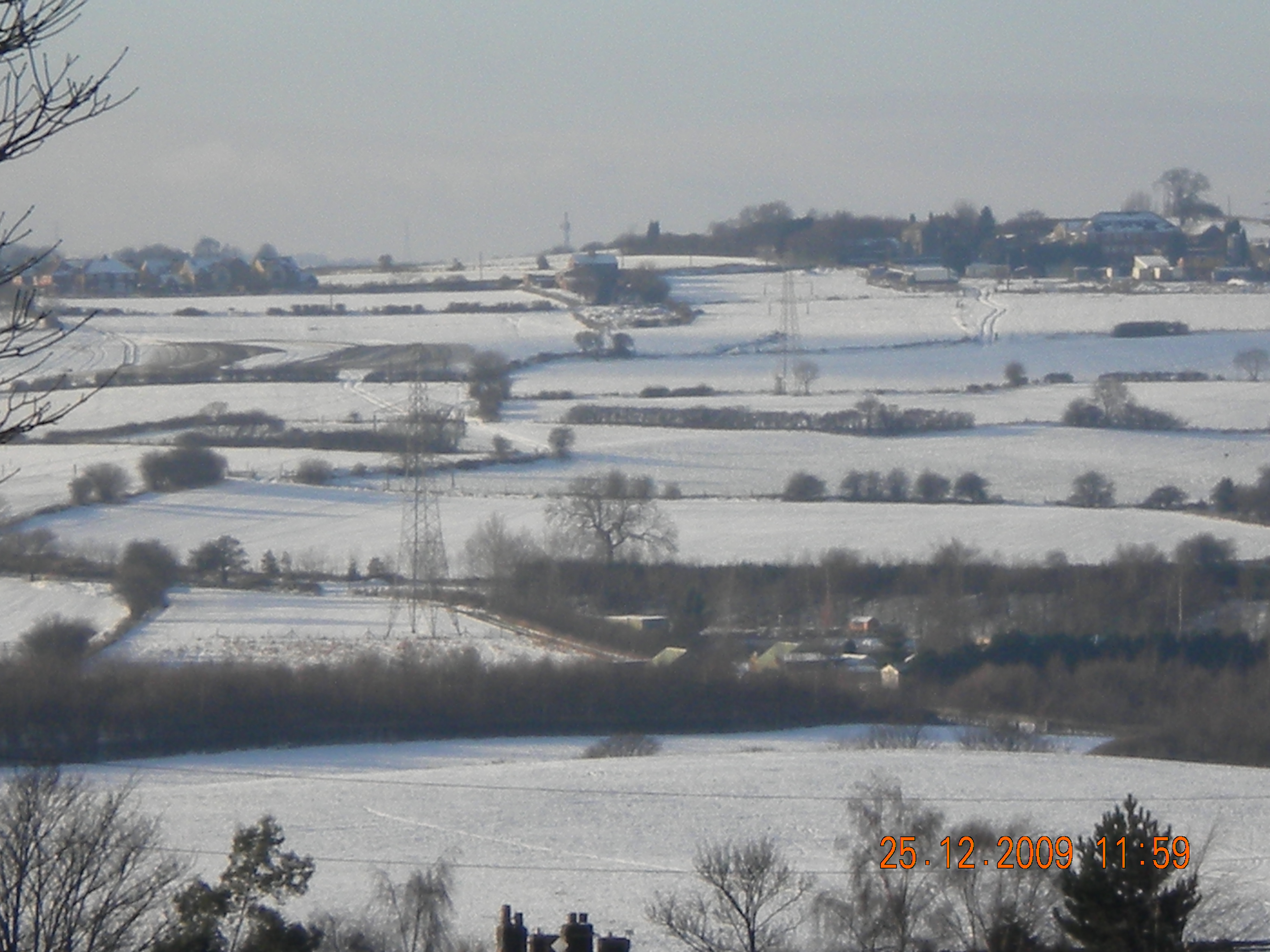
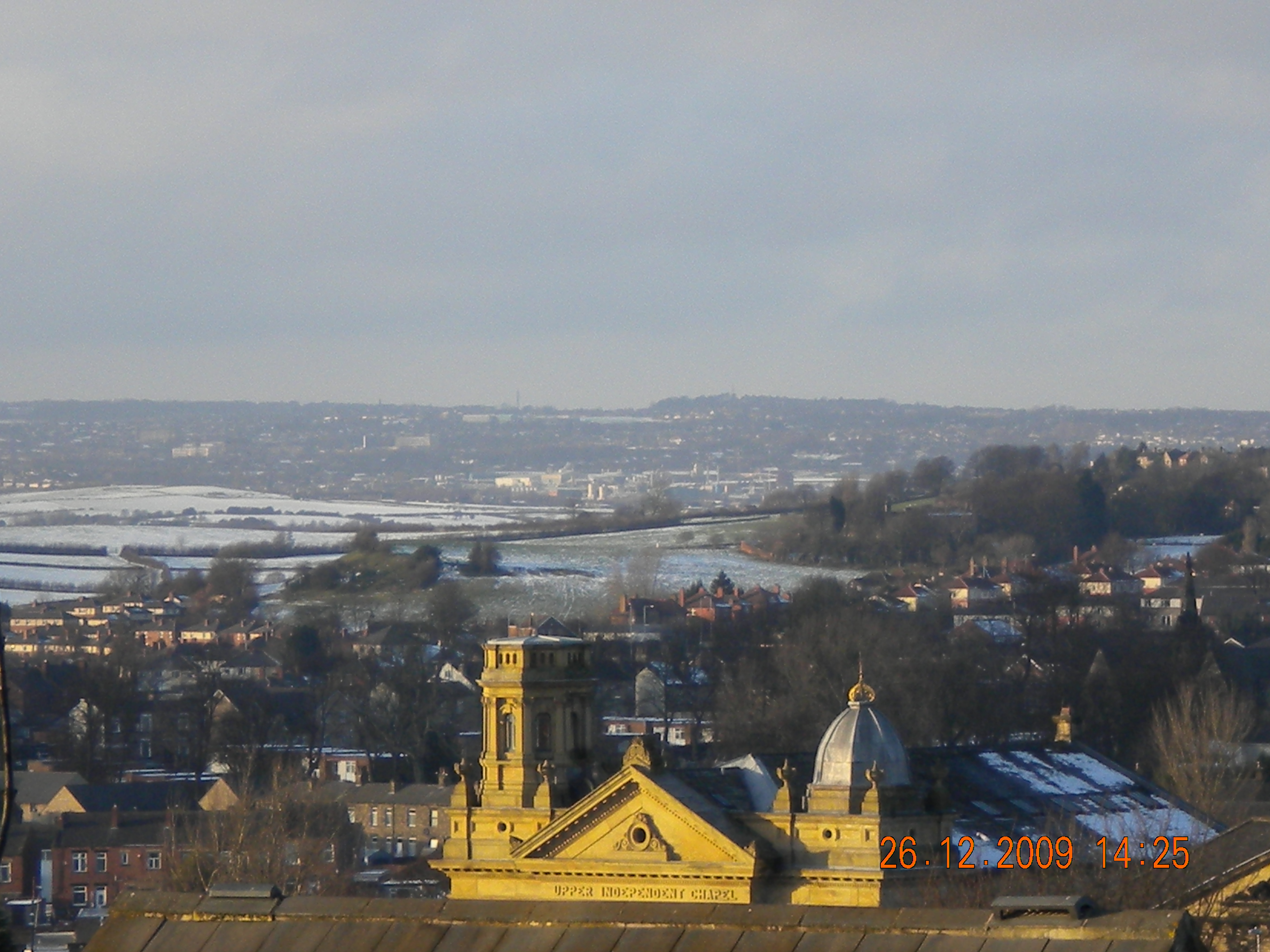
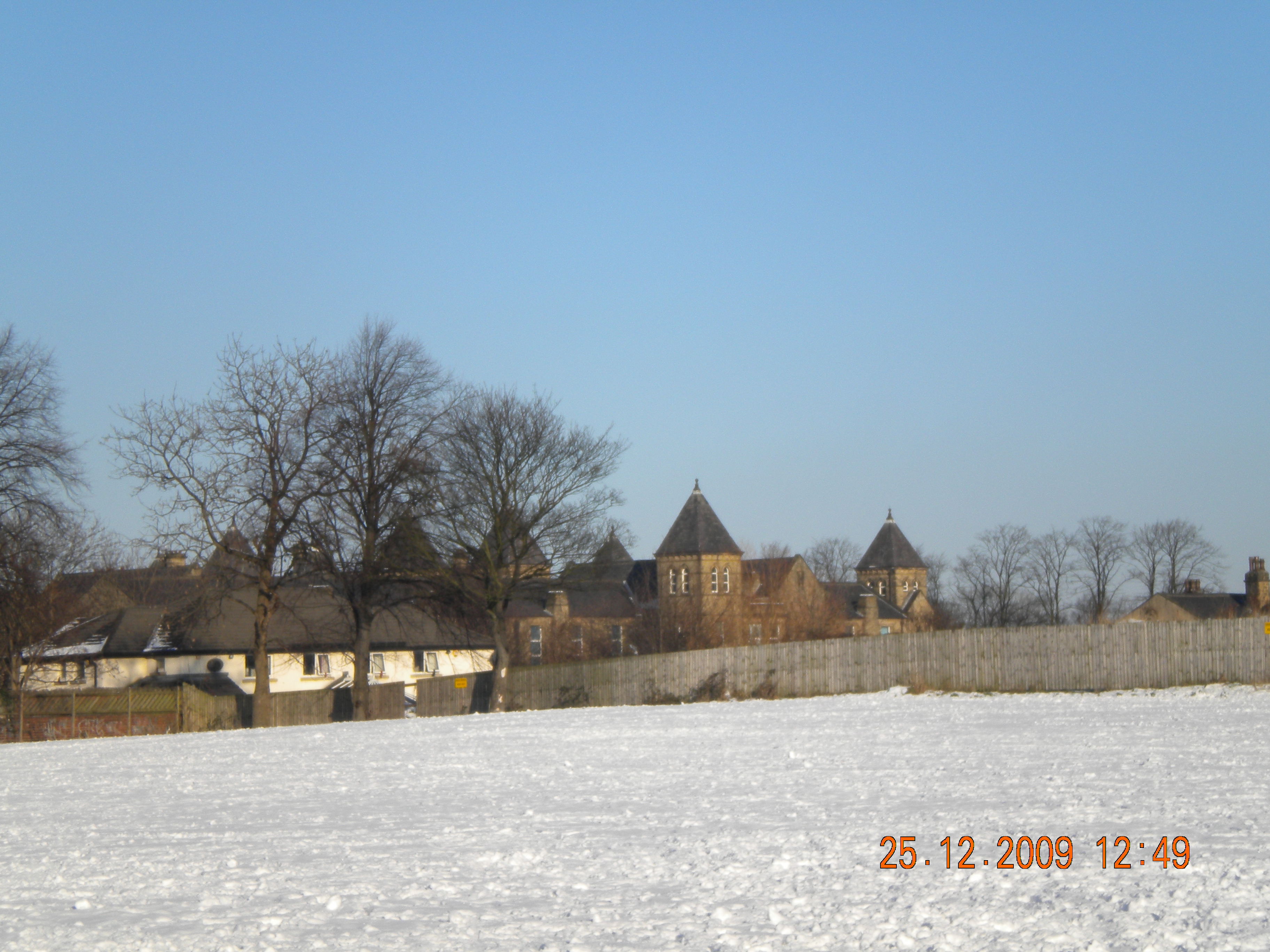
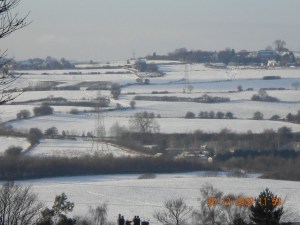
Another cold snap, after a couple of days of the Met Office talking about ‘potentially disruptive snow’, and train companies preemptively cancelling services in case it turns out to be the wrong kind. Came across, and added to,  a piece I wrote in Yorkshire in the lull between Christmas and New Year some years ago. The photographs were taken at a later date, when I was making a seasonal record of the place where I grew up. They are therefore unlikely to illustrate the meteorological conditions described accurately. Although they were in no way intended as an accompaniment to  the writing, its prior existence could well have informed  their creation. 

The 50s semi where we lived till I was thirteen, 269 Staincliffe Road, has been extended to the extent that the daughters of doctors and bank managers  I went to school with would almost have found it respectable. There was a field behind it,  ‘my field’, the house’s natural extension for me, though it belonged to the next door neighbour, whose  house is now also  double its former size. Where my field was there are now nine smart ‘executive’ homes. If the field isn’t there any more,  the view from it, still visible from the lane that runs behind, Scar End View, is better than I remember. It seems now to bear comparison with those in the supposedly superior Dales of holidays and Sunday trips. Now I’m seeing it through eyes that, unlike my octogenarian parents’, have looked at a lot of other places; seeing it through eyes too that have read  Defoe’s respectful description of the North’s industrial valleys — eyes which perhaps first began  to recognise this as their real home when reading Defoe’s Tour Through the Whole Island of Great Britian before  teaching it to students at a Scottish university. The view from Scar End looks just fine  through the sub-zero haze of late December afternoons.
DSCN0269

On each of these afternoons, between Christmas and New Year, I walk north along Scar End View. Bungalows are steeped up from the pavement on my right,  the new executive homes above them, while an unfenced playing field, unsnatched by property people, slopes away from the left verge. Below this are more houses, the Moor End council estate, before land  falls away across the main road, Heckmondwike Road, to pastures in  valleys and moors rise to the centre of the country. In a couple of years’ time, a child who lives here will go missing  and a temporary media camp will be established.  My recently widowed father will welcome visits from the police to check his bins and garage.

I’m left in a state of something like suspension, like the year and the season themselves as I look out across the Spen Valley to the Pennine heights; in a recession, or maybe regression from the routines of my adult life.  Then each day I take a slightly different route on Kilpin Hill, now my preferred destination on these walks, though a place I didn’t even really know as a child, despite its proximity, a little north and west of our home. My travels then always took me south and east, to dad’s bakery in Green Lane, to Grandma and Grandpa’s in Thornhill, to school in Horbury, for shopping in the town. I’m childlike now as I explore the lanes of millworkers’ cottages, artisans’ homes of millstone grit, now quite bijou and always somewhat magical, because it  never seems possible to take  the same route twice. Bower Lane, Robin Lane, Cawley Lane, Cresswell Lane, Occupation Lane. Walking daily this December within the bounds of the triangle between Halifax, Huddersfield and Heckmondwike Roads, drawn  across Spen Valley’s  eastern side, I learn more of the lie of this land,  where paths known as ginnels run off the road and lead you as the crow files, while the lane  takes the long route, or turns abruptly into a modern estate. In reality, there’s quite a lot of modern housing: bungalows and semis from every  postwar decade fill the gaps where maybe meadows, fields like mine once lay between the cottages. It is still possible, though, to frame a view with no twentieth-century buildings, that could be forty miles further north, in a pretty dale that attracts the tourists.

DSCN1220

What I’m drawn towards is the end of the hill, where you’ve crossed the boundary into Heckmondwike and reached Halifax Road road: no more lanes and unknown territory. I’ve usually turned back before then, to retrace my steps or discover a new way home, but today I’m compelled to continue to the end of the lane, though this promises only more of the millstone grit and postindustrial grime I remember from childhood and have glimpsed today between the gaps in the cottages of Kilpin Hill. I walk on the road because frost and ice have made the pavement  treacherous.

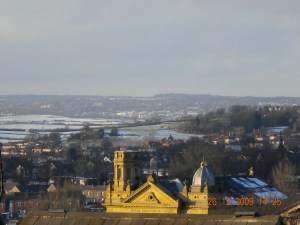
A large building glows opposite the late afternoon, late year sun on the other side of  Halifax road. I know it’s a nonconformist chapel because I half-remember it from childhood. It’s far larger in scale than the surrounding buildings but it hadn’t been cleaned up when I last saw it, so it wouldn’t have stood out quite so much as it does now, spotlighted by the low-angled orange sun. The facade is audaciously grand: Corinthian pillars and cupolas. Upper Independent Chapel is inscribed in large legend across the lintel. I can’t make out if it’s still in use, or if it’s now offices or apartments.
DSCN0347

Some small disused chapels have become homes in more rural areas; medium sized ones in small towns like this have found ironic new life as Indian restaurants. Larger ones  now house the new, non-geographically specific design and technology industries, just as  old mill buildings have  become retail spaces or art galleries. Design consultancies and architectural practices  like to get their hands on buildings like these. Even when I cross the road, carefully — it’s slippery,  although the gritter has evidently been out — I can’t see any sineage to denote the current use, so I assume that it is still the congregational chapel it always was. I could ask, but  I don’t really need to know. There’s an unimposing modern door at floor level.

Back on the home side of the road, I turn round and it’s shining still, like a monument – mosque or temple – in an eastern landscape, oblivious to its context, where all  other buildings still bear coming up for two centuries’ worth of dirt, not big or bright enough in themselves to be lit up by the setting sun. Even the hall next door, much larger than the domestic buildings, seems dwarfed. They’re all already benighted and  forever grounded while the Upper Independent  seems to float alone, a Mecca beneath the milky gauze of a day that has tried to be bright and clear but is simply too cold not to be hazy.

Next day and in very similar weather conditions, I go back, taking  a slightly different route over the hill. An Asian family  exit through the chapel door as I turn away, but  I’m mindful of my forty minute walk back, during which time the light will be lost and the pavements iced. Whichever way you go back down, by Knowles Hill, School Lane or Church Lane, the hill is steep. I’m anticipating tea and Christmas cake in my parents’ warm lounge, and I fail to ask the Muslims about the Methodist chapel.

Almost obsessively, I seem daily to be re-treading, re-occupying my childhood. I think I’m finally beginning to re-route it. The day after it’s becoming cloudier and milder, and the view from Scar End more limited. No sun: it will be dark sooner, even though theoretically the days are already lengthening, the chapel won’t be glowing and I don’t want to see it dull. So I don’t go on to Kilpin Hill, but cut up onto Staincliffe Road. Just past 269 I take a left turn, into the grounds of the hospital.  Staincliffe General Hospital,  where I was born and three of my grandparents died. I was delivered in the old building, Victorian Gothic, off Healds Road, a few years before the maternity block, now the Bronte Tower, was constructed opposite our house. It was apparently snowing when I  first made the short journey home, at this time of  year, maybe even on this day. At regular intervals during my growing up one of my grandparents was admitted to the geriatric ward, a single-story sprawl between the old and new higher-rises, and didn’t come out again. I’d go with one of the living ones to the hearing aid clinic  in Outpatients, in the room at the end of a long corridor where I also visited the orthodontist yearly. Approaching adolescence, in the couple of years before we moved down to the new house,  I’d  use the hospital grounds as  a place to hang out with my friend Mark, one of the few local children I played with.

Now it’s the District Hospital, part of the Mid-Yorkshire Hospitals Trust. Other than in the context of NHS architecture, Mid-Yorkshire doesn’t exist. Both my parents have undergone minor surgical procedures here.  Both are  on a waiting list for a further operation in one of the   new wards  that extend far back, over fields and ginnels where I also played as a child, towards Halifax Road, which eventually  passes the Upper Independent Chapel, and continues into Heckmondwike. Later my mum will receive chemotherapy at the Boothroyd Centre, named for the former Speaker of the House of Commons from these parts, and a year after her death I’ll come to the mortuary to identify my father’s body. From the other side, Westborough, where I’m now heading, the new construction isn’t so evident. Turning round to look back at the hospital from the playing field between Healds Road and Green Lane, what you see is the original Victorian building: grim,  blackened stone rising to diminutive towers, as if from  across an impoverished Magdalen Fields.

DSCN0277

I’m heading, towards the new house, in the direction of places with which I was better acquainted as a child: the streets of Westborough, where dad had his bakery and shop, and Crow Nest Park. Park Road, Birkdale Road and West Park Street; Reservoir Street, Oxford Road and Stockhill Street, where girls I went to school with lived in architect-designed bungalows, or Victorian villas that were once the homes of the mill owners and managers. Where Staincliffe and Kilpin Hill have undergone some gentrification and growth spurts of new building, here there are signs of decay and of subdivision. Some are  now HMOs; others home to extended Asian families.
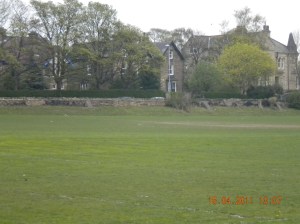
DSCN1252

I was walking around here, and along  the park’s broad  avenues on mild autumnal mornings a couple of months ago, when dad was having  hernia surgery in a hospital 20 miles away and there was less time to explore further afield; missing  my daily perambulation round Hunter’s Bog in Edinburgh’s Holyrood Park. Next year he’ll be back in the Mid-Yorkshire Trust’s sister hospital at Pontefract for a hip replacement. He’d have needed  to wait much longer to get it done in the hospital up the road. He’ll make a third trip along the M62 to Pontefract for a second hernia op a few months before his death from a heart attack when out shopping for a new radiator valve.

Today despite all the new building and the midwinter muddy playing field, there still is a lot of green — allotments, fields, parks — or there would be had  the weather not  toned everything down into khaki. Nearly everywhere you can see hills: the foothills of the Pennines, above  valleys where the towns of heavy industry lie hidden, in the north, east and south; the high moors to the west where there are no more towns until you reach Greater Manchester. Despite its location near the hub of the industrial revolution, and its evident scars from that time, this still isn’t properly an urban landscape. I’ve lived in cities since I left here more than 22 years ago, and what I still miss is its openness and variety. Now it’s Scotland that I don’t want to return to. I will go back north tomorrow, but today I’m spending my first New Year’s Eve in a long time back here.  I call in the Westborough co-op to buy a bottle of bubbly and head straight  back down the hill.

DSCN0361