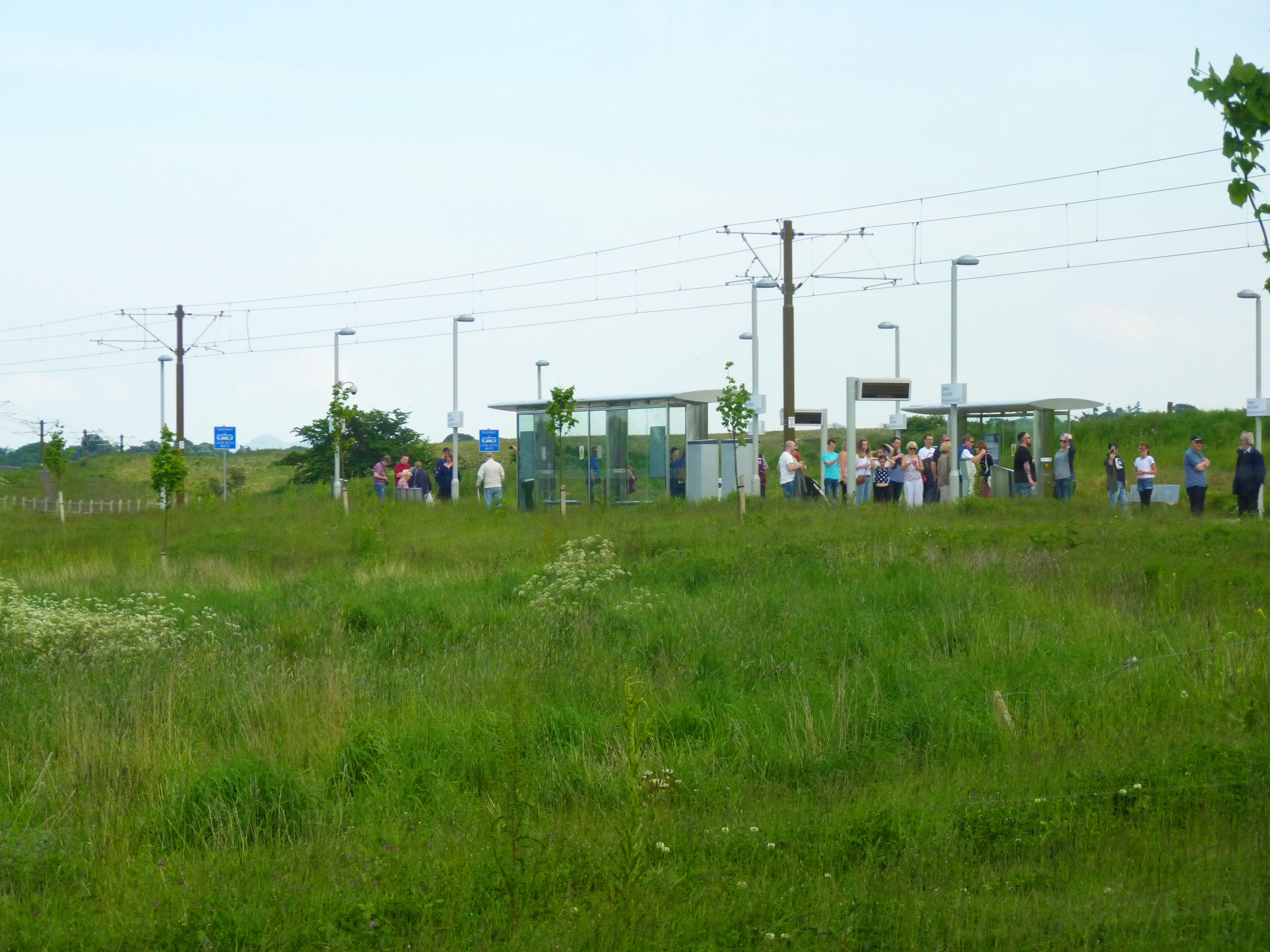
cycling from summer to autumn

I have a class in Linlithgow on the last Sunday of the month, and last weekend I cycled home from it. My plans for the 22 mile ride along the Union Canal towpath this summer had been stymied first – often – by weather, and then by engineering works which meant that I couldn’t get the bike to the start point by train. Weather and other commitments have also prevented me from building up much in the way of fitness, so this would be easily my longest ride of the season.

Over the course of a few hours (including two pub lunch pit stops – I said I was unfit), stony surfaces, where the hinterland was arable and open, alternated with squelchier ones on long wooded sections. The repetitions began to create a sense of deja vu in one unfamiliar with the route. Robert Macfarlane borrows a term that I like from American artist William Fox: ‘cognitive dissonance’ (The Old Ways, p.79). Macfarlane finds this chiefly in what he calls ‘data-depleted landscapes’ such as high moors and tidal strands, my own favourite terrains, but it can happen when any sort of defamiliarisation is induced. Sea voyage, test match, Ring cycle. With the canal a constant on my right hand I felt as though I was cycling from summer to autumn. I know what West Lothian looks like: I’ve travelled between Edinburgh and Glasgow regularly for twenty years. I watch it from up in the Pentlands on a weekly basis. But I don’t know it. Canals subvert our knowledge of terrain, linking places by the line of least resistance, the contour, and not the line of greatest efficiency (the road). Their sinuings show you the locality in a new way.

The route of the Union Canal makes a lengthy detour around the Broxburn bings. The red spoil heaps are a memorial to the extraction of shale for oil in this area. Accustomed to seeing them in the distance, their denuded and increasingly biodiverse proximity experienced from cycle level startles. It’s like a passage through an otherworld, or, to use another Macfarlane term, a xenotopia, in the middle of the central belt.

Progress eastwards was slow; Edinburgh seemed as though it was getting further and further away, even when the Pentland Hills and Arthur’s Seat had become visible on the horizon. Signposts – Winchburgh, Almond Aquaduct – kept indicating the passage of a ridiculously low mileage since the previous one. It was the final weekend of the Edinburgh festival, and the journey felt a bit like a (slow) progression from one stage set to another. Woodside, fieldside, woodside alternated like scenes designed to build dramatic tension – or muscle fatigue. I wanted to switch to a higher gear and higher cadence in order to get home a bit more quickly, but wasn’t able to on the narrow track.

A couple of people had told me that there was ‘a rough section’ on the towpath. I think it would be more accurate to say there was a smooth section, a surfaced stretch around Broxburn. For the rest of the route, I and my bike, which is officially and accurately classified as a rugged hybrid, were jolted along uncomfortably. On FB* there’s a photograph of me taken at a poetry reading last week. The forearm grasping my paper, honed by absorbing shock from the the rugged hybridity of Lothian cycle paths over the last couple of years, probably has even better definition now.

And the fest? As usual, I was just getting into my stride in week 3 when fatigue was setting in for everyone else. Unusually, I didn’t attend many music events, choosing to focus instead on poetry and spoken word. Refusing to make a distinction between ‘page’ and ‘stage’, or  book and fringe festivals, was liberating and enriching, though I followed with interest the debate  around the dichotomy and hierarchy between them. I went to two concerts, on the final Friday, and they were very good, but my head was still (too?) full of words. Other highlights: Juliet Binoche in Antigone; gyoza from the Harajuku Kitchen stall in George St; the moon making a guest appearance above the magical lights in Charlotte Square and George Square. Still to come: the exhibitions that stay up in September, and space to actually look at them. More cycling before it gets too cold, and some hillwalking before the heather dies away. Going back to work, and my ‘Summer’ holiday.

* Never an early adopter, I was initiated into the world of Facebook this summer and as a result my blog posts have become even more sporadic. I don’t even know if it is ethical or possible to link to the photo.

the play of work and other optical illusions

I’ve had a week off – no teaching, client work or meetings. Instead I took day trips to look at art outwith Edinburgh, for once without the agenda of preparing a workshop or a poem. I returned home in the evenings to watch highlights of the Vuelta a Espana and Tour of Britain. In the land of TV cycle touring, I’ve noticed, ‘podium’ is a verb and ‘abandon’ a noun. I wish I could say I’ve also had a week off from the Referendum coverage, but it’s too close (to polling day; to call), and too important to ignore. I had to turn the volume off during an exchange between Dennis Canavan and someone else on Reporting Scotland the other night. Of course I understand that with the stakes so high, and the subject so inflammatory,  interested parties will overheat. But as a voter and citizen, I’m just glad to be living in a fairly peaceable democracy. I’m starting to feel as I do when people over-identify with a sporting team: reactively neutral. Whatever the result, good and bad things will happen  Meantime, thank heavens for the wit and sanity of Gary Imlach, the best sports journalist I’m aware of.

On tuesday I travelled to Perth to look at the Alison Watt paintings that form part of GENERATION, the Scotland-wide celebration of art made in the last 25 years. I love her paintings of fabric; her painstaking crafting in paint of its folds, falls and crumples in works with titles like ‘Shift’, ‘Hood’  and ‘Tuck’. The Perth show is a mini-retrospective, a dozen works ranging from Watt’s self-portaits and nudes of the eighties, through the luscious work she produced after removing the model and making the figureless drapes the subject of the work, to new pieces that approach abstraction. One, Orion, completed this year, achieves the luminosity of a lit photo studio or stage set. Watt claims it alludes to Norman MacCaig’s beautiful short poem ‘Praise of a Thorn Bush’ (I couldn’t find a link, but it’s on p.319 of his Collected Poems); poetic is one of the first, and most lingering, words to spring to mind when viewing these paintings. In some of them, flesh, or plaster, are also suggested. Huge canvases absorb you as you approach them. Some seemed to draw me in towards a  vortex at their centre, where the darkest tones represent creases and folds in the mostly light/neutral/white fabrics. Once up close with the painting, our privilege is to observe the mark-making: how exactly she’s created the crack in a floorboard; shadow; toes.  I may not have been working, but I was still concentrating hard. Starting to experience sensory overload, I went out for a walk.

Beyond the North Inch parkland, a mile or so up the Tay, beyond the grand houses with lawns that terrace down towards the river, there’s a place where the current runs fast. On the far bank – the right bank, the east side, the Scone side –  is a shepherd’s hut kind of structure, quite camouflaged amongst trees. A human figure was sitting on the  bench in front of it, quite camouflaged against the walls. I sat down on a public bench opposite  and watched the current play. Eventually the person rose, picked up some tackle and waded in, making an arc from a gravel bank by the shore, through the shallows, until he was waist high in the midst of the fastest current. I watched him casting his line, slowly against the rapids, for maybe half an hour. When I returned my gaze to the bank, the verge in front of me was rotating, steadily, clockwise. My brain had however cleared enough to return to the gallery, and I walked back downstream.

Reflected in the seemingly static Tay, the arches of Perth Bridge completed into perfect circles, like portals to an otherworld.You could not help but imagine passing right through their centre. The trees on the banks also found their counterparts, sharp and solid below the water surface. Watt’s paintings were wonderful, and so was the scene outside the gallery. Attributing this to atmospheric conditions rather than any portent, or  illusion, of what the nation might become, I returned to the capital, from where I could cycle to a sunny Portobello beach on Wednesday, and on Thursday go to Jupiter Artland in the haar.

I grew up with the big Hepworths and Moores in the big landscapes of the Yorkshire Sculpture Park; this is maybe more akin to Ian Hamilton Finlay’s Little Sparta at the other end of the Pentland Hills, but differently ludic to his self-styled ‘republic’. You have to seek out some of the works more subtly embedded in their wooded context.  Jupiter generously afforded opportunity for another day’s play with reality and illusion, amongst Charles Jenck’s landforms, and structures built by Andy Goldsworthy: a hut floored only with unfinished rough-hewn bedrock; an unlit interior densely furnished with  floor-to-ceiling tree trunks. Boulders from the same source as the hut – the ditch spanned with a stone arch by Hamilton Finlay, and tagged ‘only connect’ –  nestled like erratic tree-houses inside coppiced branches inside the woodland. Be wildered.

le cote de blubberhouses

It was as emotional a weekend as it’s possible for a woman with absolutely no interest in football to have in front of her telly. I’d felt quite teary on hearing the announcement that the grand depart of the 2014 Tour de France would be in North and West Yorkshire, and drew big rings round the dates in my diary. Eighteen months later, last weekend, I stocked up on Wensleydale and retreated to the sofa to watch the world’s elite cyclists speeding along the routes that my father regularly rode on his day off, and which he introduced first to my mother, then me, in the car. We spent practically every weekend of my childhood driving out to the Dales or up in the local Pennines, sometimes with some grandparents, taking in a walk and  lunch. This was where I learned to love landscape and place-names, to admire the way roads (and the M62) were engineered into the contours of the uplands, and to become aware of subtle distinctions in vegetation, building materials and accent as we moved from south to north of the region.

The entire race route seemed to be filled with places of familial significance. The start was of course in Leeds. This was the city where my grandmother took me Christmas shopping (to Schofields department store, the late Fortnums of pre-Harvey Nicks era Leeds) every autumn half term, and where I took my mum to Next and the Body Shop before lunch at Pizza Express on every other trip down from Scotland – a treat for her. On the alternative visit, we’d go out of town and up into the hills – a treat for me. The roles of taker and taken varied across the county, as well as across the generations.

The cyclists pushed north-west into the Dales National Park, the Tour helicopter  performing its duty of diverting from the route to pick out landmarks, often of an ecclesiastical nature. Simultaneously, their names were engagingly captioned into French for the TV screen. Between the late nineties and 2005 I’d meet my parents for a weekend in the Swaledale area once a year.  I’d usually travel by train to Ribblehead on the Settle-Carlisle line, where they’d pick me up. We’d drive down to Hawes for afternoon tea, then over the  Buttertubs Pass, from now on in the Cote de Buttertubs,  into Swaledale, where we’d spend a few days wandering around the villages of Keld, Thwaite, Gunnerside and Muker, or driving over the high moors to Tan Hill, the highest pub in England, close to where North Yorkshire, Cumbria and County Durham coalesce. At points along the road you can see over to the Lake District and the Irish Sea; at others, to industrial Teeside and the North Sea. Everywhere there is headspace aplenty, and you feel as though you really are on the roof of the country. Another day my parents would maybe drive down to Richmond while I took an excursion on foot into the hills – the walks above the Swale from Keld to Muker, and up past the leadmining scars of Gunnerside Ghyll are in my all-time-anywhere top ten – before meeting up again for the obligatory tea and cake. We were there for their fortieth wedding anniversary in 2001 and my mum’s eightieth birthday in 2003. Last weekend I was genuinely moved by  the huge crowds at the usually deserted top of Buttertubs, already legendary in Tour and tyke lore – as well as by the sight of Jens Voigt, the oldest man in the race, who was first to the summit.

I had registered that Day One would cover the northern Dales and Day Two, the Pennine moors west of where we lived, but hadn’t actually checked out more detailed routes – it’s a bit like me not being able to engage with the Edinburgh Festival programme before August, or a travel guide before setting off on holiday. So it was a delightful surprise to learn that, after leaving York (‘change here for Leeds, Huddersfield and Manchester’ ) and Knaresborough (Mother Shipton’s Cave and a shop in the market square that sold amazing home-made biscuits in the 70s), the route continued on the A59 up to Blubberhouses Moor. Fab name, in either English or French, possibly from the Anglo-Saxon for ‘house / fortress by the bubbling stream’. Despite the initial semantic association one tends to make, its derivation has nothing to do with the emotions provoked by this occasion, but it is the scene of significant childhood and family memories.

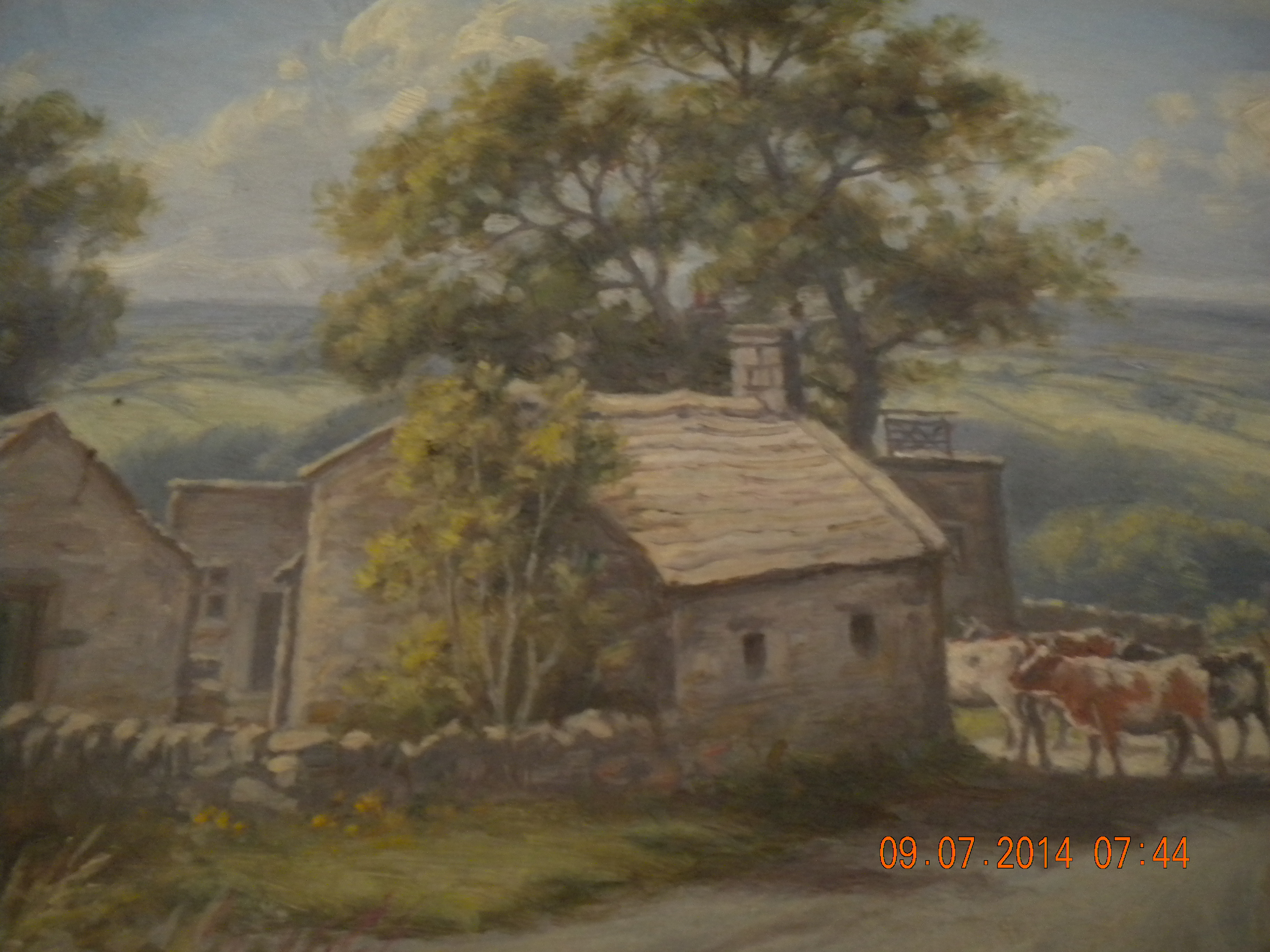
The Simpsons, friends of my dad’s parents, farmed at Kex Gill, right upon the summit of the Cote de Blubberhouses, after being relocated a few miles upstream from their previous home, at West End (really) when the valley was flooded by the water board to create Thruscross Reservoir. Their original farm was called The Gate. A pictographic sign of a five-barred version hung from a tree beside the road. I know this because I  inherited a watercolour and an oil painting of the scene by Albert E Jackson. I have rarely felt stranger than when looking at them on the wall of my Edinburgh flat when I brought them up shortly after my dad died, eleven months after his wife. Now they’re just part of my furniture, alongside other artworks from and of the region, in a small corner of Lothian that is forever Yorkshire. I don’t even look at them properly very often, so this was a timely reminder to savour my possessions and the memories they engender. They are conveniently situated just above the TV, now showing the Tour back on French soil, minus two significant British riders.
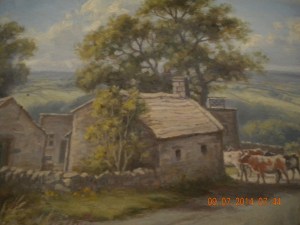
DSCN1859

My own parents became friends with the next generation at Kex Gill, Shelagh and Peter Harrison, and took me there from an early age. I used to name and bottle-feed the pet lambs, those orphaned or rejected by their mothers (I can still remember calling one Hannah); and Peter taught me to drive a tractor on one of their steep fields when I was about thirteen. At that time I wanted to be a vet. Shelagh, baker of the best cakes I can remember, is in her eighties, and we still exchange Christmas cards.

The Tour turned south towards our ‘local’ moors, over Oxhenhope, close to the wuthering heights of literary fame, but better known to my family for its hostelry, the Raggalds Inn; down to Hebden Bridge, former textile town turned hub for artists and writers since its Hughes / Plath era, and up Cragg Vale, the longest continuous road climb in England. I’ve walked up, but if my own cycling renaissance of the last couple of years has taught me anything, it’s that you experience terrain very differently en velo.

After skirting Huddersfield and whizzing through Holmfirth, the peloton headed up the biggest climb of the day, Holme Moss, on the Derbyshire border, before turning towards the finish at Sheffield and the steepest climb, a previously unknown suburban street called Jenkin Road. If I hadn’t been busy wanting to be a vet, mountaineer, dancer, plumber, opera singer, writer or teacher (only some of the above remain unrealistic dreams, so I’m not entirely beset by unfulfilled professional longings),  I think I might have quite liked to be a tour planner, scouting locations and scrutinising gradients to create a route. I can imagine something of the challenge and satisfaction of orchestrating the   combination of a series of lines of tarmac on the land surface (and of  coloured inks on the map page) into a course, the template for an event. To a degree the selection is arbitrary: I also enjoyed re-imagining the roads not taken by the Tour, and in combinations possibly never taken  on our family trips either.

From a (TV) spectator point of view the route made a most satisfactory visual narrative of how moor threads to dale and limestone turns to gritstone; of the passage between agricultural and industrial, and of the ubiquity of the drystone wall. With the presence of  crowds and racers and great weather the narrative evolved into high drama. On steep and narrow sections of the road competitor and spectator became virtually indistinguishable from each other, a carnival  superimposed on the normally sombre landscape.

Holme Moss was site of one of the two great  West Yorkshire beacons, its TV masts. Like its sibling rival on Emley Moor this local landmark has been locally invested with almost mythological significance. Viewed from the Pennine foothills  where I grew up, they and a series of other communications masts punctured the horizon of the high moor at intermittent intervals; by them you found both your physical and psychological bearings. I recall a semi-rural myth that you could predict who was going to win a general election, not from the exit polls, but from the direction the clouds were scudding (they rarely sauntered) over Emley Moor.  The first sighting of the mast from a train crossing the vale of York meant that, for good or ill, I was approaching home. Like many leavers, when I was younger I did not always want to return. In the last decade I have no doubt romanticised the place, mainly because my parents died, as parents do, and the family home was sold, effectively severing my direct links; and also in resistance to some popular and press views of the region, for example in the wake of the ‘disappearnce’ of Shannon Matthews. The visit of the Tour de France has added a few further stanzas or paragraphs to this narrative of personal engagement – quite literally so, here.

According to certificates from the Mid-Yorkshire District Association of the Cyclists Touring Club, my father cycled 100 miles in 8 hours on September 16th 1945, 200 miles in 24 hours on June 22nd-23rd 1946, 100 miles in 6 hours on October 6th 1946,  150 miles in 12 hours on September 21st 1947 and 130 miles in 12 hours on May 30th 1948. Some of his cycling memorabilia has been used in Jan Bee Brown’s film and exhibition ‘Daisy Daisy’ in the Yorkshire Dales Journeys event at the Dales Countryside Museum, Hawes, which runs until 30 September.


the power to communicate

I’ve lost my voice. I think I contracted something on an Edinburgh tram. I caught one one along Princes St on their first day of public service, en route to the Three Harbours Festival in East Lothian. There was a continental, party atmosphere in central Edinburgh. The sun was shining, staff were aplenty and smiling  and there was no mention of delays and budgets, though one of the tracker announcements was playing up, and the number of minutes to the promised arrival of the next westbound tram kept increasing rather than decreasing. A tannoy announcement  exhorted people to take selfies (I never thought I’d use that word) and send them to Transport for Edinburgh. I don’t even have a smart phone, and hadn’t thought to bring a camera. My friend Rosie and I went on to have a grand day out by the sea, wandering around the open studios, and enjoying some excellent fish and chips. I regretted not packing the camera: Cockenzie looked continental too, and next time the weather’s that good, the twin chimneys of the power station that overlooks the port may have been demolished. On the way back we’d had enough of the 26 bus by York Place, alighted and hopped onto a second tram. This is where I suspect I was infected. It was like rush hour on the London Underground, and it was with relief that I fought my way off at Haymarket. My camera had stayed at home, but Olga Wojtas, a fine writer, was out and about with hers. I was particularly amused by this shot of Ingliston Park & Ride.

2014 05 31_5036_Ingliston park and ride stop

Enough to give you hayfever. From which I was suffering anyway, before the onset of summer cold. After a week of attempting to clear nasal and cerebral congestion with some vigorous coughing and nose-blowing, I strained my vocal chords. I didn’t know you could do that. As a year-round allergy sufferer, I’m always attempting to un-block congestion by these means. The doc advised me to shut up for a week. Luckily I’m not a singer, actor or motivational speaker, and voluntarily keeping schtum (partly voluntarily: I can only whisper and croak) is actually quite liberating – as I remember from a couple of bouts of laryngitis when younger.

Ironically enough, this term’s theme at South Side Writers is ‘The Power to Communicate’. We’re contributing text for an exhibition of digital art at the Scottish Mental Health Arts and Film Festival in October, and taking the opportunity to address the topic as widely as possible while we’re at it. You could say that promoting the power to communicate is what a writing group does by default, but once you start tackling the issue deliberately, the questions raised are many and fascinating. When you move beyond famously power-laden discourses like law and medicine, themselves very fertile areas for creative writers, you can begin to consider the fictive or poetic potential of kids passing notes in class, or dedicatory quotations in gifted books. And I think it’s always useful for writers, whatever their level of experience, to examine and maybe re-evaluate how they communicate to their readership.

I shan’t be communicating via the spoken word this Friday. I can, however, nod, smile, wave, print out a handout and write illegibly on a flip chart. Were the theme something other than ‘the power to communicate’, I’d probably cancel the class, but under these circumstances I think it will be fun just to give it a go and see what happens.


slow trains and sound bites

I went to Glasgow last Friday with the intention of working on some unfinished drafts at the Transport Museum. When I first visited last summer, the idea of having a transport theme at South Side Writers came to me whilst sunbathing on the deck between the museum and the Tall Ship. Since then we’ve used text, images and personal reminiscence featuring longships, mobility scooters, transporters, donkeys and just about every every other imaginable mode of transport to prompt explorations of character, plot, pacing, structure and sound, as well as looking closely at concepts like ‘flight’. I’d identified Zaha Hadid’s museum building as an interesting place to sit and write for an hour or two. Now it was summertime again, officially at least, and the group was on its Easter break, so I set off for the west on the slow train. This involves:  a pleasant half-hour walk to Slateford Station via the blooming gardens of Craiglockhart; avoiding congestion in  Edinburgh city centre and at Waverley Station, and a cheaper fare to Glasgow which does not carry off-peak restrictions either. The train is indeed slow,  a proper ‘stopping train’, but I like its meanderings around lesser-visited parts of the central belt, home to people I may never meet, trees and livestock.

Progress  from Central Station to  Partick was slowed further at the architecture and design centre, The Lighthouse, when I chanced across a half-hour creative writing workshop, ‘Lunchtime Bites’.   Facilitator Emily Dodd had selected a photograph from the Britain From Above exhibition, the Broxburn Oil Works. She gave us  a short introduction and set us to write for 15 minutes.  As a creative writing tutor, one  of the most satisfying aspects of an extremely satisfying job is when you hear a group’s varying responses to the same starting point, and the surprise of those who didn’t think they could do it.   Another is when you attend a workshop on your day off and get to practice  the magical process for yourself.

Some writers can produce a lot of good material in a quarter of an hour under these conditions. In recent years my personal word-processor speed has slowed – one of my best friends describes me as glacial – so I opted for a haiku . Out of the notes I’d made I linked two images –  the background slag-heap detritus of the chemical process, and the foreground canal –  in three lines. As Emily pointed out, fifteen minutes is a good time to break off anyway; when you return to your writing you’ll have an altered perspective on it.

I used my surplus material in a draft that re-worked some of Emily’s introductory material about the social and ecological environment and history. Add a bit of my own time-and-space preoccupation  and maybe or maybe not a human character, and it could become something more substantial. We were photographed and recorded  after the session. I’m here,  sounding like a northern Janet Street-Porter with a plane above my head.

Emily spoke with great enthusiasm about working with community groups who had grown up close to some of the photographed locations. Those of us present at this session hadn’t, though  I was inevitably struck by parallels with the former industrial landscapes of northern England.

After the designated half-hour I looked round the rest of the Britain from Above exhibition. It’s more accurately described as ‘oblique aerial photography’, or Britain from a bit above. This isn’t like the view from an aeroplane, unless you’re just coming in to land (at that point I have my eyes closed and I’m gripping my seat arm-rests as we dangle above some too-near coastal water). The oblique perspective affords potential for some  innovative point-of-view work – though without making much of a conscious decision I settled for being the viewer outside the frame, making references to the fact that I was viewing a photograph, not the place itself. I resolved to pedal  along the Union Canal towpath to Broxburn to have a look at the site in colour and from bicycle level this spring.

And so to my final destination of the day. I’d sort of forgotten that It wasn’t just me who was on holiday – the schools were too. It was grand to see the museum full of eager children, but useless for settling down to write. I wandered around Hyndland and Dowanhill instead, and got the slow train back in good time for the Friday night treat or torture – I’m not sure which, but I think that’s the point – that is Steve Coogan and Rob Brydon’s Trip to Itlay.

decoration and embellishment

We’ve just come to the end of another term at SouthSide Writers. This time the theme was Decoration. Staff at the South Side Centre are hoping to spruce up the building a bit, enhancing the walls with text and art. This set me thinking about decorative art in general. It tends to be regarded as the poor cousin of the Fine Art, which I, like many others, regularly use as a writing prompt. Yet Scotland has its own  great traditions of design:  Paisley, tartan, and Charles Rennie Mackintosh, as well as work derived from Celtic motifs. Every other culture has countless  riches in media including textile, ceramics, wood, metal and stone. There are many amazing examples just round the corner from Southside at the National Museum of Scotland. Why not use some of these as a basis for a set of writing classes?

What, if anything, do artistic and literary decoration have in common? Pondering this question in the first session, while Radio 3 was celebrating its Baroque Spring, the Southside consensus seemed to be: plain style  good, ornament(ation) bad. Well, long live minimalism – and I like white cubes very well – but aren’t we now in a more tolerant, multiple and eclectic aesthetic era, the nostalgia-kitsch of some product branding notwithstanding? Embellishment  of objects adds design interest in the shape of details or features, and doesn’t just foster a sense of comfort in times of austerity. Beautification doesn’t have to equate to falsification here, so why was rhetorical embellishment regarded with such suspicion? Pursuing the connection between literary and decorative arts, we pared down our attention to the line as a unit of meaning, as championed by artists Paul Klee and Richard Long, and practiced writing lines with varying numbers of syllables and stresses. Klee’s phrase ‘take a line for a walk’  is a useful starting point for the timed or ‘flow’ writing exercises often used in writing groups, this one included, even if it tends nowadays to conjure up the undesired image of a dog on a retractable lead. Long literally walked, trod, lines into the landscape; built landforms; and produced huge text panels  that ‘captioned’  his walks.

We planned an excursion to Dovecot Weaving Studios to look at some tapestries. By happy co-incidence their current exhibition was by Julie Brook. Brook had been commissioned by the Studios to make land art in Libya and Namibia, and chose to  record  her work in the medium of film. The two main rooms  contained screens showing sequences of mesmerising, immersive moving images. Earth, water and sand moved, evolved. One of the sequences was entitled ‘Drawing a Line’; a number of Brook’s accompanying paper works, hung around the studios, also had ‘line’ in their title. Sometimes the films were more documentary, showing Brook making the work in the desert, slicing into a mudbank; or building a  stone ‘raised line’, a 3D sculptural form. (Is there a literary analogy for that?) We simply sat and wrote words and phrases that were suggested to us. I thought of the beginning of the world, in the opening of Wagner’s Ring Cycle specifically, but of cosmic origins generally, and  of Blake; of monoliths and landslips and 127 Hours; of wine-dark and blood-red seas, and of this stanza from Hopkins’ Wreck of the Deutschland:

 I am soft sift
      In an hourglass—at the wall
   Fast, but mined with a motion, a drift,
      And it crowds and it combs to the fall;
I steady as a water in a well, to a poise, to a pane,
But roped with, always, all the way down from the tall
    Fells or flanks of the voel, a vein . . .

For once, I didn’t want to make a new poem, I just wanted to let the images swim around and mingle with my own associations.  I think this may have been true for the other writers too: several  turned up at the next session with streams of consciousness and series of fragments and evocative suggestions. This gave rise to an extensive  discussion of matters arising from the exhibition. We talked a lot this term: ornamentation generated conversation. Several writers suggested that the very richness of decoration was inhibiting to the writing process. I don’t think it necessarily has to be: you can, for example, use a piece of decorated crockery in fiction as a way of conveying something about the character who owns or uses it, as one member did – but I am nonetheless intrigued by the group’s views.

The evening before our visit to Dovecot some of us went to hear Brook in conversation with Don Paterson, one of a series of talks with practitioners from other fields, including dance and film as well as poetry. Paterson suggested that poetry was quite a cinematic medium. I’ve never previously used film as a writing prompt, but I’m keen to do so again. Certainly one was invited to  construct one’s own meaning, if not narrative, from the way multiple relationships played out between the moving images on Brook’s screens. Alluding to  Klee, she spoke of reducing responses to place, and form itself, to the simplest possible element: the line. It’s this interplay between the simple and the complex, the detail and the embellishment, that intrigues me, in whatever medium is used.

Paper works  accompanied the films, abstract geometric shapes or reduced forms, some using desert clay or the glorious local red Otjize pigment. Was there a literary equivalent of pigment? I asked the writers to ‘translate’ a chosen picture into words. Of course it could  be argued that there’s no point  in drawing parallels between different media in this way, but I think it is worth asking if we can gain some insight, some enhancement of creativity, from at least considering the possibility. I sometimes have Paul Klee or Richard Long in mind when making a line of text – now I will possibly also think of Julie Brook. One of the Dovecot makers, Jonathan Cleaver, produced a rug in response to Brook’s work on pigment. We learned a new word for an artistic medium: tufted.

Later on in the term we considered places where text and image are actually juxtaposed on paper: in illustration and ekphrastic collaborations (writing about art); in art which incorporates text, from illuminated manuscripts to Blake and onwards into the twentieth century; in calligraphy (when viewing a foreign script, do you ‘read’ it as a text or look at it as a picture?); in concrete poetry and ‘language art’, places where text is presented as art.

We  moved on to look at the way the material world is everywhere enhanced  – or reduced, some might say – by text, in  forms ranging from  signage, advertising and  branded clothing to standing stones and tombstones. After writing some postcards, ‘wish you were heres’ from the imaginative landscapes evoked by a set of stills from Julie Brook, we considered other applications of the word card (Are all cards used for either communicational, transactional or ludic purposes? Is ‘plastic card’ an oxymoron?). We examined playing cards, recto and verso, in a new light. Why clubs? Isn’t a diamond actually a rhombus? The answers to these questions can most likely be found on the internet, but we hadn’t thought to ask them before. Finally, we returned to the idea of line. The number of pips on the card dealt to each writer was to determine the number of syllables, or lines, to be used, and for good measure the name of the suit was to be included in the piece of writing produced.

the art of writing

I will be teaming up with artist  Campbell Sandilands,  who trained in Japan and specialises in brush calligraphy, for  a unique set of seasonal classes at the Scottish National Gallery in 2013-14.   We will start the day by looking at Japanese prints from the NGS collection and reading some haiku, continue making our own work, and conclude with ceremonial tea and readings! Join us  for one or more of these creative sessions in celebration of the seasonsAll levels of experience welcome.
 
 The Tale of the Brush: A Year of Haiku and Calligraphy – Practical One-Day Courses
Clore Education Studios, Scottish National Gallery
Wednesday 21 August, Summer
Saturday 21 September, Autumn
Saturday 11 January, Winter
TBC, Spring
10.30am-4pm
£30 (£25) per session
 
I will also be leading a five week creative writing course at the Scottish National Gallery, 1.30-4.30pm, Wednesdays 2-30 October. This will feature a set of exercises specially devised for responding to visual art (including some new ones if you’ve been before!) and the opportunity to spend two sessions looking at and writing about the Peter Doig exhibition. Booking information available soon.

mad march and invisible colours: could spring be far behind?

The closing lines of Shelley’s ‘Ode to the West Wind’, and a reflection that the poet didn’t live in Scotland and wasn’t factoring in climate change, formed an accompaniment to many of my March wanderings: to Fife for  StAnza; to the Scottish National Portrait Gallery  for a workshop on creative writing for undergraduates in English and journalism from Napier University; to Glasgow for a two-day training event; into the snowy hills, wafting my walking poles around like ski sticks. The month-long cold snap was ushered in at StAnza, where I  facilitated a workshop called ‘Different Viewpoints’ on the first morning. Sponsored by Lapidus Scotland, this undertook to examine through practical exercises the relationships between ‘personal’ or ‘therapeutic’ and ‘creative’ writing, and between ‘internal’ and ‘external’ stimuli. Against the backdrop of, and engaging closely with, an exhibition of poems and paintings about liminal spaces entitled Unmapped, the participants created poems that beautifully wove together personal experience, memory and present-moment response to real and imagined places.

Back in Edinburgh, facilitating a session for undergraduates, rather than the ‘adults’ I usually work with, set me thinking further about ekphrasis, or the use of visual art to inspire writing, and how and why we teach it. When the BP  Portrait exhibition was up earlier in the year, in the winter proper, I took to  reading Michael Longley in front of a wonderful portrait of the poet, The Dailects of Silence, by Colin Davidson  At the close of his most recent collection A Hundred Doors, Longley has an elegy, ‘White Farmhouse’, which concludes with a line that cites Marcel Duchamp’s claim   ‘titles are invisible colours’. Are they? I need to ponder some more, but titles (if not artist statements and gallery glosses) can be of abiding interest to those with a textual background who are looking at pictures. What are we to make, for example, of Ben Nicholson’s habit of supplementing a matter-of-fact dating or stating of medium with a descriptor, as in June 1961 (Green Goblet and Blue Square), or Painted Relief (Plover’s Egg Blue)?

Words on Canvas were invited to write in response to paintings in the Royal Scottish Painters in Watercolour (RSW) annual exhibition. There were 252 works in the exhibition, and our deadline was just a week after we first got to see them. I had a couple of hours in the gallery beforehand, en route to the Portrait Gallery to have a look at Rousseau and Hume prior the Napier session. I quickly saw the work I wanted to write about, Gordon Mitchell’s Lasting Impressions, a painting of a sun lounger  against a sun-baked wall whose cracked plaster revealed the shapes of human silhouettes. I was reminded first of  the second paragraph of  The Wasteland, the lines about aridity, broken images and shadows, that lead up to ‘I will show you in fear a handful of dust’; and then, more optimistically, of a standing joke about the cost of hiring a sun lounger on the cote d’azur from last year’s summer holiday. Fine, but on Monday morning fifteen other writers (minus a couple I bumped into in the gallery who were already hard at work) would need to choose from the remaining 251. The usual WoC format is a Gallery tour, covering just  four or five works, followed by a writing critique session a fortnight later.  Feeling under some pressure, I started to jot down the titles of works that attracted me for one reason or another. Then I took up the catalogue, and noted down titles that themselves appealed (invisible colours if you like). Bingo, eureka, etcetera. Rousseau, Hume. On Monday I asked those writers who hadn’t already seen the exhibition and selected a work initially to choose a title that appealed, and write to that before seeing the picture to which it pertained. Then we paired up and did some writing exercises in front of the paintings, and a week later we had a pamphlet of stories and poems, and were ready to attend a reception where we were introduced to the painters of the works we’d selected. ‘Have you met your artist yet?’, we’d ask as we encountered each other circulating the exhibition, glasses of fizz in hand. Several writers reported uncanny correspondences between their thought processes and those of their painter-partner.  Gordon Mitchell told me his sun lounger was located near St Tropez. I had it not terribly far away, on the Cap d’Antibes, but then I don’t suppose it’d have been in Copenhagen or Anstruther.

Meanwhile, the South Side Writers concluded their term on fruit & veg with an attempt to break out of the tradition and make an original,  contemporary statement on the subject, accompanied by a very tasty and refreshing fruit salad. Mine felt very modernist, nearly a century past its sell-by date.

In Glasgow just before Easter I did the two-day training for Living Life To The Full (LLTTF). This is a CBT-based programme designed to be delivered in eight sessions in non-clinical settings, by professionals from different fields who season the basic template with their own personality, experience and knowledge. The target client or user is the individual with mild to moderate depression or anxiety, maybe near the bottom of a long waiting list for treatment,  but it could, I think, be really useful for helping anyone to problem-solve their way around the various obstacles they inevitably encounter. Writer’s block, relationship tensions, builders who don’t turn up. Well, maybe not the latter: it doesn’t promise miracles. The programme was on the periphery of my radar untilLapidus Scotland members were invited to learn more about it at a Bibliotherapy seminar at the National Library of Scotland in February. We heard some pretty inspiring presentations, by Drs Ann Wales, whose job title, Programme Director for Knowledge Management, doesn’t quite convey the extent of her humanity and intellectual curiosity; and Chris Williams, founder of LLTTF. Later we took part in  sessions which could be loosely categorised as either  ‘creative’ (poetry, storytelling, journalling) or ‘scientific’ (concerned with the transmission of knowledge and information).

After this I felt fairly sure that my place when working in healthcare settings was firmly in the creative camp, but I was curious to learn more about this method dedicated to transmitting health information (according to a social, rather than medical, model) in simplicity and clarity  in order to help individuals make positive changes in their lives. I signed up for the training. It turned out to be a truly inspiring couple of days. After an accelerated trip through the components of the programme, we were divided into small groups, with the task of preparing a small chunk of it to deliver to the rest. Oh no, I thought. I’m too tired. I haven’t slept properly the last few nights. I assimilate information slowly, with much reflection and walking around: I’m not ready to do this yet. I don’t want to look a numptie in front of esteemed Lapidus colleagues, or the lovely people from other fields I’ve only just met. Luckily, the extrovert part of me that enjoys a bit of a performance kicked in. I had fun, and, I hope, communicated my points effectively. More than that, hearing the others’ presentations really helped to reinforce everything we’d  learned in a short space of time, and I left with a sense of the possibilities that this new tool might afford.

Now that April’s here – and yes, I would like to pop down to England, though my guess is that the spring isn’t much more advanced there this time – I’ve paced along the plateau of  Capelaw Hill and been to a stimulating workshop on poetry and place with Australian poet Mark Tredinnick at the Scottish Poetry Library. At the end of a UK tour where he too has written of ‘the winter / that did not want to end’, he appeared less tired than I, much closer to home. In an open-plan learning type format,  he interspersed his  own observations about the poetry of place with dialogue with the attendees about their approaches to the matter. The moment when  Mark asked me who I was reading at the moment – rather than when faced with delivering part of a LLTTF module at short notice after little sleep – was the one chosen for me to go blank. Michael Longley?  The many writers from and writing about these islands and beyond whom I encountered at StAnza? In truth I’d been thinking most recently about  influences further back in the tradition: the Anglo-Saxon poets, Wordsworth, Hopkins, sundry Modernisits, as well as relishing the challenge of how on earth, in the air or by the water  to make it new myself, now. I could have talked about some or all of these – or about prose writings on place by the likes of  Kathleen Jamie and Robert McFarlane; or innovations other Scottish writers and artists are making – some of them in a  global context. Or I could have engaged more with some of  the many things that resonated for me in the others’ words that afternoon . . . but eloquence had well and truly taken leave of me. It may take some sun and more visible colours to power up my brain again.

stanza 13: legacy and place

IMG_0772

Photo: Stephanie Green

StAnza Poetry Festival, St Andrews, Scotland, 6-10 March 2013

One of the festival themes was ‘Legacy & Place’.

It was like a Hebridean holiday: you bumped the same people several times a day. Andrew the drystane-dyker poet; Enid who wrote so movingly in your workshop; Annie the young journalist; Rebecca whose poems graced the walls of the room used for workshops,  complementing paintings of the peripheral made by her collaborator Anna. People you knew from Edinburgh; Canadian writers you just met for the first time; cheerful StAnza staff.

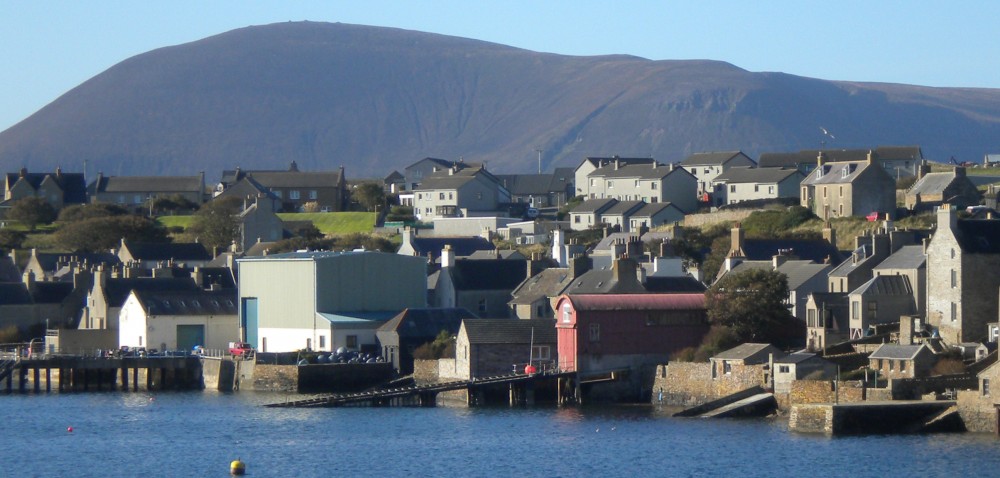
Weather enclosed and defamiliarised the Fife town and seemed to intensify and brew the creative and social activity.  The wynd where  I took shelter  from the landfall of an Orcadian wind suddenly felt like a Stromness pend, and was filled with kent faces. I was happily disorientated. When the visibility improved a little on Saturday, I walked along The Scores to the West Sands to ground and assimilate the many wonderful words I’d heard over the previous three days, from the voices of Gillian Clarke, George Szirtes, Ken Babstock, Chris Whyte, Erin Moure, Mark Doty, Jean Atkin and more. Offshore, in parallel, waves broke endlessly, uniformly, companionably from the still-near horizon. Up at the cathedral, I stepped over the remnants of low walls and was reminded of the cloistral ruins on the tidal island of Birsay, and every bit as cut off from the quotidian. The wind intensified; drove in a tide of Shetland vowels. Time to return to the warmth of StAnza’s replacement hub, the Town Hall, made resplendent with words, sounds, images and tactile textual objects, to see  the collaboration between Fife poets and Shetland craft makers, Farlin. Time to hear Walt Whitman and Marina Tsvetaeva echoing down the generations and across continents.

It wasn’t  unexpected that, meteorologically enabled or not, sounds and other senses from  the northern and western isles  found their way along the wind and waves and into my experience of the venues in St Andrews. It did however come as a surprise to me to be taken back to the Lake District. When Gillian Clarke spoke of childhood fear as a foundation for poetry in her compelling exploration of  Brythonic verse and the Welsh alliterative pattern cynghanedd,  she cited Heaney’s testament to the pervading power of early terrors.   I was reminded of Wordsworth’s assertion near the beginning of The Prelude that he was ‘fostered alike by beauty and by fear’, before embarking on his incomparable blank verse catalogue of childhood adventures and misdemeanours. When Erin Moure, in a dynamic workshop on revision, commented that ‘language can do more than we know’, I searched my memory for the source of his line ‘we feel that we are greater than we know’. And then Jean Atkin, appearing with Zoe Skoulding in the highly atmospheric vaulted undercroft at St John’s, read her poem about the old coffin path that connects Ambleside and Grasmere. I was back in my graduate school days, trying to impress American delegates at the Wordsworth Summer Conference whilst walking that same path on a visit to Rydal Mount, the Wordsworths’ home between 1813 and 1850. Or  earnestly studying early MS. drafts towards The Prelude at Dove Cottage, but waiting for the weather to clear so I could climb Helvellyn (a Cumbric place-name, incidentally, closely related to Brythonic). My supervisor was the late Robert Woof, director of the Wordsworth Trust, who tended to be there, rather than doing his day job across the pennines at Newcastle University. Since that time, the Trust, like the universities, has recognised the benefits of welcoming creatives alongside academics. Time to pay a return visit, perhaps.

But for now, thank you, Eleanor Livingstone and all the StAnza team and participants.

all points north: the poetics of peace and armitage

Simon Armitage’s 1999 essay collection All Points North was re-issued by Penguin to accompany his newer memoir, Gig, last year. I  read it just as the debate  reignited about whether the proposed high-speed train link from London to Manchester and Leeds  would heal or exacerbate the north-south divide.  All Points  is a generically eclectic mixture of ideas of north, innovative on a number of  appealing counts.

It’s largely written in the second person, the better to accentuate the difference between narrator (Armitage, or his literary persona, or a prose-writing variant thereof) from protagonist (his younger selves, including youth growing up amidst trans-Pennine rivalry, and probation officer in Manchester). ‘You were thirteen when you first went to Old Trafford’; ‘Your mum taps you on the back’. From the onset, he lets us know that his version of events, or anyone’s, isn’t necessarily to be believed, when he  follows up an urban myth in circulation amongst the probation service with another professional  anecdote, then concludes ‘that story isn’t true either’. It’s therefore entirely possible that a smattering of examples of good old-fashioned northern sexism, sometimes attributed to ‘your mate’, are made up too, to make a point – albeit an unclear one. That times have changed? That they haven’t?  Various other sorts of fiction are skilfully alluded to: he writes the the script of an imaginary northern-nostalgia TV drama; when  Pat Barker’s novel Regeneration is being filmed, he visits the  set for the Craiglockhart War Hospital, not on location in Edinburgh, but  in a Glasgow studio. His phrase ‘the Leeds of the mind’ reminds us that Armitage’s accounts of, for example, Harvey Nicks, or the DSS HQ Quarry House, are subjective versions of place, recognisble, but different to what say, Tony Harrison’s, or mine, would be; parallel to the Edinburghs of Scott’s or Stevenson’s or Ian Rankin’s minds.

Rather than appearing as stand-alone essays, chapters and fragments are thematically linked into a continuous narrative. So  ‘Jerusalem’, the invented Calderdale soap, follows a critique of the region’s status as prime location for television drama. There are transcripts of real TV films and radio features made by Armitage, too, with his poetry interpolated – on homelessness in Manchester; Saturday night in Leeds; the Humber Bridge. Finally there’s a stunning soundscape/voice collage, ‘Points of Reference – North’ (1996-97), which features the printed voices of a range of experts including Patrick Moore, Ian McCaskill when he was a weatherman, and Rowan Williams before he was an archbishop.

Accounts of print and broadcast news items trigger either personal memories or  a deadpan retelling of the same-everywhere provinciality of local news. Forays to London, Brazil, Iceland, or 1920  are punctuated with six refrains of ‘Over the Top to Manchester’, accounts of Pennine crossings for business or pleasure experienced as ritual re-enactments of a route.  A number of the travel sections start with the preposition ‘to’, a  shortcut to the place in question which becomes a form of literary shorthand: To Portsmouth.  To Rochdale. To Hull. Riffs on identity, mistaken and otherwise, abound, Armitage exploiting his generic northern surname. On page 118, no less, there is a sequence called ‘Directory Enquiries’, where Direct Line threaten to increase his insurance premium because poet is held to be a higher-risk occupation than probation officer.

In 1999 when All Points was first published, my own points of reference  and station stops were a bit further north still.  I was  preoccupied with matters such as  Ossian, and the post-Enlightenment development of the Highlands as a tourist destination. I would quite like to reclaim the term ‘North Britain’, coined after the Union to ensure the Scots knew their place. In many ways – linguistic, topographical, culinary – the northern English and lowland Scots have more in common with each other than the northern and southern English do, or the lowland and highland Scots. I like, too, the idea of being ‘northumbrian’, from (anywhere) north of the Humber.

Since the the turn of the century, my focus has been re-directed south (of the Scottish Lowlands) again. I started to re-read Harrison and Hughes and the Brontes, and seek out literary versions of the region new to me. A preoccupation with grimupnorthness was satisfied but not sated by David Peace’s Red Riding quartet: Nineteen Seventy Four, Nineteen Seventy Seven, Nineteen Eighty and Nineteen Eighty Three, some of my formative years, written between 1999 and 2002 with a sparse lyricism.

Channel 4’s 2009 film of the novels, compressed into a trilogy, was full of   slowburning menace and menacing abstraction. Only the police beatings that regularly punctuated the action had an unfortunate ring of comedy: maybe because they  were performed by uniformed functionaries, they were a bit too much  Monty Python’s Spanish Inquisition dressed up as Dixon of Dock Green. The real  nightmare for me was in the architecture, the concrete jungle: the road tunnel  under Leeds city centre,  and the gargantuan cooling towers of Ferrybridge Power Station.  We drove through the tunnel most weekends when I was young: it was the conduit to the other side of the city and what lay beyond – the Dales, the A1- and therefore a means of escape.

Red Riding and All Points North actually have an architectural feature, or location, in common: the Redbeck Cafe outside Wakefield, a no-place where police did bad things to journalists, fugitive sleuths holed up to sort out child murders and their own demons, and an am-dram troupe en route to a convention in Bridlington stopped for refreshments.

Peace, like Armitage, melds fact and fiction. But the former finds no Romantic redemption in landscape. His poetry lies in the cadences of the minimalist dialogue with which he tells of the  Yorkshire Ripper murders, child abduction, organised crime and police corruption. As for the legion of reporters who covered the ‘abduction’ of schoolgirl Shannon Matthews  in 2009, scenery only exists for Peace as metaphor for  social depravation. When his attention is directed  west of the Yorkshire conurbation, it’s towards the legacy of moors murderers Ian Brady and Myra Hindley, rather than  the remains of Elmet evoked in poems and photography by Ted Hughes and Fay Godwin. Yet there’s also something libretto-like in Peace’s minimalism. He has   a Wagnerian grasp of theme, and ability to reprise it by flashback and in different voices. The Quartet could be a Ring Cycle for the end of the twentieth century, except that its geometry seems squarely cuboid as opposed to  circular. I’m envious of the scope of Peace’s vision, but not its content. Both Red Riding and All Points sent me back to Armitage’s poetry; to  Barbara Hepworth’s statements about the sculptural forms of the West Riding Hills, and to my own unabashed nostalgia for gritstone wall and flat vowel.

.