fruit and veg; and inside out

Each term the South Side Writers have a new theme. In Spring 2013 it’s Fruit & Veg. This is because

(i) there’s been a bit of a running joke about bananas in the group for a couple of years. I always eat one before the class starts. Some time ago member Olga Wojtas showed us her party piece, which involved turning a banana into the profile of a penguin by partly peeling it and taking one bite. Time seemed ripe, pun intended, to bring the subject to more conscious and literary attention.

(ii) Last term we did Borders, Boundaries and Edges and I felt it was time for something more concrete and less conceptual.

Before Christmas we discussed and wrote about different sorts of boundaries – geographical, political, personal – and literary, in the shape of stanzas and paragraphs. We looked at examples of visual art with clearly defined lines (Mondrian, for example), and with fuzzy ones (Whistler`), and some that combined both, such as a couple of my favourite paintings in the National Galleries Scotland collection: Cezanne’s  The Big Trees, and Klee’s Threatening Snowstorm.

Design
After Paul Klee

blueprint for rebuilding
out of the bruising

provisional etching
of the reconstruction of Dresden

prophetic minaret to a
cloud-capped ground zero

Valhalla in a new era
for post-conflagration gods

plans on the drawing board
prefigure each apocalypse

This poem first appeared in Words on Canvas (National Galleries of Scotland, 2009).

One week everyone brought in an object with an (accessible, usable) inside and outside. I asked a series of questions, to be answered first with respect to the object’s exterior, and then again about its interior, so that you ended up with two lists which could be used or combined in various ways as a writing prompt.

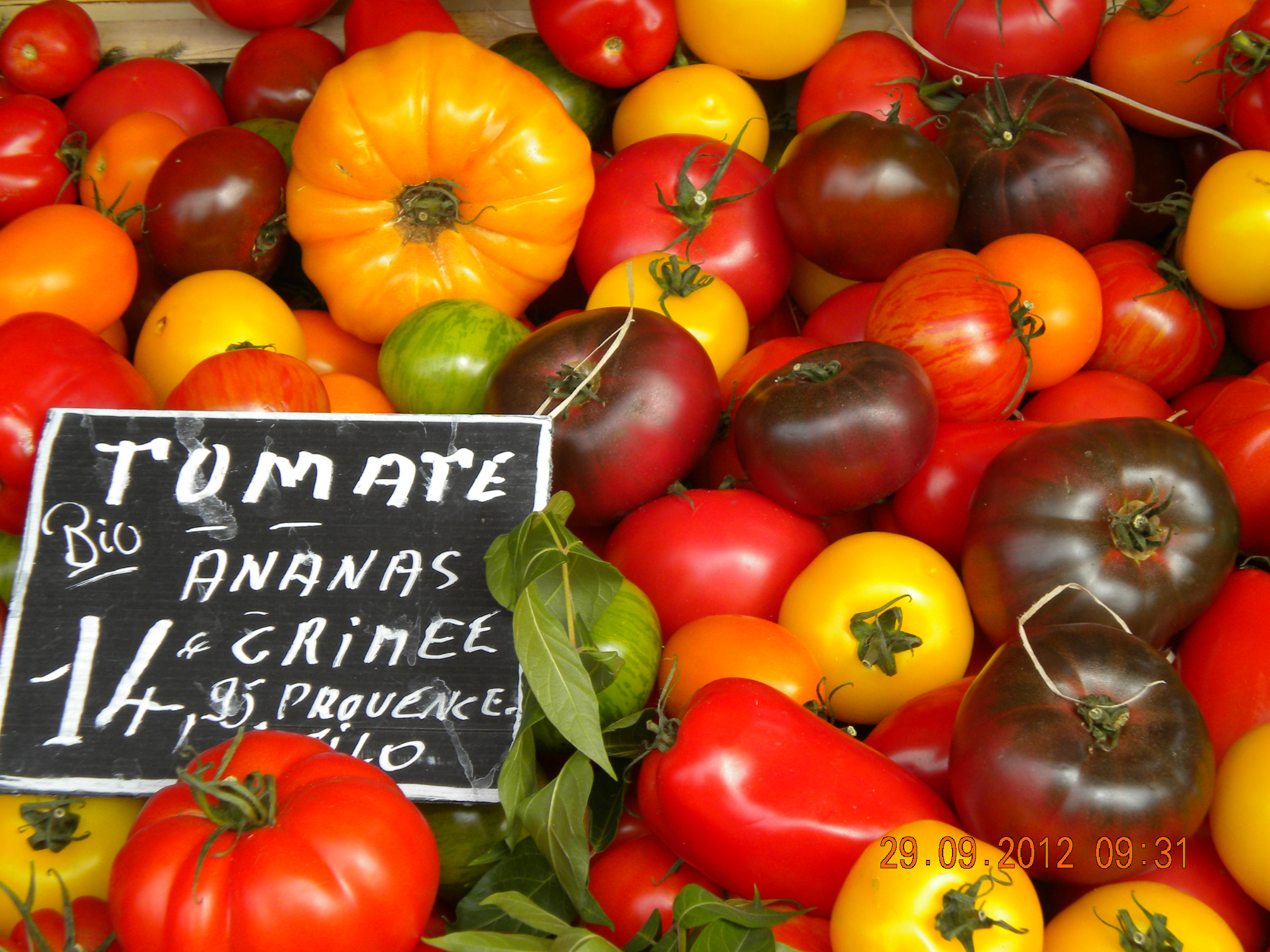
Fruit ( we haven’t really made it into veg yet) is proving to be a fascinating subject for a series of writing classes because of its range of usage, literal and metaphorical, throughout literary history from Virgil’s ‘The Salad’, through the various sorts of Christian-era symbolism, to an abundance of contemporary works. It too has insides and outsides, of course. We started the term  sniffing, feeling, peeling and tasting fruit and will end with a fruit & word salad. Each writer is now researching a different fruit and bringing in a textual  example of it. In response we’ve written about hybrids (nectarcot, anyone?), provenance and packaging, architectural pineapples  and still lifes, as well as addressing a species and defamiliarising the common-or-garden so that it becomes exotic. Oh, and a banana is a herb.

all points north: the poetics of peace and armitage

Simon Armitage’s 1999 essay collection All Points North was re-issued by Penguin to accompany his newer memoir, Gig, last year. I  read it just as the debate  reignited about whether the proposed high-speed train link from London to Manchester and Leeds  would heal or exacerbate the north-south divide.  All Points  is a generically eclectic mixture of ideas of north, innovative on a number of  appealing counts.

It’s largely written in the second person, the better to accentuate the difference between narrator (Armitage, or his literary persona, or a prose-writing variant thereof) from protagonist (his younger selves, including youth growing up amidst trans-Pennine rivalry, and probation officer in Manchester). ‘You were thirteen when you first went to Old Trafford’; ‘Your mum taps you on the back’. From the onset, he lets us know that his version of events, or anyone’s, isn’t necessarily to be believed, when he  follows up an urban myth in circulation amongst the probation service with another professional  anecdote, then concludes ‘that story isn’t true either’. It’s therefore entirely possible that a smattering of examples of good old-fashioned northern sexism, sometimes attributed to ‘your mate’, are made up too, to make a point – albeit an unclear one. That times have changed? That they haven’t?  Various other sorts of fiction are skilfully alluded to: he writes the the script of an imaginary northern-nostalgia TV drama; when  Pat Barker’s novel Regeneration is being filmed, he visits the  set for the Craiglockhart War Hospital, not on location in Edinburgh, but  in a Glasgow studio. His phrase ‘the Leeds of the mind’ reminds us that Armitage’s accounts of, for example, Harvey Nicks, or the DSS HQ Quarry House, are subjective versions of place, recognisble, but different to what say, Tony Harrison’s, or mine, would be; parallel to the Edinburghs of Scott’s or Stevenson’s or Ian Rankin’s minds.

Rather than appearing as stand-alone essays, chapters and fragments are thematically linked into a continuous narrative. So  ‘Jerusalem’, the invented Calderdale soap, follows a critique of the region’s status as prime location for television drama. There are transcripts of real TV films and radio features made by Armitage, too, with his poetry interpolated – on homelessness in Manchester; Saturday night in Leeds; the Humber Bridge. Finally there’s a stunning soundscape/voice collage, ‘Points of Reference – North’ (1996-97), which features the printed voices of a range of experts including Patrick Moore, Ian McCaskill when he was a weatherman, and Rowan Williams before he was an archbishop.

Accounts of print and broadcast news items trigger either personal memories or  a deadpan retelling of the same-everywhere provinciality of local news. Forays to London, Brazil, Iceland, or 1920  are punctuated with six refrains of ‘Over the Top to Manchester’, accounts of Pennine crossings for business or pleasure experienced as ritual re-enactments of a route.  A number of the travel sections start with the preposition ‘to’, a  shortcut to the place in question which becomes a form of literary shorthand: To Portsmouth.  To Rochdale. To Hull. Riffs on identity, mistaken and otherwise, abound, Armitage exploiting his generic northern surname. On page 118, no less, there is a sequence called ‘Directory Enquiries’, where Direct Line threaten to increase his insurance premium because poet is held to be a higher-risk occupation than probation officer.

In 1999 when All Points was first published, my own points of reference  and station stops were a bit further north still.  I was  preoccupied with matters such as  Ossian, and the post-Enlightenment development of the Highlands as a tourist destination. I would quite like to reclaim the term ‘North Britain’, coined after the Union to ensure the Scots knew their place. In many ways – linguistic, topographical, culinary – the northern English and lowland Scots have more in common with each other than the northern and southern English do, or the lowland and highland Scots. I like, too, the idea of being ‘northumbrian’, from (anywhere) north of the Humber.

Since the the turn of the century, my focus has been re-directed south (of the Scottish Lowlands) again. I started to re-read Harrison and Hughes and the Brontes, and seek out literary versions of the region new to me. A preoccupation with grimupnorthness was satisfied but not sated by David Peace’s Red Riding quartet: Nineteen Seventy Four, Nineteen Seventy Seven, Nineteen Eighty and Nineteen Eighty Three, some of my formative years, written between 1999 and 2002 with a sparse lyricism.

Channel 4’s 2009 film of the novels, compressed into a trilogy, was full of   slowburning menace and menacing abstraction. Only the police beatings that regularly punctuated the action had an unfortunate ring of comedy: maybe because they  were performed by uniformed functionaries, they were a bit too much  Monty Python’s Spanish Inquisition dressed up as Dixon of Dock Green. The real  nightmare for me was in the architecture, the concrete jungle: the road tunnel  under Leeds city centre,  and the gargantuan cooling towers of Ferrybridge Power Station.  We drove through the tunnel most weekends when I was young: it was the conduit to the other side of the city and what lay beyond – the Dales, the A1- and therefore a means of escape.

Red Riding and All Points North actually have an architectural feature, or location, in common: the Redbeck Cafe outside Wakefield, a no-place where police did bad things to journalists, fugitive sleuths holed up to sort out child murders and their own demons, and an am-dram troupe en route to a convention in Bridlington stopped for refreshments.

Peace, like Armitage, melds fact and fiction. But the former finds no Romantic redemption in landscape. His poetry lies in the cadences of the minimalist dialogue with which he tells of the  Yorkshire Ripper murders, child abduction, organised crime and police corruption. As for the legion of reporters who covered the ‘abduction’ of schoolgirl Shannon Matthews  in 2009, scenery only exists for Peace as metaphor for  social depravation. When his attention is directed  west of the Yorkshire conurbation, it’s towards the legacy of moors murderers Ian Brady and Myra Hindley, rather than  the remains of Elmet evoked in poems and photography by Ted Hughes and Fay Godwin. Yet there’s also something libretto-like in Peace’s minimalism. He has   a Wagnerian grasp of theme, and ability to reprise it by flashback and in different voices. The Quartet could be a Ring Cycle for the end of the twentieth century, except that its geometry seems squarely cuboid as opposed to  circular. I’m envious of the scope of Peace’s vision, but not its content. Both Red Riding and All Points sent me back to Armitage’s poetry; to  Barbara Hepworth’s statements about the sculptural forms of the West Riding Hills, and to my own unabashed nostalgia for gritstone wall and flat vowel.

.

classes of 2012

The summer of 2012 saw, inter alia, the 25th anniversary of Edinburgh’s South Side Community Education Centre. As part of the celebrations, the writing and art groups mounted a joint exhibition in the centre cafe on the theme The South Side 1986-87. 
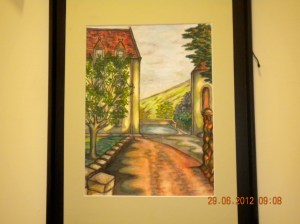
DSCN1556

ODYSSEY by Iain Matheson

She comes to a standstill at the corner of Hill Street. The bus had been prompt, she had been late. By the timetable there’s not another due for half-an-hour – too long to wait when she has just this one day to see the Edinburgh sights. She wants to walk but doesn’t know the way. She picks a boy to ask but he’s already gone, poking furiously at a screen in his hand. An old man passes, bent double, his life’s belongings in a dozen plastic bags, his momentum unstoppable. She flags down another man carrying a banjo.

‘Excuse me please, I’m looking for Blackford Hill, do you know if I can walk there?’

Banjoman stops, stares into space. Finally his eyes close; his head makes a slow rotation, once to the left, once to the right, back to the centre. His eyes reopen and meet hers.

‘No such place.’

Banjoman’s voice resonates as from the foot of a mineshaft.

‘Oh dear, are you quite sure? I saw it on a map and thought I’d like to go there.’

‘Tourist maps. This is the only map you need.’

Banjoman props his instrument against the marbled wall at the corner of Hill Street and unbuckles a rucksack. He labours inside for almost a minute till he produces a coloured, crumpled sheet. He stretches it loudly between his hands to flatten it, then beckons her. At the top, florid green letters declare,’The Southside’. She looks for a moment and says,

‘Yes, I’ve visited some of these places today, McEwan Hall… and the birthplace

of Harry Potter. Now, if you could show me which road to take for Blackford Hill…’

‘No such place.’

Banjoman’s phrase, repeated, combines fate and triumph. He points to the map.

‘That’s all the places there are. It’s a map of the world.’

She looks at him, bewildered, she says, Sorry? although she knows she has heard correctly. A map of the whole world.

‘But what about the castle?’ Once more the slowly shaken head.

‘Or Princes Street – I’ve been there!’ A raised eyebrow joins in the motion.

‘What about the roads at the edge of this map – they can’t just stop?’

Banjoman’s head changes tack; now it nods, the same, slow, reptile’s move, once up, once down.

‘But what happens when people leave The Southside?’

‘They don’t leave.’

‘And how do other people get here?’

‘There’s no other people.’

‘What about travelling to work, going on holiday, buses – where do the buses go?’

‘All in people’s heads.’ The nodding head now comes with a smile, lips closed.

‘So – so there’s really nowhere else? Just  – The Southside?’

Banjoman becomes animated, he raises an eyebrow and smiles and nods, all at once.

‘This is quite a shock. Do you think I could keep this map please?’

‘Take it, take it, I’ve plenty more.’

Banjoman nods twice to settle the matter. He struggles back into his rucksack, picks up his banjo and rejoins the flow of Southsiders on Nicolson Street. She stares at the map in her hands, appalled and secretly thrilled. Bowmont Place, Bernard Terrace, Middle Meadow Walk… singing inside she sets off to explore, the whole world at her feet.

*       *        *       *      *     *     *

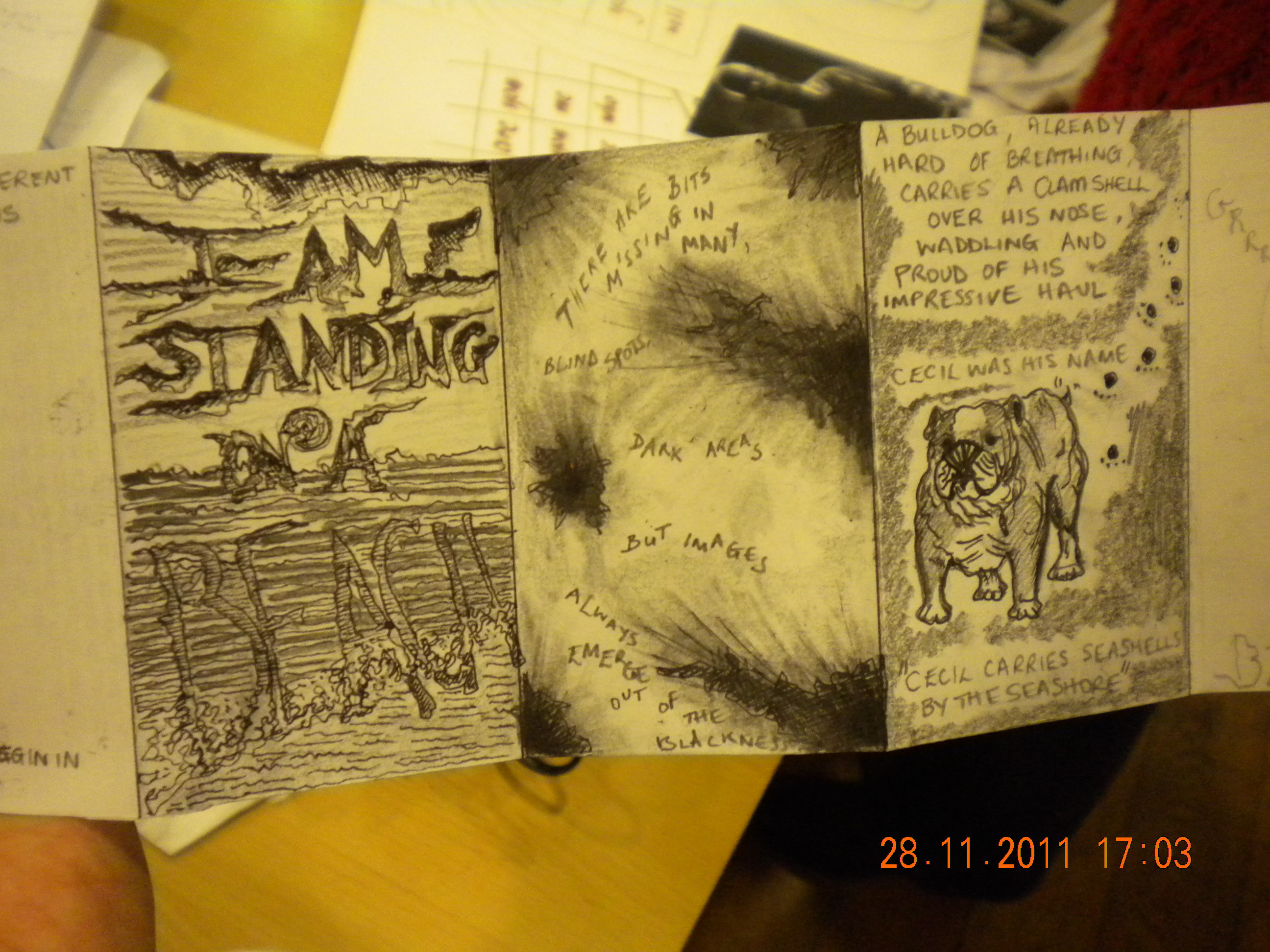
As usual there were many creative writing activities at National Galleries Scotland. Shortly after the re-opening of the splendid Portrait Gallery I ran a five-week creative writing course on portraiture and character, which was repeated in the autumn.  In August cartoonist Malcy Duff and I collaborated for the third time on Text & Image, a course that looks at the history of combining words and pictures, then introduces practical exercises on interpreting writing as drawing and drawing as writing; illustrating writing and captioning images, and presenting text as image. Experimentation is encouraged, and we also include some sound poetry, creative reading and performance.
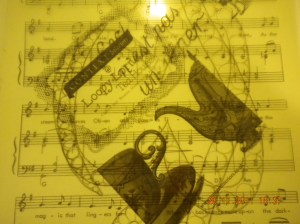
DSCN1425DSCN1429DSCN1433

This time we were based out at the modern art galleries for two full days, and able to use the wonderful resources of their archive, including artist’s books by key figures of twentieth-century art, as well as the temporary Picasso and Modern British Art and Munch exhibitions.

It is always a delight to work with Words on Canvas, a group of very talented writers that meet fortnightly at the Galleries. This year some of us also participated in a collaboration between poets and craft makers on an exhibition for the Pittenweem Festival, Fife.

In August Southsiders and WoCers  joined to give a well-received reading at the Captain’s Bar, as part of the Edinburgh Festival Fringe.

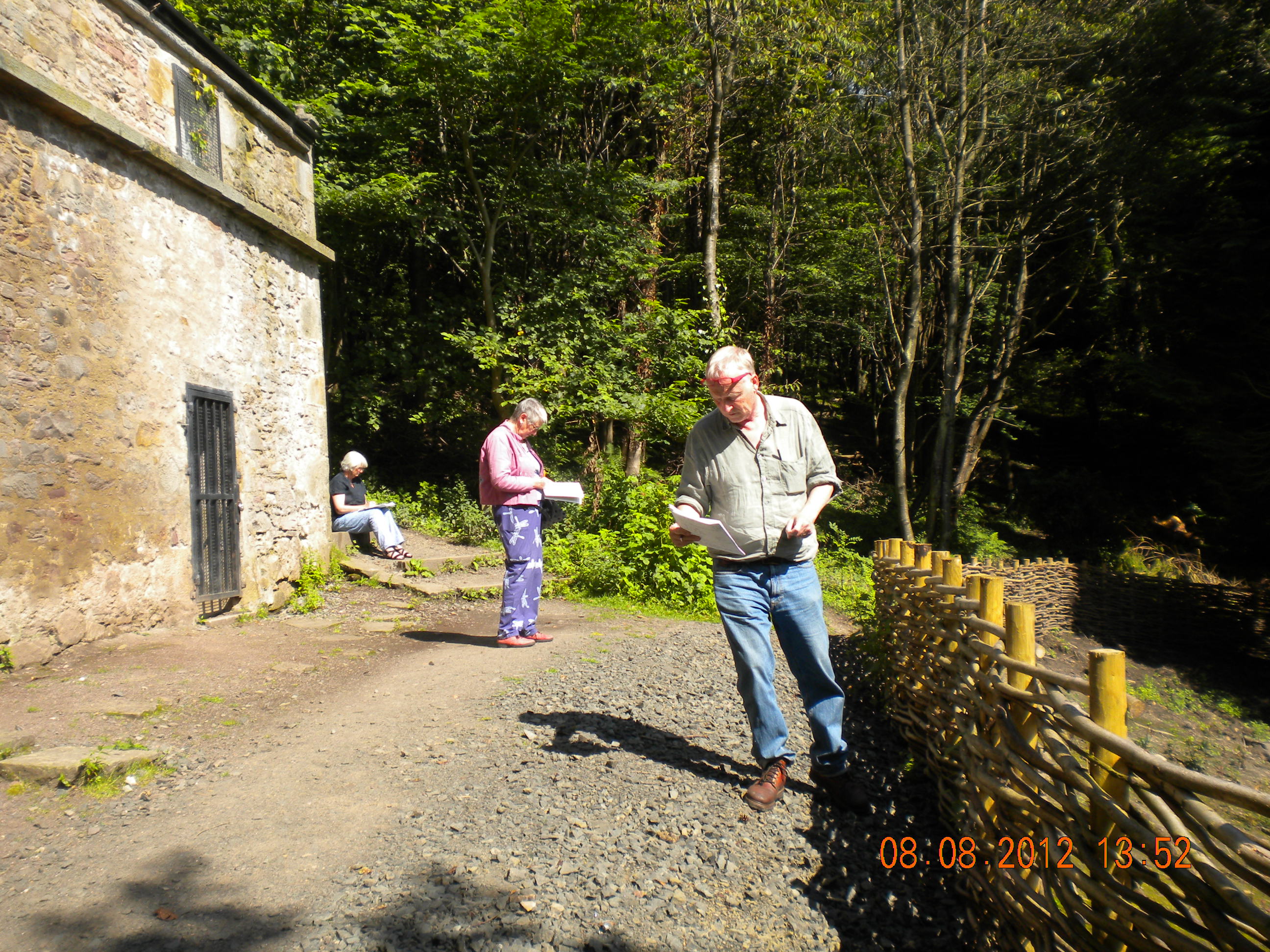
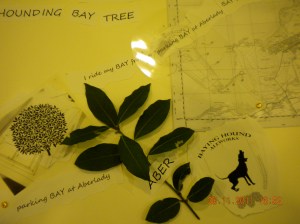
In the summer I was invited to lead a series of four monthly workshops at the Hermitage of Braid, to produce textual art for its newly-reclaimed walled garden. Given the sort of summer we had, or rather didn’t have, we were incredibly lucky to be able to work outside on all four occasions, three of them in pretty good weather.

DSCN1587DSCN1589

Juliet Wilson, who blogs as Crafty Green Poet, wrote a haiku which can be read by clicking the link.


BRAIDBURN SYMPHONY by Olga Wojtas

I take my seat and listen

To my left, the bass throb of the waterfall

To my right, the soft rippling through rocks

Stereophonic streaming

The pizzicato of jogging shoes

A scherzo of children’s giggles

The faintest fluttering of leaves

A yap

A yap

A yap

Fortissimo barking

Chorus of apologies

The faintest fluttering of leaves

The bass throb of the waterfall

The soft rippling through rocks

I wrote the following poem to mark the occasion.

Braid

On the Occasion of the Writing Workshops for the Walled Garden, Summer 2012

June’s birdsong is all but washed away
by the shout of the Braid in July
in a hurry through the Hermitage today
on its course along the lower side of the garden wall
to the shore of a firth making scarce more noise.
Out in the North Sea it mingles  via the Humber
with the waters of  Spen and Calder which  return
to the burn that stitches the Pentlands to Portobello.

This is not the Water of Leith but of remembrance.
Above it all this sort-of summer sits a new Parnassus
on  the top-most terrace  where we are  inspired
by  coast-bound stream and   breeze along the Braid,
whose water, like the brook Derwent at the bottom
of  Wordsworth’s childhood garden, is ‘boxed’  but not here
‘stripped of his voice’, two centuries and thirty  steps  below
along the  southern edge of  an Edinburgh plot.

And if like that, could this not also be
the forest pool by which a goddess bathed
as a bewildered hunter chanced upon her and gawped;
or the bank where a visitor from across the Pond
planted lily of the valley with her betrothed
in memory of their first meeting here;
and  a perpetual memorial to the  woman  who tried
to rescue her dog in a spate like this and was drowned?

The rest of the work produced is available to read in a folder at the Hermitage Visitor Centre, and some of it will find a permanent home in the garden, alongside sculpture and other artworks.

I always enjoy participating in others’ workshops. In March I joined a session led by Ken Cockburn to mark World Heritage Day. To tie in with this year’s theme, the Roman legacy in Scotland, Ken devised a series of writing walks on the seven hills of Edinburgh. I went on the one on Salisbury Crags. Ken’s account, and poems by myself and other participants,  can be read here.

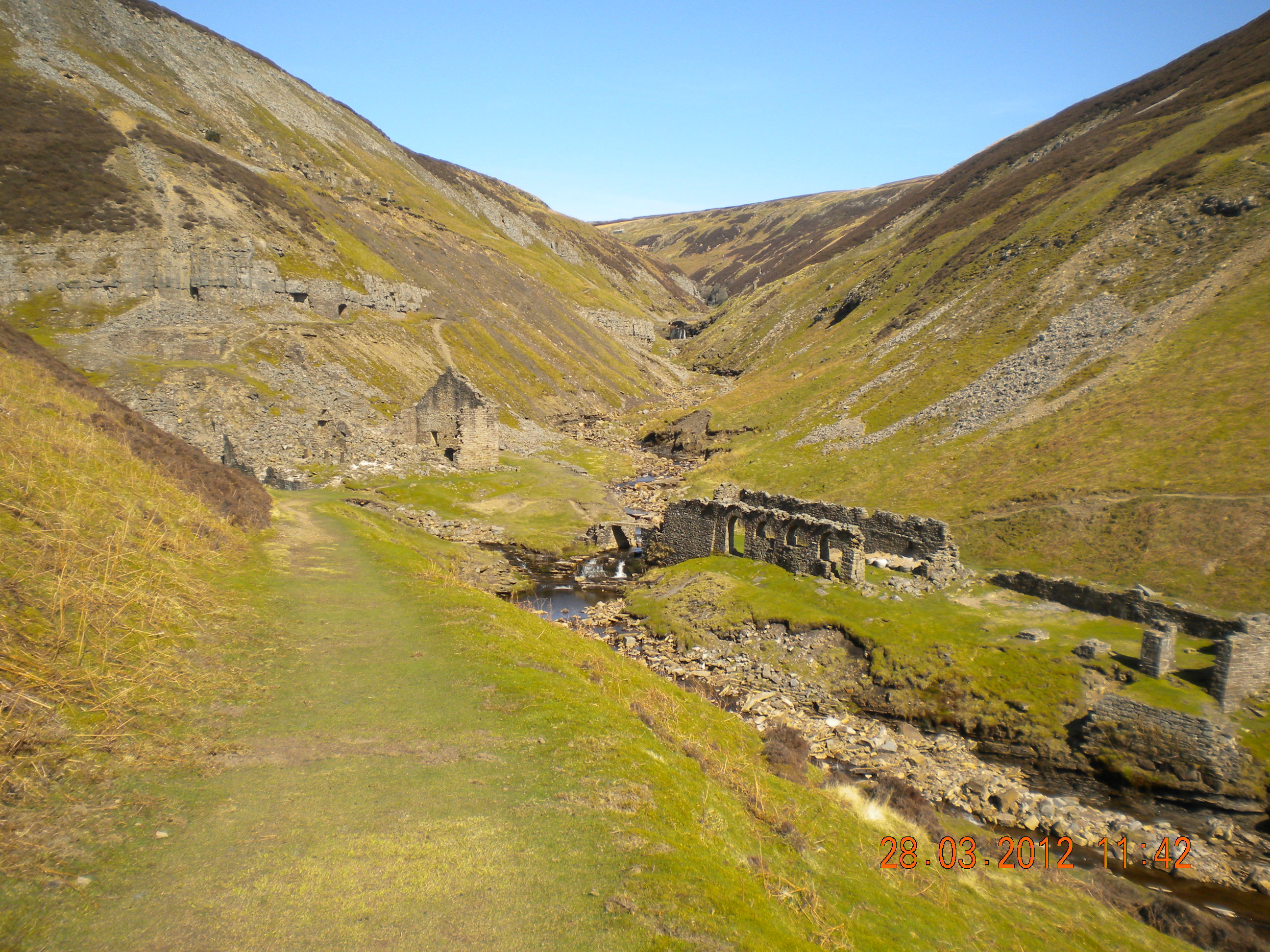
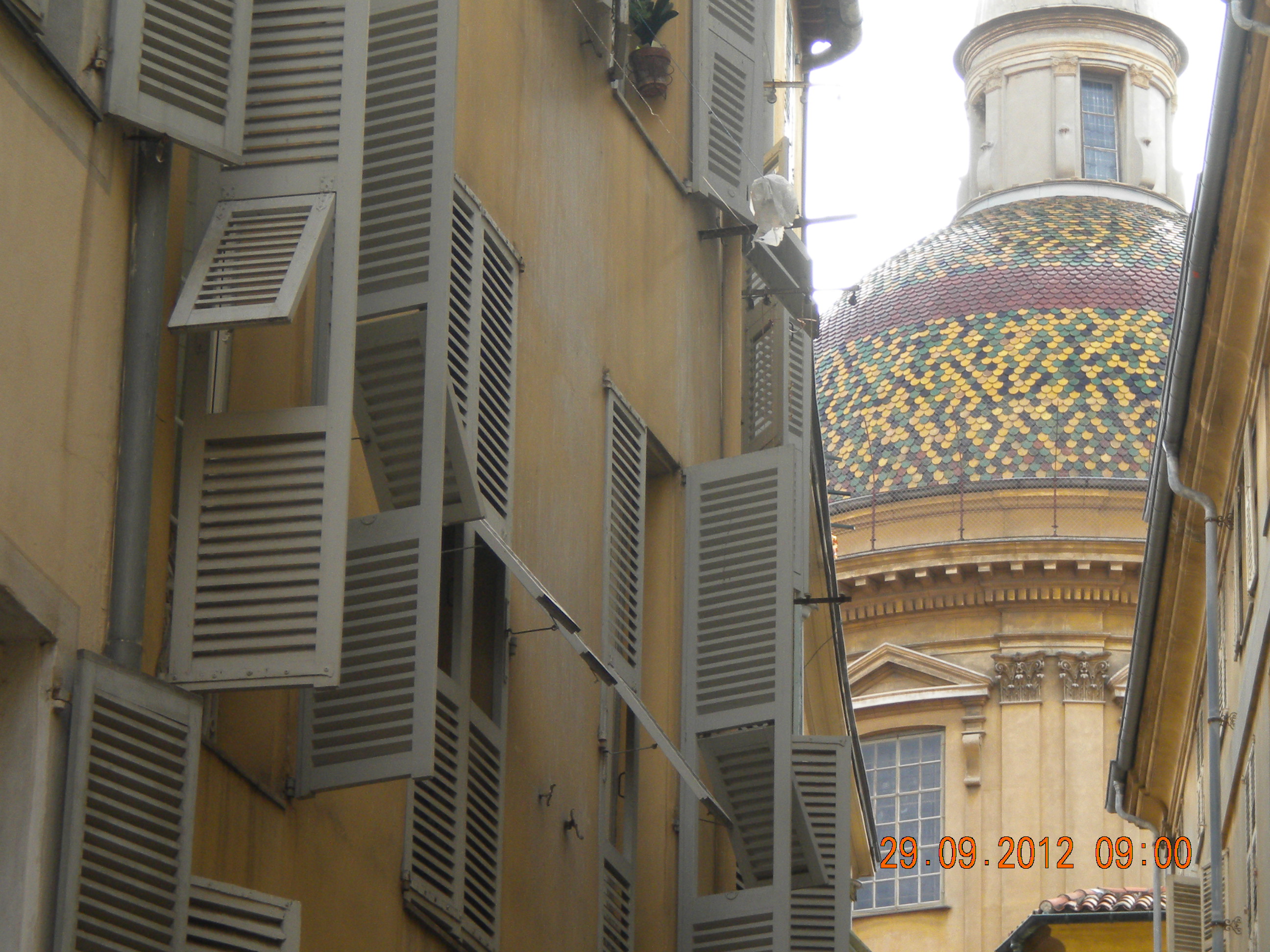
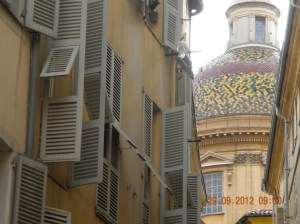
Elsewhere in 2012, I had wonderful holidays walking and writing in Swaledale, Yorkshire; and sea-bathing and eating in the south of France.

DSCN1512

Scar

On the slant of Kisdon Hill
the song of a robin sears the whole air
substantial as the drystone walls
that   brand the fields of Thwaite austere
and  project their shadow on the meadow
– here  angular, rectilinear, there
in  a random,  crazed geometry –
while underground levels invisibly divide
the land’s inside into seams and veins
directed at the artery
of this damaged country.

Yet along the inroads to the moor
stones from smelt-mill and lead-mine
crumble and return to screes
on the sides of  Surrender’s* shallow valley
and in  the steep ravine of Gunnerside Ghyll
where land formed from human hand
and the structures carved by nature
resolve in mutual cohabitation.

* The Surrender Mining Company is one of several that operated commercially  in Swaledale in the eighteenth century. ‘Surrender’ is also a legal term internationally associated with the handing over of mining rights and land.
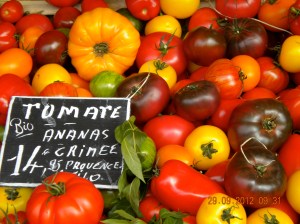
DSCN1632
DSCN1630

The former trip took place in the mini-heatwave at the end of March and the latter in the season of Alpine storms. In between the two, I watched more sport on TV than I ever thought imaginable. It started with the Tour de France, which I discovered on ITV 4 for the first time. Cycling + scenery = my kind of sport. Catching the mountain stages live in the afternoons was what I imagine playing a video game is like. Vicarious thrills, vicarious holiday, vicarious summer. The Tour was, of course, followed by the Olympics and Paralympics.  I overcame my initial cynicism to treasure the winning smiles of Nicola Adams, the first woman to win an Olympic medal for boxing; Katherine Grainger,  the rower who finally took gold after three games’ worth  of silver, and Adam Hills on Channel 4’s The Last Leg. The night after it was all over, Will Self, interviewed by Jeremy Paxman, remained unconverted: ‘the Selfs are not welcome at the court of King Coe’. Airing that, then, was maybe an editorial misjudgment on the part of Newsnight.

On t’medals table
if Yorkshire wer a country
it’d ‘a come twelfth.

midwinters

DSCN1729

each December day
the sun describes a low arc
over Capelaw Hill

Well, at least it did at the beginning of the month. For much of December 2012  lack of light made living in Edinburgh seem like living in an episode of The Killing. This is my third winter on this edge of town. For the previous nine years I lived in a fourth-floor flat with a view to Arthur’s Seat and Salisbury Crags. There were many times when it was tempting just to sit and gaze out of the window, and some times of year when it became a ritual simply to do so: on midsummer evenings when light lingered long; and especially in December, when the sun would rise between Arthur’s Seat and the Crags, over whose flank it would describe a low arc before setting behind one of the spires of the South Side – where  I stayed for the  six years before that.

I was born in midwinter, on St Lucy‘s Day, the shortest day in Scandinavian tradition and some calculations of the Julian calendar,  when, according to John Donne, ‘the world’s whole sap is sunk’. A more optimistic take is offered by  George Mackay Brown’s poem ‘Seven Stars for Lucy’, in Voyages (1983). Peter Maxwell Davies’s ‘Lullabye for Lucy’,  a setting of another text by Mackay Brown, celebrates the birth of the first child in thirty-two years in the depopulating valley of Rackwick on  Hoy, Orkney, where Max had made his home. With its reference to plants, lambs and ‘the brimming / Dance of the valley’, the imagery of the poem is more vernal than hibernal, but it’s a grand song to set you up for going out to mark the passing of another year.

According to family lore,  snowflakes fell on my face when I was first brought home from hospital early in the new year.  I have a vague memory of the existence of  a photograph posed just before I was swaddled into the back of my dad’s car, but maybe that’s just a picture I invented to accompany the story.  I was a winter child, and adolescent, and young adult; I adored the pale clarity of the northern winter light, and I never felt the cold. When I studied in Newcastle in the eighties, I did wear a coat  for an evening out, counter to local tradition, and occasionally felt a bit chilly in the flat when we couldn’t afford to turn the heating on, but I rarely complained. On the other hand, I had very poor tolerance of heat. In summer I lurked in the shade, a Niles Crane of a thing in high-factor sunblock and UV-protective clothing. Until I had a course of acupuncture and went into reverse. I discovered sunbathing, and just how bloody cold the east coast of Scotland can be in the winter. In the last decade, I seem to have achieved more of an equilibrium. All seasons, and the changes between them, are now sweet to me. It’s now January 2013, and, temporarily and thermally at least, what TS Eliot called ‘midwinter spring’. In my wee garden on the fringe of the city with a view to the Pentland Hills,  I’m well placed to partake of seasonal shifts and observe and write about their reversals and vagaries. I grew up in a location that could similarly be described as both suburban and semi-rural; it suited me, and I’ve come full circle again.