GENERATION and regeneration

I spent a lot of time this summer and autumn at the GENERATION exhibitions celebrating art made in Scotland over the last 25 years. Sometimes I was working, as a freelancer in the NGS education department, sometimes working on my own material, and others being a tourist at other exhibitions in the series around the country.

In the RSA building on the Mound in Edinburgh there were seven rooms devoted to the work of seven different artists. To my own surprise, my personal favourite grew to be Martin Boyce’s installation of a park at dusk. This comprised skeletal steel benches, bed-frames and off-kilter bins in primary colours, was divided into sections by black mesh fences placed at oblique angles, and lit by fluorescent tubes representing trees. Originally designed for Glasgow’s Tramway, a larger, more industrial space than this, the biggest room in Robert Playfair’s RSA building, it appeared to be (re)creating a sense of urban decay and fostering a feeling of menace. I’d ask my tour groups how optiimistic it made them feel on  a scale of 1-10; most responses were between 3 and 5. The work’s apparently incongruous title,  Our Love is like the Flowers, the Rain, the Sea and the Hours is the chorus of the song ‘The Village’ in  New Order’s 1983 album  Power, Corruption & Lies.

Music, it strikes me,  is possibly more ‘generational’ than any other artform. Members of my tour groups tended to be either too young or too old to know  much about the post-punk and ‘industrial’ sounds, often emanating from Manchester, that became the soundtrack to the lives of students in another post-industrial city.  Boyce and a number of other artists in the exhibition studied on the Environmental Art course set up at Glasgow School of Art in the 80s. The course is credited, in the Generation Reader, a collection of essays published to  accompany the exhibition catalogue, and in a BBC documentary made about the exhibition, with being responsible for  the artist-led energy that produced such a diverse body of work during this time. Both stress how great emphasis was placed on socialising. I wondered what happened if you were an introvert with different tastes in music – what happened to the artist as outsider? – but maybe you just (just!) studied painting.

Anyway, after three months I’d settled on the Boyce room as the one most conducive to writing, low light levels notwithstanding, and I started to find it uplifting. At twenty-minute intervals, a  plangent soundtrack, specially composed for the installation, played as text slowly formed, then dissolved, on one of the walls. It was hard to read – Boyce devises his own fonts to blur the boundary between text and image – but seemed to say this place is dreaming. For a time I thought it read ‘this place is breathing’.

It occurs to me now that Boyce’s text could also be a reference to the phrase terribilis ist locus iste.  Originally from the Vulgate version of Genesis 28.17, and most often found inscribed on door lintels,  this was Jacob’s response to his vision of a ladder leading to heaven. Terribilis has been variously translated as ‘dreadful’ (King James) and ‘fearsome’ (New English); it means ‘awesome’ in the sense of sublime, terror-inducing.

This place is not terrible to me. I have partly measured out my adult life in the exhibitions I’ve seen in these rooms; sought them – and found comfort – in times of distress, shared memorable afternoons in them with friends, and been privileged to work in them.  This year, Boyce’s soundtrack and text and manufactured gloaming worked against the urban harshness of his physical materials in a way that allowed memories and imaginings to float free. This place was breathing and dreaming because it was immersive, real and unreal simultaneously, a creative and potential space. Also . . .  the portable gallery seats unintentionally referenced the steel and chain-link of the fencing and bed-frame components of the installation and, with a person seated on them,  became a temporary part of it. (These paragraphs are in the past tense because the exhibition closed on 2 November. Our Love was de-installed and returned to homes in various collections, including Tate.)

The open thresholds between the rooms gave sight-lines to works by other artists. From Our Love you could glimpse the gorgeous purples of Callum Innes‘ Exposed Painting series, or the black and white palate of a space made over to woodcut prints and ceramic works by David Shrigley that  playfully questioned the limits of black-and-white thinking. I’ve written in the company of Innes’ slow-burning paintings before, and it’s easy to find in them a meditative quality. More surprising was the  effect of sitting amidst Shrigley’s army (or pantomime cast?) of torso-less boots on plinths – boots that we are figuratively invited to fill, and that Shrigley will fill when his work is sited on the Fourth Plinth in Trafalgar Square in 2016.

Over at the Portrait Gallery, Luke Fowler‘s 61- minute film The Poor Stockinger, the Luddite Cropper and the Deluded Followers of Joanna Southcott loosens the memory in a manner different to Boyce’s parkscape. Shot in 21st Century West Yorkshire, it features footage from the 1950s of Marxist historian E P Thompson, and an original soundtrack which includes a setting of Blake’s ‘London’. A voiceover (sterner in tone than that of the charismatic Thompson himself) reads from Thompson’s reports on the WEA classes in Social History and Literature in eleven West Riding towns. As well as a portrait of a man, he’s created on 16mm film a narrative of a place where industrial and rural landscapes are held in balance. Fowler’s image-assemblage maybe even works a bit like memory itself. He shows where habitation has spilled up hillsides, like a reverse landslide.  A lorry passes between gritstone walls at the pace of a horse and cart as smoke from a chimney in a field merges with cloud. Skies are punctuated with pylons and factory chimneys that look like Venetian campaniles.  Fields, olive from their gritstone underlay, are overlaid with snow. At night the moving lights of cars weave amongst the still ones from buildings, creating illuminated  townscapes where neon, sodium, street, factory and domestic lighting co-exist in a painterly fashion.  The time it takes a car to pass across the frame seems longer than if you were standing on the pavement yourself. Fowler cuts from the shot of a  factory, chimney and tower block warmed by a sunlight that makes of them a Mediterranean composition, to a close-up of the chimney’s top showing, not a cloud-capped tower, but one crowned with scaffolding. He revisits a frame from earlier in the film, but now the soundtrack has moved on.  And he dwells, too, on the details: the interiors of educational institutions, from stained-glass crests in windows opening onto more West Riding masonry, in both its hewn and unhewn states, to corridors and functional seating. (This paragraph is in the present tense because the film exists even when it isn’t being watched.)

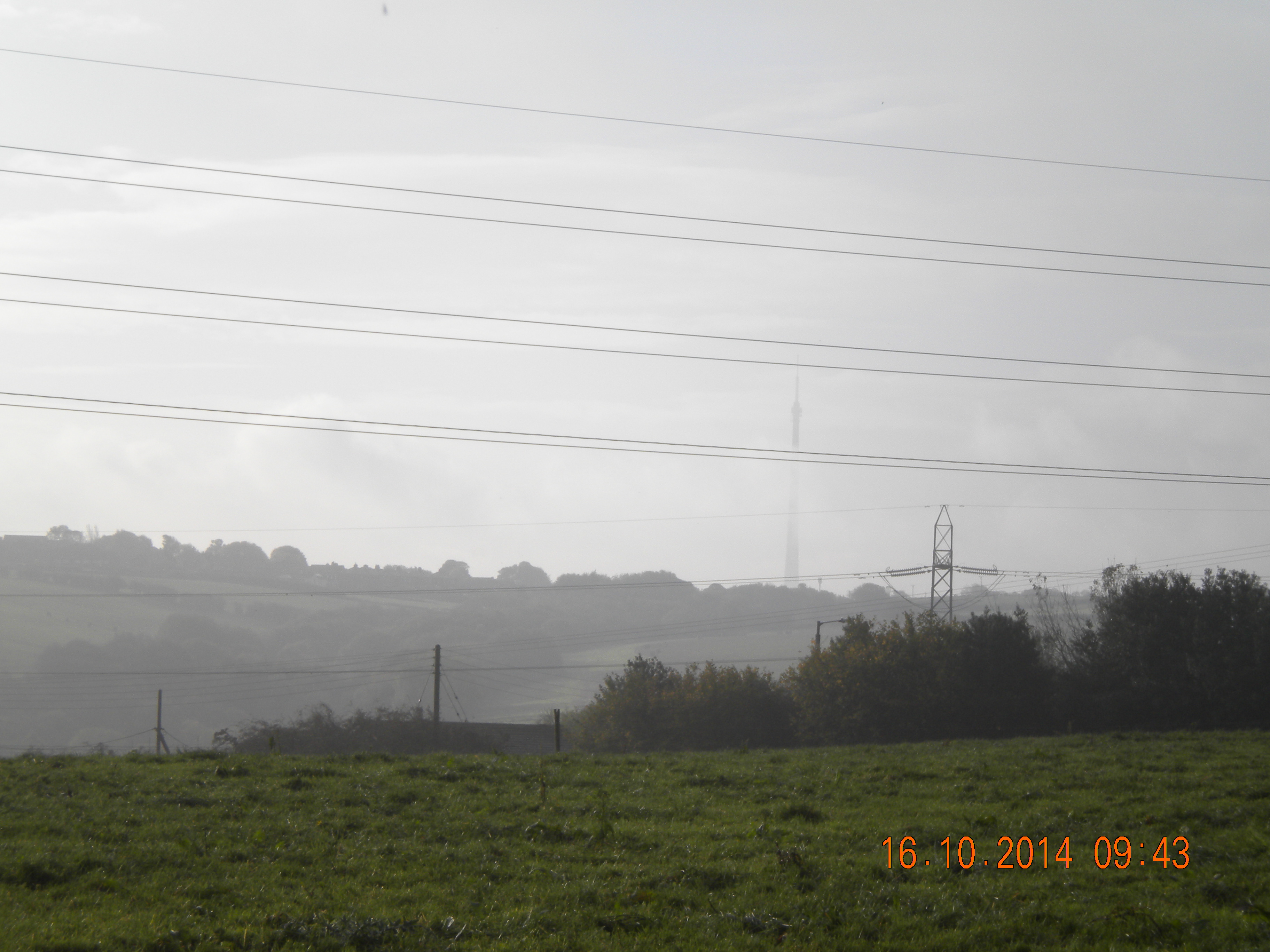
I had a four-day interlude in the West Riding myself at half term. I visited the Hepworth Wakefield for the first time and Yorkshire Sculpture Park for the umpteenth, but  it retains its power to seep onto my soul. One of the other reasons for my visit was to look at and try to write about the horizon – the elongated concave  profile of Saddleworth Moor, the skyline as seen from the Calder valley. I was prevented from achieving this by a mist which pressed down into the valley, amplifying the hoot of the Transpennine train, and on the upland spur where I was staying accentuating underfoot textures – flag, cobble, pebble, brick, grit, leaf, mud – on by-ways with names like Beaumont’s Bolt and Pudding Lane. It insinuated itself round the midriff of Emley Moor television mast, and chilled through several layers of clothing in the  mornings, as I stood at an exposed hilltop bus stop where a big vista of high moor and industrial valley appears in clear weather. By midday sun had squeezed enough heat through the mist and onto the land for lunch to be taken outdoors at a village pub. It obfuscated plans, but it assisted memory – being up here on winter nights, high above the conurbation lights – and enabled the creation of new narratives, such as the fit between Luke Fowler’s vision of the location and my own experience if it.
DSCN1929

DSCN1939DSCN1938

During this period the wonderful Scottish Mental Health Arts and Film Festival  was running, this year with the theme ‘The Power to Communicate’. South Side Writers generated the text for a great wee exhibition at the Southside Centre. I attended a screening of Regeneration at Craiglockhart campus, formerly the war hospital where Wilfred Owen met Siegfried Sassoon. Sassoon, who acted as poetic mentor to the younger Owen, was treated by the psychiatrist WHR Rivers, pioneer of psychotherapeutic methods used with ptsd today, and surely one of the great heroes of WW1. Rivers also worked on the regeneration of damaged nerve tissue. In the film of Pat Barker’s novel, adapted to give more of a  narrative arc (I don’t recall having any problem with the book’s narrative geometry), he is shown to experience secondary trauma. In the novels, if my memory is accurate, his own neuroses are attributed to his experiences working as an anthropologist in Melanesia in the Pacific, and a relatively minor childhood worry – one doesn’t need to have been to war to be beset by hard to-shift-demons. If one has been to war. . . well, thank the goodness that remains for Rivers and his legacy.

Afterwards there was a panel discussion involving the screen writer Allan Scott, an Afghanistan veteran and two psychotherapists from the Rivers Centre for traumatic stress at the Royal Edinburgh Hospital – where, in addition to medication and talking therapies, it seems they offer art therapy but not creative writing. Of course, there are many situations where the non-linguistic nature of art, or music, is what is needed –  but wouldn’t it be a highly appropriate tribute to Rivers and his most famous patient if, as more research is conducted into the efficacy of the ‘writing cure’, this were to be adopted in the clinic named for him?

Pat Barker, unable to attend, sent a generous message, which included a phrase that went something like: ‘while you work on the material, the material works on you’. This is an excellent encapsulation of the therapeutic benefits of creative writing. To put it another way: you generate the material; it regenerates you.
the play of work and other optical illusions

I’ve had a week off – no teaching, client work or meetings. Instead I took day trips to look at art outwith Edinburgh, for once without the agenda of preparing a workshop or a poem. I returned home in the evenings to watch highlights of the Vuelta a Espana and Tour of Britain. In the land of TV cycle touring, I’ve noticed, ‘podium’ is a verb and ‘abandon’ a noun. I wish I could say I’ve also had a week off from the Referendum coverage, but it’s too close (to polling day; to call), and too important to ignore. I had to turn the volume off during an exchange between Dennis Canavan and someone else on Reporting Scotland the other night. Of course I understand that with the stakes so high, and the subject so inflammatory,  interested parties will overheat. But as a voter and citizen, I’m just glad to be living in a fairly peaceable democracy. I’m starting to feel as I do when people over-identify with a sporting team: reactively neutral. Whatever the result, good and bad things will happen  Meantime, thank heavens for the wit and sanity of Gary Imlach, the best sports journalist I’m aware of.

On tuesday I travelled to Perth to look at the Alison Watt paintings that form part of GENERATION, the Scotland-wide celebration of art made in the last 25 years. I love her paintings of fabric; her painstaking crafting in paint of its folds, falls and crumples in works with titles like ‘Shift’, ‘Hood’  and ‘Tuck’. The Perth show is a mini-retrospective, a dozen works ranging from Watt’s self-portaits and nudes of the eighties, through the luscious work she produced after removing the model and making the figureless drapes the subject of the work, to new pieces that approach abstraction. One, Orion, completed this year, achieves the luminosity of a lit photo studio or stage set. Watt claims it alludes to Norman MacCaig’s beautiful short poem ‘Praise of a Thorn Bush’ (I couldn’t find a link, but it’s on p.319 of his Collected Poems); poetic is one of the first, and most lingering, words to spring to mind when viewing these paintings. In some of them, flesh, or plaster, are also suggested. Huge canvases absorb you as you approach them. Some seemed to draw me in towards a  vortex at their centre, where the darkest tones represent creases and folds in the mostly light/neutral/white fabrics. Once up close with the painting, our privilege is to observe the mark-making: how exactly she’s created the crack in a floorboard; shadow; toes.  I may not have been working, but I was still concentrating hard. Starting to experience sensory overload, I went out for a walk.

Beyond the North Inch parkland, a mile or so up the Tay, beyond the grand houses with lawns that terrace down towards the river, there’s a place where the current runs fast. On the far bank – the right bank, the east side, the Scone side –  is a shepherd’s hut kind of structure, quite camouflaged amongst trees. A human figure was sitting on the  bench in front of it, quite camouflaged against the walls. I sat down on a public bench opposite  and watched the current play. Eventually the person rose, picked up some tackle and waded in, making an arc from a gravel bank by the shore, through the shallows, until he was waist high in the midst of the fastest current. I watched him casting his line, slowly against the rapids, for maybe half an hour. When I returned my gaze to the bank, the verge in front of me was rotating, steadily, clockwise. My brain had however cleared enough to return to the gallery, and I walked back downstream.

Reflected in the seemingly static Tay, the arches of Perth Bridge completed into perfect circles, like portals to an otherworld.You could not help but imagine passing right through their centre. The trees on the banks also found their counterparts, sharp and solid below the water surface. Watt’s paintings were wonderful, and so was the scene outside the gallery. Attributing this to atmospheric conditions rather than any portent, or  illusion, of what the nation might become, I returned to the capital, from where I could cycle to a sunny Portobello beach on Wednesday, and on Thursday go to Jupiter Artland in the haar.

I grew up with the big Hepworths and Moores in the big landscapes of the Yorkshire Sculpture Park; this is maybe more akin to Ian Hamilton Finlay’s Little Sparta at the other end of the Pentland Hills, but differently ludic to his self-styled ‘republic’. You have to seek out some of the works more subtly embedded in their wooded context.  Jupiter generously afforded opportunity for another day’s play with reality and illusion, amongst Charles Jenck’s landforms, and structures built by Andy Goldsworthy: a hut floored only with unfinished rough-hewn bedrock; an unlit interior densely furnished with  floor-to-ceiling tree trunks. Boulders from the same source as the hut – the ditch spanned with a stone arch by Hamilton Finlay, and tagged ‘only connect’ –  nestled like erratic tree-houses inside coppiced branches inside the woodland. Be wildered.

the power to communicate

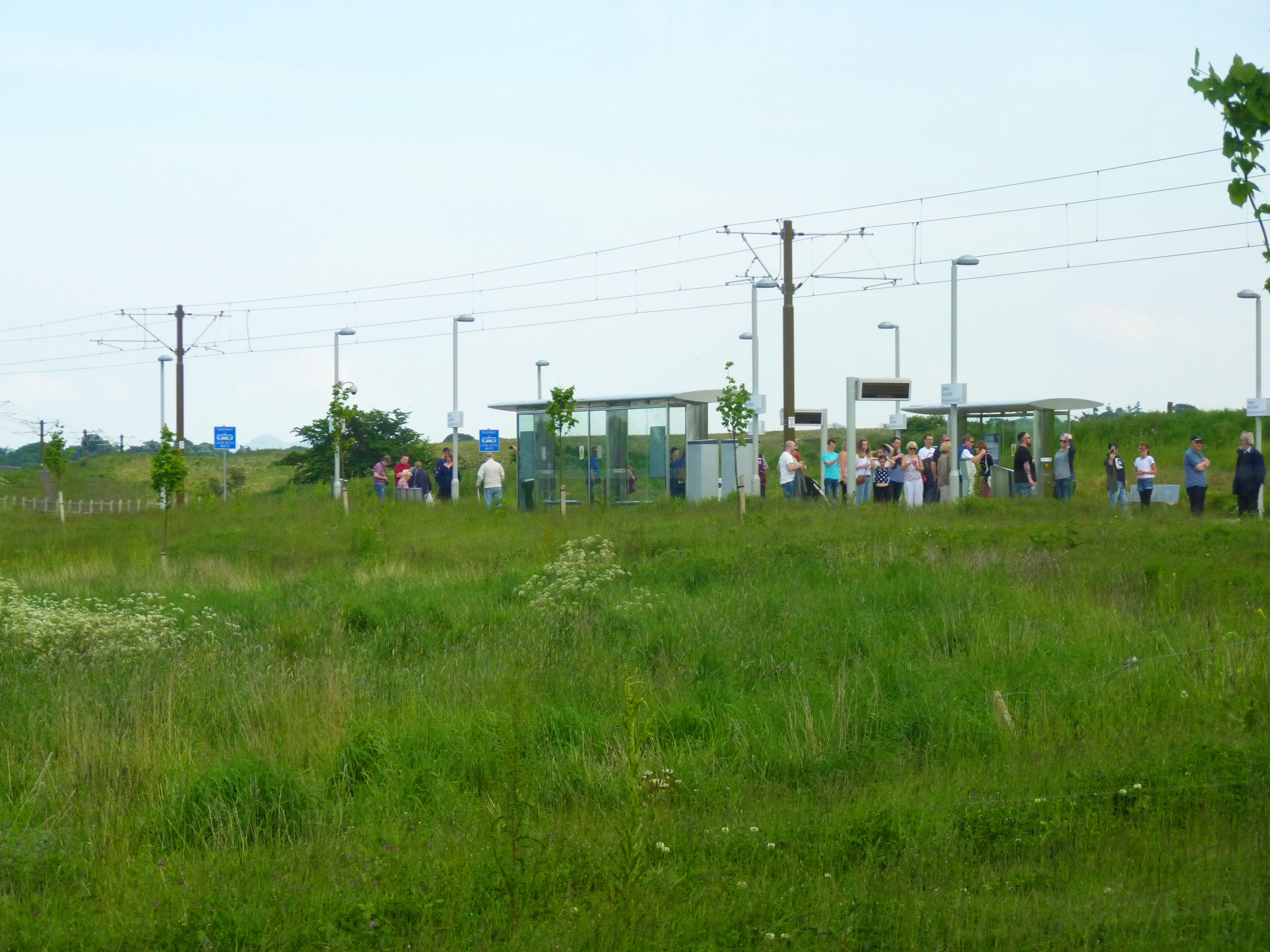
I’ve lost my voice. I think I contracted something on an Edinburgh tram. I caught one one along Princes St on their first day of public service, en route to the Three Harbours Festival in East Lothian. There was a continental, party atmosphere in central Edinburgh. The sun was shining, staff were aplenty and smiling  and there was no mention of delays and budgets, though one of the tracker announcements was playing up, and the number of minutes to the promised arrival of the next westbound tram kept increasing rather than decreasing. A tannoy announcement  exhorted people to take selfies (I never thought I’d use that word) and send them to Transport for Edinburgh. I don’t even have a smart phone, and hadn’t thought to bring a camera. My friend Rosie and I went on to have a grand day out by the sea, wandering around the open studios, and enjoying some excellent fish and chips. I regretted not packing the camera: Cockenzie looked continental too, and next time the weather’s that good, the twin chimneys of the power station that overlooks the port may have been demolished. On the way back we’d had enough of the 26 bus by York Place, alighted and hopped onto a second tram. This is where I suspect I was infected. It was like rush hour on the London Underground, and it was with relief that I fought my way off at Haymarket. My camera had stayed at home, but Olga Wojtas, a fine writer, was out and about with hers. I was particularly amused by this shot of Ingliston Park & Ride.

2014 05 31_5036_Ingliston park and ride stop

Enough to give you hayfever. From which I was suffering anyway, before the onset of summer cold. After a week of attempting to clear nasal and cerebral congestion with some vigorous coughing and nose-blowing, I strained my vocal chords. I didn’t know you could do that. As a year-round allergy sufferer, I’m always attempting to un-block congestion by these means. The doc advised me to shut up for a week. Luckily I’m not a singer, actor or motivational speaker, and voluntarily keeping schtum (partly voluntarily: I can only whisper and croak) is actually quite liberating – as I remember from a couple of bouts of laryngitis when younger.

Ironically enough, this term’s theme at South Side Writers is ‘The Power to Communicate’. We’re contributing text for an exhibition of digital art at the Scottish Mental Health Arts and Film Festival in October, and taking the opportunity to address the topic as widely as possible while we’re at it. You could say that promoting the power to communicate is what a writing group does by default, but once you start tackling the issue deliberately, the questions raised are many and fascinating. When you move beyond famously power-laden discourses like law and medicine, themselves very fertile areas for creative writers, you can begin to consider the fictive or poetic potential of kids passing notes in class, or dedicatory quotations in gifted books. And I think it’s always useful for writers, whatever their level of experience, to examine and maybe re-evaluate how they communicate to their readership.

I shan’t be communicating via the spoken word this Friday. I can, however, nod, smile, wave, print out a handout and write illegibly on a flip chart. Were the theme something other than ‘the power to communicate’, I’d probably cancel the class, but under these circumstances I think it will be fun just to give it a go and see what happens.


Inspired? 2006-14

Last Thursday the presentations and public readings for the 2014 Inspired? Get Writing! competition, organised by National Galleries Scotland, the English Speaking Union and Scottish Poetry Library, took place at the National Gallery. Primary school winners in the morning, secondary afternoon, adults evening. The winning entries, up to ten in each category, are read by Suzanne Ensom, Lorna Irvine and John Duncan, with the artworks that inspired them shown on the big screen in the NG lecture theatre. This was the final time the competition would be run in its present format, and I went along for the whole day for the first time. It’s like a long theatre event: dramatic tension rises then relaxes, while  momentum builds over the course of the day. The audience bonds during intervals, and feels it has achieved something worthwhile by the end.

In his introduction, Scottish National Gallery Director Michael  Clarke said that reading the creative writing enabled those whose business is visual art to gain new insights about and perspectives on works with which they were familiar. I found it a joyous way too of re-considering the whole business of ekphrasis, or writing about art. And of discovering works in the NGS collection with which I’m unfamiliar. For there were no skating ministers this year (though previous ones have indeed afforded new insights into activities on Duddingston Loch in 1795). In addition to a pair of Titian Venuses and a shoal of Bellanys there  were also two works by Scottish photographer David Williams in the line-up: dancer Michael Clark and fiddler Aly Bain. The blurry-blue print of Bain appears on the cover of his 1992 CD Lonely Bird. I have a copy of this, and had no idea the original photograph was in the NGS. It was mesmerising to listen to the synaesthetic poem about it by a Primary schoolgirl. I was sitting next to a member of the NGS writing group, Words on Canvas. She said to me afterwards that she could swear she had seen Bain’s knee moving.

Another Primary winner wrote a poem called ‘Untitled’ about a Jackson Pollock painting called Untitled, the doubled untitling allowing an unfettered imagination to be caught without compromise in  accomplished form.

In the afternoon, the adolescents were predictably preoccupied with darker matters – to the extent that reader Lorna Irvine asked us to note how there appeared to be a collective trepidation about entering full adulthood. Or at least there was on the part of the narrators; as one of my WoC companions pointed out, the teenagers themselves seemed cheery and charming – on the surface at least. What interested me even more was that this age group was now regularly availing itself of the full 1,000 words permitted, something which, given some of the subject matter – racism, violence, loneliness – made things rather harder for the the listener. But I wanted to celebrate the fact that there were exploring their subjects at length and in depth. With further maturity will come the ability to modulate, to cut down, to realise when less is more. Some of them may learn to write humour well.  Two wrote about video works,  presented as stills on the lecture theatre screen, Bill Viola’s Catherine’s Room, and Dalziel + Scullion’s  Water Falls Down.  I’d like to see more creative textual explorations of film; both are narrative devices. Not much poetry in this category (let’s hear a 1,000 word lyric poem!); possibly this age group responds more to the genre in its spoken word or rap incarnations – though there’s absolutely no reason why visual art in museums shouldn’t inspire these too.  By now I needed cake, and adjourned to discuss proceedings so far with the enthralled WoC contingent over afternoon tea.

Final session. Sir James Guthrie’s kailyard scene A Hind’s Daughter was re-imagined as a Dutch landscape. We laughed at comic writing worthy of a radio or TV script. I was temporarily diverted by the idea of the gallery shop selling Gut Your Own Herring kits to accompany a John Bellany exhibition. We were directed by an omniscient narrator to the eye, then hand, of Mary, Queen of Scots, in one of several pieces which directly addressed our ways of seeing.

Members of Words on Canvas and South Side Writers have done well in this competition over the years. I entered back in 2006 and was highly commended in the then ‘published adults’ category, the first of many to write about a John Bellany painting. In the groups I provide prompts or feedback and have no say in the way the writer perceives the artwork or the accomplishment with which they respond to it textually, so I’m not trying to claim any credit here. And I have nothing to do with the running of the competition, in which entrants are anyway anonymously judged. But of course I’m pleased when writers from groups I’m involved with win prizes or get work published. Many congratulations this time to Jean Taylor and Marjorie Lofti Gill.

My recollections are very selective. I don’t think that even means I’ve always remembered the  best pieces of writing, though that will sometimes be the case. After forty-five poems and stories inspired by nearly as many images had been superbly performed by the three readers – and, in the case of the adults, some of the authors – between 10.30 am and 7.15pm, my ability to correlate author with picture was severely compromised. I  am very pleased that NGS is moving towards the digitisation of the winning entries from all nine years of the competition: this will be a valuable, and inspiring, lasting resource.

slow trains and sound bites

I went to Glasgow last Friday with the intention of working on some unfinished drafts at the Transport Museum. When I first visited last summer, the idea of having a transport theme at South Side Writers came to me whilst sunbathing on the deck between the museum and the Tall Ship. Since then we’ve used text, images and personal reminiscence featuring longships, mobility scooters, transporters, donkeys and just about every every other imaginable mode of transport to prompt explorations of character, plot, pacing, structure and sound, as well as looking closely at concepts like ‘flight’. I’d identified Zaha Hadid’s museum building as an interesting place to sit and write for an hour or two. Now it was summertime again, officially at least, and the group was on its Easter break, so I set off for the west on the slow train. This involves:  a pleasant half-hour walk to Slateford Station via the blooming gardens of Craiglockhart; avoiding congestion in  Edinburgh city centre and at Waverley Station, and a cheaper fare to Glasgow which does not carry off-peak restrictions either. The train is indeed slow,  a proper ‘stopping train’, but I like its meanderings around lesser-visited parts of the central belt, home to people I may never meet, trees and livestock.

Progress  from Central Station to  Partick was slowed further at the architecture and design centre, The Lighthouse, when I chanced across a half-hour creative writing workshop, ‘Lunchtime Bites’.   Facilitator Emily Dodd had selected a photograph from the Britain From Above exhibition, the Broxburn Oil Works. She gave us  a short introduction and set us to write for 15 minutes.  As a creative writing tutor, one  of the most satisfying aspects of an extremely satisfying job is when you hear a group’s varying responses to the same starting point, and the surprise of those who didn’t think they could do it.   Another is when you attend a workshop on your day off and get to practice  the magical process for yourself.

Some writers can produce a lot of good material in a quarter of an hour under these conditions. In recent years my personal word-processor speed has slowed – one of my best friends describes me as glacial – so I opted for a haiku . Out of the notes I’d made I linked two images –  the background slag-heap detritus of the chemical process, and the foreground canal –  in three lines. As Emily pointed out, fifteen minutes is a good time to break off anyway; when you return to your writing you’ll have an altered perspective on it.

I used my surplus material in a draft that re-worked some of Emily’s introductory material about the social and ecological environment and history. Add a bit of my own time-and-space preoccupation  and maybe or maybe not a human character, and it could become something more substantial. We were photographed and recorded  after the session. I’m here,  sounding like a northern Janet Street-Porter with a plane above my head.

Emily spoke with great enthusiasm about working with community groups who had grown up close to some of the photographed locations. Those of us present at this session hadn’t, though  I was inevitably struck by parallels with the former industrial landscapes of northern England.

After the designated half-hour I looked round the rest of the Britain from Above exhibition. It’s more accurately described as ‘oblique aerial photography’, or Britain from a bit above. This isn’t like the view from an aeroplane, unless you’re just coming in to land (at that point I have my eyes closed and I’m gripping my seat arm-rests as we dangle above some too-near coastal water). The oblique perspective affords potential for some  innovative point-of-view work – though without making much of a conscious decision I settled for being the viewer outside the frame, making references to the fact that I was viewing a photograph, not the place itself. I resolved to pedal  along the Union Canal towpath to Broxburn to have a look at the site in colour and from bicycle level this spring.

And so to my final destination of the day. I’d sort of forgotten that It wasn’t just me who was on holiday – the schools were too. It was grand to see the museum full of eager children, but useless for settling down to write. I wandered around Hyndland and Dowanhill instead, and got the slow train back in good time for the Friday night treat or torture – I’m not sure which, but I think that’s the point – that is Steve Coogan and Rob Brydon’s Trip to Itlay.

decoration and embellishment

We’ve just come to the end of another term at SouthSide Writers. This time the theme was Decoration. Staff at the South Side Centre are hoping to spruce up the building a bit, enhancing the walls with text and art. This set me thinking about decorative art in general. It tends to be regarded as the poor cousin of the Fine Art, which I, like many others, regularly use as a writing prompt. Yet Scotland has its own  great traditions of design:  Paisley, tartan, and Charles Rennie Mackintosh, as well as work derived from Celtic motifs. Every other culture has countless  riches in media including textile, ceramics, wood, metal and stone. There are many amazing examples just round the corner from Southside at the National Museum of Scotland. Why not use some of these as a basis for a set of writing classes?

What, if anything, do artistic and literary decoration have in common? Pondering this question in the first session, while Radio 3 was celebrating its Baroque Spring, the Southside consensus seemed to be: plain style  good, ornament(ation) bad. Well, long live minimalism – and I like white cubes very well – but aren’t we now in a more tolerant, multiple and eclectic aesthetic era, the nostalgia-kitsch of some product branding notwithstanding? Embellishment  of objects adds design interest in the shape of details or features, and doesn’t just foster a sense of comfort in times of austerity. Beautification doesn’t have to equate to falsification here, so why was rhetorical embellishment regarded with such suspicion? Pursuing the connection between literary and decorative arts, we pared down our attention to the line as a unit of meaning, as championed by artists Paul Klee and Richard Long, and practiced writing lines with varying numbers of syllables and stresses. Klee’s phrase ‘take a line for a walk’  is a useful starting point for the timed or ‘flow’ writing exercises often used in writing groups, this one included, even if it tends nowadays to conjure up the undesired image of a dog on a retractable lead. Long literally walked, trod, lines into the landscape; built landforms; and produced huge text panels  that ‘captioned’  his walks.

We planned an excursion to Dovecot Weaving Studios to look at some tapestries. By happy co-incidence their current exhibition was by Julie Brook. Brook had been commissioned by the Studios to make land art in Libya and Namibia, and chose to  record  her work in the medium of film. The two main rooms  contained screens showing sequences of mesmerising, immersive moving images. Earth, water and sand moved, evolved. One of the sequences was entitled ‘Drawing a Line’; a number of Brook’s accompanying paper works, hung around the studios, also had ‘line’ in their title. Sometimes the films were more documentary, showing Brook making the work in the desert, slicing into a mudbank; or building a  stone ‘raised line’, a 3D sculptural form. (Is there a literary analogy for that?) We simply sat and wrote words and phrases that were suggested to us. I thought of the beginning of the world, in the opening of Wagner’s Ring Cycle specifically, but of cosmic origins generally, and  of Blake; of monoliths and landslips and 127 Hours; of wine-dark and blood-red seas, and of this stanza from Hopkins’ Wreck of the Deutschland:

 I am soft sift
      In an hourglass—at the wall
   Fast, but mined with a motion, a drift,
      And it crowds and it combs to the fall;
I steady as a water in a well, to a poise, to a pane,
But roped with, always, all the way down from the tall
    Fells or flanks of the voel, a vein . . .

For once, I didn’t want to make a new poem, I just wanted to let the images swim around and mingle with my own associations.  I think this may have been true for the other writers too: several  turned up at the next session with streams of consciousness and series of fragments and evocative suggestions. This gave rise to an extensive  discussion of matters arising from the exhibition. We talked a lot this term: ornamentation generated conversation. Several writers suggested that the very richness of decoration was inhibiting to the writing process. I don’t think it necessarily has to be: you can, for example, use a piece of decorated crockery in fiction as a way of conveying something about the character who owns or uses it, as one member did – but I am nonetheless intrigued by the group’s views.

The evening before our visit to Dovecot some of us went to hear Brook in conversation with Don Paterson, one of a series of talks with practitioners from other fields, including dance and film as well as poetry. Paterson suggested that poetry was quite a cinematic medium. I’ve never previously used film as a writing prompt, but I’m keen to do so again. Certainly one was invited to  construct one’s own meaning, if not narrative, from the way multiple relationships played out between the moving images on Brook’s screens. Alluding to  Klee, she spoke of reducing responses to place, and form itself, to the simplest possible element: the line. It’s this interplay between the simple and the complex, the detail and the embellishment, that intrigues me, in whatever medium is used.

Paper works  accompanied the films, abstract geometric shapes or reduced forms, some using desert clay or the glorious local red Otjize pigment. Was there a literary equivalent of pigment? I asked the writers to ‘translate’ a chosen picture into words. Of course it could  be argued that there’s no point  in drawing parallels between different media in this way, but I think it is worth asking if we can gain some insight, some enhancement of creativity, from at least considering the possibility. I sometimes have Paul Klee or Richard Long in mind when making a line of text – now I will possibly also think of Julie Brook. One of the Dovecot makers, Jonathan Cleaver, produced a rug in response to Brook’s work on pigment. We learned a new word for an artistic medium: tufted.

Later on in the term we considered places where text and image are actually juxtaposed on paper: in illustration and ekphrastic collaborations (writing about art); in art which incorporates text, from illuminated manuscripts to Blake and onwards into the twentieth century; in calligraphy (when viewing a foreign script, do you ‘read’ it as a text or look at it as a picture?); in concrete poetry and ‘language art’, places where text is presented as art.

We  moved on to look at the way the material world is everywhere enhanced  – or reduced, some might say – by text, in  forms ranging from  signage, advertising and  branded clothing to standing stones and tombstones. After writing some postcards, ‘wish you were heres’ from the imaginative landscapes evoked by a set of stills from Julie Brook, we considered other applications of the word card (Are all cards used for either communicational, transactional or ludic purposes? Is ‘plastic card’ an oxymoron?). We examined playing cards, recto and verso, in a new light. Why clubs? Isn’t a diamond actually a rhombus? The answers to these questions can most likely be found on the internet, but we hadn’t thought to ask them before. Finally, we returned to the idea of line. The number of pips on the card dealt to each writer was to determine the number of syllables, or lines, to be used, and for good measure the name of the suit was to be included in the piece of writing produced.

the art of writing

I will be teaming up with artist  Campbell Sandilands,  who trained in Japan and specialises in brush calligraphy, for  a unique set of seasonal classes at the Scottish National Gallery in 2013-14.   We will start the day by looking at Japanese prints from the NGS collection and reading some haiku, continue making our own work, and conclude with ceremonial tea and readings! Join us  for one or more of these creative sessions in celebration of the seasonsAll levels of experience welcome.
 
 The Tale of the Brush: A Year of Haiku and Calligraphy – Practical One-Day Courses
Clore Education Studios, Scottish National Gallery
Wednesday 21 August, Summer
Saturday 21 September, Autumn
Saturday 11 January, Winter
TBC, Spring
10.30am-4pm
£30 (£25) per session
 
I will also be leading a five week creative writing course at the Scottish National Gallery, 1.30-4.30pm, Wednesdays 2-30 October. This will feature a set of exercises specially devised for responding to visual art (including some new ones if you’ve been before!) and the opportunity to spend two sessions looking at and writing about the Peter Doig exhibition. Booking information available soon.

mad march and invisible colours: could spring be far behind?

The closing lines of Shelley’s ‘Ode to the West Wind’, and a reflection that the poet didn’t live in Scotland and wasn’t factoring in climate change, formed an accompaniment to many of my March wanderings: to Fife for  StAnza; to the Scottish National Portrait Gallery  for a workshop on creative writing for undergraduates in English and journalism from Napier University; to Glasgow for a two-day training event; into the snowy hills, wafting my walking poles around like ski sticks. The month-long cold snap was ushered in at StAnza, where I  facilitated a workshop called ‘Different Viewpoints’ on the first morning. Sponsored by Lapidus Scotland, this undertook to examine through practical exercises the relationships between ‘personal’ or ‘therapeutic’ and ‘creative’ writing, and between ‘internal’ and ‘external’ stimuli. Against the backdrop of, and engaging closely with, an exhibition of poems and paintings about liminal spaces entitled Unmapped, the participants created poems that beautifully wove together personal experience, memory and present-moment response to real and imagined places.

Back in Edinburgh, facilitating a session for undergraduates, rather than the ‘adults’ I usually work with, set me thinking further about ekphrasis, or the use of visual art to inspire writing, and how and why we teach it. When the BP  Portrait exhibition was up earlier in the year, in the winter proper, I took to  reading Michael Longley in front of a wonderful portrait of the poet, The Dailects of Silence, by Colin Davidson  At the close of his most recent collection A Hundred Doors, Longley has an elegy, ‘White Farmhouse’, which concludes with a line that cites Marcel Duchamp’s claim   ‘titles are invisible colours’. Are they? I need to ponder some more, but titles (if not artist statements and gallery glosses) can be of abiding interest to those with a textual background who are looking at pictures. What are we to make, for example, of Ben Nicholson’s habit of supplementing a matter-of-fact dating or stating of medium with a descriptor, as in June 1961 (Green Goblet and Blue Square), or Painted Relief (Plover’s Egg Blue)?

Words on Canvas were invited to write in response to paintings in the Royal Scottish Painters in Watercolour (RSW) annual exhibition. There were 252 works in the exhibition, and our deadline was just a week after we first got to see them. I had a couple of hours in the gallery beforehand, en route to the Portrait Gallery to have a look at Rousseau and Hume prior the Napier session. I quickly saw the work I wanted to write about, Gordon Mitchell’s Lasting Impressions, a painting of a sun lounger  against a sun-baked wall whose cracked plaster revealed the shapes of human silhouettes. I was reminded first of  the second paragraph of  The Wasteland, the lines about aridity, broken images and shadows, that lead up to ‘I will show you in fear a handful of dust’; and then, more optimistically, of a standing joke about the cost of hiring a sun lounger on the cote d’azur from last year’s summer holiday. Fine, but on Monday morning fifteen other writers (minus a couple I bumped into in the gallery who were already hard at work) would need to choose from the remaining 251. The usual WoC format is a Gallery tour, covering just  four or five works, followed by a writing critique session a fortnight later.  Feeling under some pressure, I started to jot down the titles of works that attracted me for one reason or another. Then I took up the catalogue, and noted down titles that themselves appealed (invisible colours if you like). Bingo, eureka, etcetera. Rousseau, Hume. On Monday I asked those writers who hadn’t already seen the exhibition and selected a work initially to choose a title that appealed, and write to that before seeing the picture to which it pertained. Then we paired up and did some writing exercises in front of the paintings, and a week later we had a pamphlet of stories and poems, and were ready to attend a reception where we were introduced to the painters of the works we’d selected. ‘Have you met your artist yet?’, we’d ask as we encountered each other circulating the exhibition, glasses of fizz in hand. Several writers reported uncanny correspondences between their thought processes and those of their painter-partner.  Gordon Mitchell told me his sun lounger was located near St Tropez. I had it not terribly far away, on the Cap d’Antibes, but then I don’t suppose it’d have been in Copenhagen or Anstruther.

Meanwhile, the South Side Writers concluded their term on fruit & veg with an attempt to break out of the tradition and make an original,  contemporary statement on the subject, accompanied by a very tasty and refreshing fruit salad. Mine felt very modernist, nearly a century past its sell-by date.

In Glasgow just before Easter I did the two-day training for Living Life To The Full (LLTTF). This is a CBT-based programme designed to be delivered in eight sessions in non-clinical settings, by professionals from different fields who season the basic template with their own personality, experience and knowledge. The target client or user is the individual with mild to moderate depression or anxiety, maybe near the bottom of a long waiting list for treatment,  but it could, I think, be really useful for helping anyone to problem-solve their way around the various obstacles they inevitably encounter. Writer’s block, relationship tensions, builders who don’t turn up. Well, maybe not the latter: it doesn’t promise miracles. The programme was on the periphery of my radar untilLapidus Scotland members were invited to learn more about it at a Bibliotherapy seminar at the National Library of Scotland in February. We heard some pretty inspiring presentations, by Drs Ann Wales, whose job title, Programme Director for Knowledge Management, doesn’t quite convey the extent of her humanity and intellectual curiosity; and Chris Williams, founder of LLTTF. Later we took part in  sessions which could be loosely categorised as either  ‘creative’ (poetry, storytelling, journalling) or ‘scientific’ (concerned with the transmission of knowledge and information).

After this I felt fairly sure that my place when working in healthcare settings was firmly in the creative camp, but I was curious to learn more about this method dedicated to transmitting health information (according to a social, rather than medical, model) in simplicity and clarity  in order to help individuals make positive changes in their lives. I signed up for the training. It turned out to be a truly inspiring couple of days. After an accelerated trip through the components of the programme, we were divided into small groups, with the task of preparing a small chunk of it to deliver to the rest. Oh no, I thought. I’m too tired. I haven’t slept properly the last few nights. I assimilate information slowly, with much reflection and walking around: I’m not ready to do this yet. I don’t want to look a numptie in front of esteemed Lapidus colleagues, or the lovely people from other fields I’ve only just met. Luckily, the extrovert part of me that enjoys a bit of a performance kicked in. I had fun, and, I hope, communicated my points effectively. More than that, hearing the others’ presentations really helped to reinforce everything we’d  learned in a short space of time, and I left with a sense of the possibilities that this new tool might afford.

Now that April’s here – and yes, I would like to pop down to England, though my guess is that the spring isn’t much more advanced there this time – I’ve paced along the plateau of  Capelaw Hill and been to a stimulating workshop on poetry and place with Australian poet Mark Tredinnick at the Scottish Poetry Library. At the end of a UK tour where he too has written of ‘the winter / that did not want to end’, he appeared less tired than I, much closer to home. In an open-plan learning type format,  he interspersed his  own observations about the poetry of place with dialogue with the attendees about their approaches to the matter. The moment when  Mark asked me who I was reading at the moment – rather than when faced with delivering part of a LLTTF module at short notice after little sleep – was the one chosen for me to go blank. Michael Longley?  The many writers from and writing about these islands and beyond whom I encountered at StAnza? In truth I’d been thinking most recently about  influences further back in the tradition: the Anglo-Saxon poets, Wordsworth, Hopkins, sundry Modernisits, as well as relishing the challenge of how on earth, in the air or by the water  to make it new myself, now. I could have talked about some or all of these – or about prose writings on place by the likes of  Kathleen Jamie and Robert McFarlane; or innovations other Scottish writers and artists are making – some of them in a  global context. Or I could have engaged more with some of  the many things that resonated for me in the others’ words that afternoon . . . but eloquence had well and truly taken leave of me. It may take some sun and more visible colours to power up my brain again.

fruit and veg; and inside out

Each term the South Side Writers have a new theme. In Spring 2013 it’s Fruit & Veg. This is because

(i) there’s been a bit of a running joke about bananas in the group for a couple of years. I always eat one before the class starts. Some time ago member Olga Wojtas showed us her party piece, which involved turning a banana into the profile of a penguin by partly peeling it and taking one bite. Time seemed ripe, pun intended, to bring the subject to more conscious and literary attention.

(ii) Last term we did Borders, Boundaries and Edges and I felt it was time for something more concrete and less conceptual.

Before Christmas we discussed and wrote about different sorts of boundaries – geographical, political, personal – and literary, in the shape of stanzas and paragraphs. We looked at examples of visual art with clearly defined lines (Mondrian, for example), and with fuzzy ones (Whistler`), and some that combined both, such as a couple of my favourite paintings in the National Galleries Scotland collection: Cezanne’s  The Big Trees, and Klee’s Threatening Snowstorm.

Design
After Paul Klee

blueprint for rebuilding
out of the bruising

provisional etching
of the reconstruction of Dresden

prophetic minaret to a
cloud-capped ground zero

Valhalla in a new era
for post-conflagration gods

plans on the drawing board
prefigure each apocalypse

This poem first appeared in Words on Canvas (National Galleries of Scotland, 2009).

One week everyone brought in an object with an (accessible, usable) inside and outside. I asked a series of questions, to be answered first with respect to the object’s exterior, and then again about its interior, so that you ended up with two lists which could be used or combined in various ways as a writing prompt.

Fruit ( we haven’t really made it into veg yet) is proving to be a fascinating subject for a series of writing classes because of its range of usage, literal and metaphorical, throughout literary history from Virgil’s ‘The Salad’, through the various sorts of Christian-era symbolism, to an abundance of contemporary works. It too has insides and outsides, of course. We started the term  sniffing, feeling, peeling and tasting fruit and will end with a fruit & word salad. Each writer is now researching a different fruit and bringing in a textual  example of it. In response we’ve written about hybrids (nectarcot, anyone?), provenance and packaging, architectural pineapples  and still lifes, as well as addressing a species and defamiliarising the common-or-garden so that it becomes exotic. Oh, and a banana is a herb.

all points north: the poetics of peace and armitage

Simon Armitage’s 1999 essay collection All Points North was re-issued by Penguin to accompany his newer memoir, Gig, last year. I  read it just as the debate  reignited about whether the proposed high-speed train link from London to Manchester and Leeds  would heal or exacerbate the north-south divide.  All Points  is a generically eclectic mixture of ideas of north, innovative on a number of  appealing counts.

It’s largely written in the second person, the better to accentuate the difference between narrator (Armitage, or his literary persona, or a prose-writing variant thereof) from protagonist (his younger selves, including youth growing up amidst trans-Pennine rivalry, and probation officer in Manchester). ‘You were thirteen when you first went to Old Trafford’; ‘Your mum taps you on the back’. From the onset, he lets us know that his version of events, or anyone’s, isn’t necessarily to be believed, when he  follows up an urban myth in circulation amongst the probation service with another professional  anecdote, then concludes ‘that story isn’t true either’. It’s therefore entirely possible that a smattering of examples of good old-fashioned northern sexism, sometimes attributed to ‘your mate’, are made up too, to make a point – albeit an unclear one. That times have changed? That they haven’t?  Various other sorts of fiction are skilfully alluded to: he writes the the script of an imaginary northern-nostalgia TV drama; when  Pat Barker’s novel Regeneration is being filmed, he visits the  set for the Craiglockhart War Hospital, not on location in Edinburgh, but  in a Glasgow studio. His phrase ‘the Leeds of the mind’ reminds us that Armitage’s accounts of, for example, Harvey Nicks, or the DSS HQ Quarry House, are subjective versions of place, recognisble, but different to what say, Tony Harrison’s, or mine, would be; parallel to the Edinburghs of Scott’s or Stevenson’s or Ian Rankin’s minds.

Rather than appearing as stand-alone essays, chapters and fragments are thematically linked into a continuous narrative. So  ‘Jerusalem’, the invented Calderdale soap, follows a critique of the region’s status as prime location for television drama. There are transcripts of real TV films and radio features made by Armitage, too, with his poetry interpolated – on homelessness in Manchester; Saturday night in Leeds; the Humber Bridge. Finally there’s a stunning soundscape/voice collage, ‘Points of Reference – North’ (1996-97), which features the printed voices of a range of experts including Patrick Moore, Ian McCaskill when he was a weatherman, and Rowan Williams before he was an archbishop.

Accounts of print and broadcast news items trigger either personal memories or  a deadpan retelling of the same-everywhere provinciality of local news. Forays to London, Brazil, Iceland, or 1920  are punctuated with six refrains of ‘Over the Top to Manchester’, accounts of Pennine crossings for business or pleasure experienced as ritual re-enactments of a route.  A number of the travel sections start with the preposition ‘to’, a  shortcut to the place in question which becomes a form of literary shorthand: To Portsmouth.  To Rochdale. To Hull. Riffs on identity, mistaken and otherwise, abound, Armitage exploiting his generic northern surname. On page 118, no less, there is a sequence called ‘Directory Enquiries’, where Direct Line threaten to increase his insurance premium because poet is held to be a higher-risk occupation than probation officer.

In 1999 when All Points was first published, my own points of reference  and station stops were a bit further north still.  I was  preoccupied with matters such as  Ossian, and the post-Enlightenment development of the Highlands as a tourist destination. I would quite like to reclaim the term ‘North Britain’, coined after the Union to ensure the Scots knew their place. In many ways – linguistic, topographical, culinary – the northern English and lowland Scots have more in common with each other than the northern and southern English do, or the lowland and highland Scots. I like, too, the idea of being ‘northumbrian’, from (anywhere) north of the Humber.

Since the the turn of the century, my focus has been re-directed south (of the Scottish Lowlands) again. I started to re-read Harrison and Hughes and the Brontes, and seek out literary versions of the region new to me. A preoccupation with grimupnorthness was satisfied but not sated by David Peace’s Red Riding quartet: Nineteen Seventy Four, Nineteen Seventy Seven, Nineteen Eighty and Nineteen Eighty Three, some of my formative years, written between 1999 and 2002 with a sparse lyricism.

Channel 4’s 2009 film of the novels, compressed into a trilogy, was full of   slowburning menace and menacing abstraction. Only the police beatings that regularly punctuated the action had an unfortunate ring of comedy: maybe because they  were performed by uniformed functionaries, they were a bit too much  Monty Python’s Spanish Inquisition dressed up as Dixon of Dock Green. The real  nightmare for me was in the architecture, the concrete jungle: the road tunnel  under Leeds city centre,  and the gargantuan cooling towers of Ferrybridge Power Station.  We drove through the tunnel most weekends when I was young: it was the conduit to the other side of the city and what lay beyond – the Dales, the A1- and therefore a means of escape.

Red Riding and All Points North actually have an architectural feature, or location, in common: the Redbeck Cafe outside Wakefield, a no-place where police did bad things to journalists, fugitive sleuths holed up to sort out child murders and their own demons, and an am-dram troupe en route to a convention in Bridlington stopped for refreshments.

Peace, like Armitage, melds fact and fiction. But the former finds no Romantic redemption in landscape. His poetry lies in the cadences of the minimalist dialogue with which he tells of the  Yorkshire Ripper murders, child abduction, organised crime and police corruption. As for the legion of reporters who covered the ‘abduction’ of schoolgirl Shannon Matthews  in 2009, scenery only exists for Peace as metaphor for  social depravation. When his attention is directed  west of the Yorkshire conurbation, it’s towards the legacy of moors murderers Ian Brady and Myra Hindley, rather than  the remains of Elmet evoked in poems and photography by Ted Hughes and Fay Godwin. Yet there’s also something libretto-like in Peace’s minimalism. He has   a Wagnerian grasp of theme, and ability to reprise it by flashback and in different voices. The Quartet could be a Ring Cycle for the end of the twentieth century, except that its geometry seems squarely cuboid as opposed to  circular. I’m envious of the scope of Peace’s vision, but not its content. Both Red Riding and All Points sent me back to Armitage’s poetry; to  Barbara Hepworth’s statements about the sculptural forms of the West Riding Hills, and to my own unabashed nostalgia for gritstone wall and flat vowel.

.