Quiet Please, or A Year in the Sound of a Recreational Hill-User

WINTER: HUSH ON THE MAINS

A year ago I wrote a poem for Scottish PEN’s anthology to mark the 700th anniversary of the Declaration of Arbroath. Titled ‘A Declaration of Hush’, it starts, and ends, on the bridge over the Braid Burn at Colinton Mains, in the lull between Christmas and New Year – a week when I love to stay home, go for walks, do less, gather strength for the rest of winter. More polemical that what I usually write, it is a plea for quiet (and sometimes an angry or comic one, rather than being quiet itself): for listening, for toning down ‘unnecessary racket and clamour and din’ until ‘we can start to hear again’ other species and life-forms, nuance and diversity, and ‘our own hearts beat, breath and footfall’. It is also a love song to where I live, and can be read here.

31 December 2019

I never imagined when I wrote this that the turn-of-year quiet that I find so nourishing would persist throughout much of 2020. I was not always coping well with the way the world was pre-pandemic, particularly when in crowds or on public transport. Maybe I am neurodivergent – I certainly identify and empathise with people who are; maybe this is something I will go on to investigate, but it is not the main point of this post.

SPRING: DISTANCING

I chose to move out from Edinburgh to the edge of the Pentland Hills ten years ago, not exactly predicting being locked down during a pandemic, but thinking carefully about where I wanted to be – to spend Christmases, to return to from work and other trips, to write and exercise, to welcome friends.

Thanks to a commission from Pentlands Book Festival, I have written elsewhere about my experience of lockdown locality, and how, despite fear of the virus and collateral stresses including worry about money, I was fortunate to be literally and figuratively in a ‘good place’ when we were required to Stay Home. 

After a silent start, I wrote a lot. My skin, often barometer of my wider health, was in good condition – no doubt due also to lower pollution levels. 
In easy walking and cycling distance from hills quietened in the absence of many other leisure users, I consider myself privileged to have witnessed the passage of a spring when the song of skylarks was louder than the noise of traffic on the city bypass. I was also, of course, relatively privileged in other ways during a pandemic that has exposed and exacerbated inequalities. I have a garden. I did have work, and lost less income than many freelance artists.

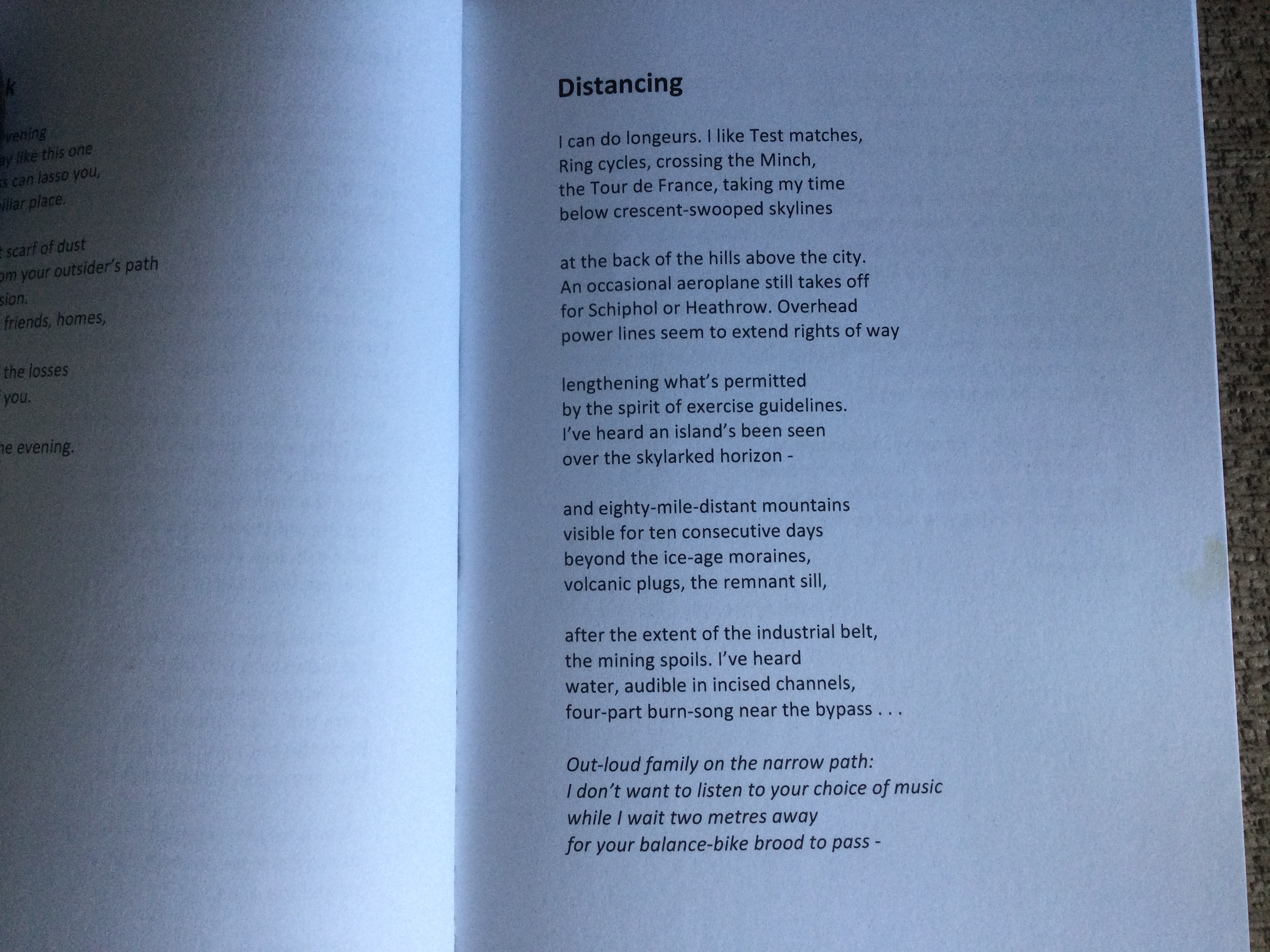
I wrote a poem for Beyond the Storm, an anthology published to raise money for NHS charities:
SUMMER: CRESCENDO 

After the lockdown ‘anthropause’, the hills got noisier again and quickly became louder than they’d been before. With travel restrictions still in operation and many other leisure activities still closed, the Pentlands, like other rural areas close to urban centres, became unsustainably but unsurprisingly busy. The virus had impacted on everyone’s wellbeing, whether or not affected directly by Covid. Outdoor, green and wild places are as beneficial for mental health as for physical fitness, and there is a range of hills starting within a five-mile radius of a capital city centre.

One side-effect of the pandemic has been territoriality  – again unsurprising, with movement circumscribed in a way many had never experienced before.

A post-lockdown trope emerged, and played on repeat, on the local hill users’ Facebook group: that upland and wilder areas, which are / should be for all, were welcome-policed, not by hostile landlords, but by an old guard who considered themselves to be more worthy of them and were hostile to the influx. An ongoing online debate about access, parking, littering and more crescendoed into testosterone-fuelled rage and condescending judgementalism. There was a fair cacophony on the moral high ground.

Glad that people were able to find solace and release in the hills, at the same time I was often dismayed, and at times, shocked – for example when seeing long strands of cars parked along the verges of the lanes that lead towards the hills, their drivers disregarding advice from the Ranger service, and outdoor authorities across the country, to have alternative plans in case their carpark of choice was full. It usually was after 10am, even on weekdays and in bad weather. These vehicles blocked access for farm traffic and emergency services – fire risk was now high after a long dry spell – and later, after a long wet spell, caused drainage problems. 

I was most dismayed and shocked to hear music played out loud.

For every person who needs slow and quiet there is a counterpart who wants speed and noise, and this may not have been the best time to point out the latter’s unhelpful connection with adrenalin and antagonism to relaxation – we each cope in our own way; understandably many find being alone with their own thoughts just too difficult and need constant external distraction and stimulus. One of these does, however, have a disproportionate impact on the other; the effect of the quiet on the loud is negligible.
Disclosure: I’ll admit to some nimbyism existing alongside a more altruistic concern for people who live and work in the hills and for other species here; to some difficulty in compromising over the shared space. Simultaneous and contradictory truths are possible.

AUTUMN: THE HARLAW HOWLER

One Sunday I met  Out-Loud Family, or another iteration of them, again. I chose, unwisely, to return from a country cycle via a popular reservoir route. A family was blocking the – very wide – track from the carpark to the water. But they had young kids, who can be difficult to organise; I swerved past and smiled at the older boy, struggling to manoeuvre his bike. Then I heard  music coming from a tinny speaker on the back of the woman’s bike, glared, and rode on. The group caught up with me shortly afterwards at a bottleneck by a gate. We hung around waiting to get through, accompanied by their music, and I eventually said to the woman something along the lines of ‘can you tell me why you feel the need to play music out loud?’

Because my washing machine and car and computer and tooth were broken and my neighbour was being noisy and I’d gone out for a quiet day and made the wrong choice about the route home, my tone was quite possibly accusatory or judgy, when in fact I was just trying to ascertain their motivation and establish a civil discussion. I know that ranting at someone will not encourage them to examine their behaviour or its impact on others.

The woman replied  – this was the only thing she said – ’because it’s what we like to do.’

Her husband weighed in, saying (several times, with increasing volume and aggression): ‘It’s a free country. If you have an opinion just keep it to yourself’. They rode on and left the gate open and I’m afraid I yelled after them.

I cycled homewards, but they’d invaded my headspace. How dare he . . . but, they could’ve had as crap a week as me and I may have just made it all worse for them. . . 

That did not, in my opinion, make it ok for them to noise-pollute, but still. Patience, tolerance, understanding, compassion. Do unto others, etcetera. Let it go.

After tea, a bath, and food I logged onto Facebook. At the top of my news feed was this:

‘Anyone had any experience of the Harlaw Howler. Took the wife and kids . . . . We have a speaker and like to cycle listening to music. . .Anyway this older woman though it was in her right to question why we need to listen to music  . . . we had to endure the dirty looks and comments . . . First time in hundreds of miles with music playing dance or chart and [n]ever been insulted or questioned. This person actually thought they could say I can’t listen to music lol’

I watched ninety-plus comments drifting in during the evening, pro and con. There were 58 Likes for someone who commented ‘I actually think it’s anti social to ride or walk in the hills playing audible music. I’d prefer you kept it to yourself.’ Three comments, quickly deleted (I reported one of them to the site admins, and another woman noted she’d reported the others), were abusive and misogynist. A couple of comments encouraged seeing the situation more from the woman’s point of view, and speculated about her mental health, though not a single one mentioned neurodiversity or noise sensitivity. In a referendum I think the Quiet side would have won, but only very marginally.

The man / husband went on to claim that I’d been scaring another family. In the moment of being confronted by him I filtered out everyone else;  I hope I didn’t scare anyone, but my recollection remains that he was the one shouting – although It’s hard not to raise your voice when social distancing. I had to brace myself not to react, and alas, on finding they’d also left the gate open – the congestion had now eased, so it needed to be closed – yelled after them. 

I’m not going to go further into cyber-abuse and trolling – aurally silent, but capable of creating a cacophony from which its victim cannot escape – here, except to note the un-nuanced din of online disagreement that has been a collateral effect of Covid-19 restrictions across many  social media platforms and interest groups. As far as name-calling goes, I’ve heard worse, and was actually quite tempted to claim the ‘Harlaw Howler’ moniker. I was lucky to remain unidentified in the evening’s FB entertainment – no one had taken a photo. Harder to accept was the man’s belief that I had no right to challenge his behaviour, his choice to play music out loud; that he had absolutely no concept of this being unacceptable, or that others would find it intrusive or distasteful – or inappropriate in a place where people come for peace and quiet and to listen to birdsong.

In claiming ‘This person actually thought they could say I can’t listen to music lol’ he accused me (or the ‘Harlaw Howler’) of showing an unacceptable sense of entitlement, whilst failing toconsider his own family’s entitled behaviour.

WINTER AGAIN: THE USER-FRIENDLY HILLS

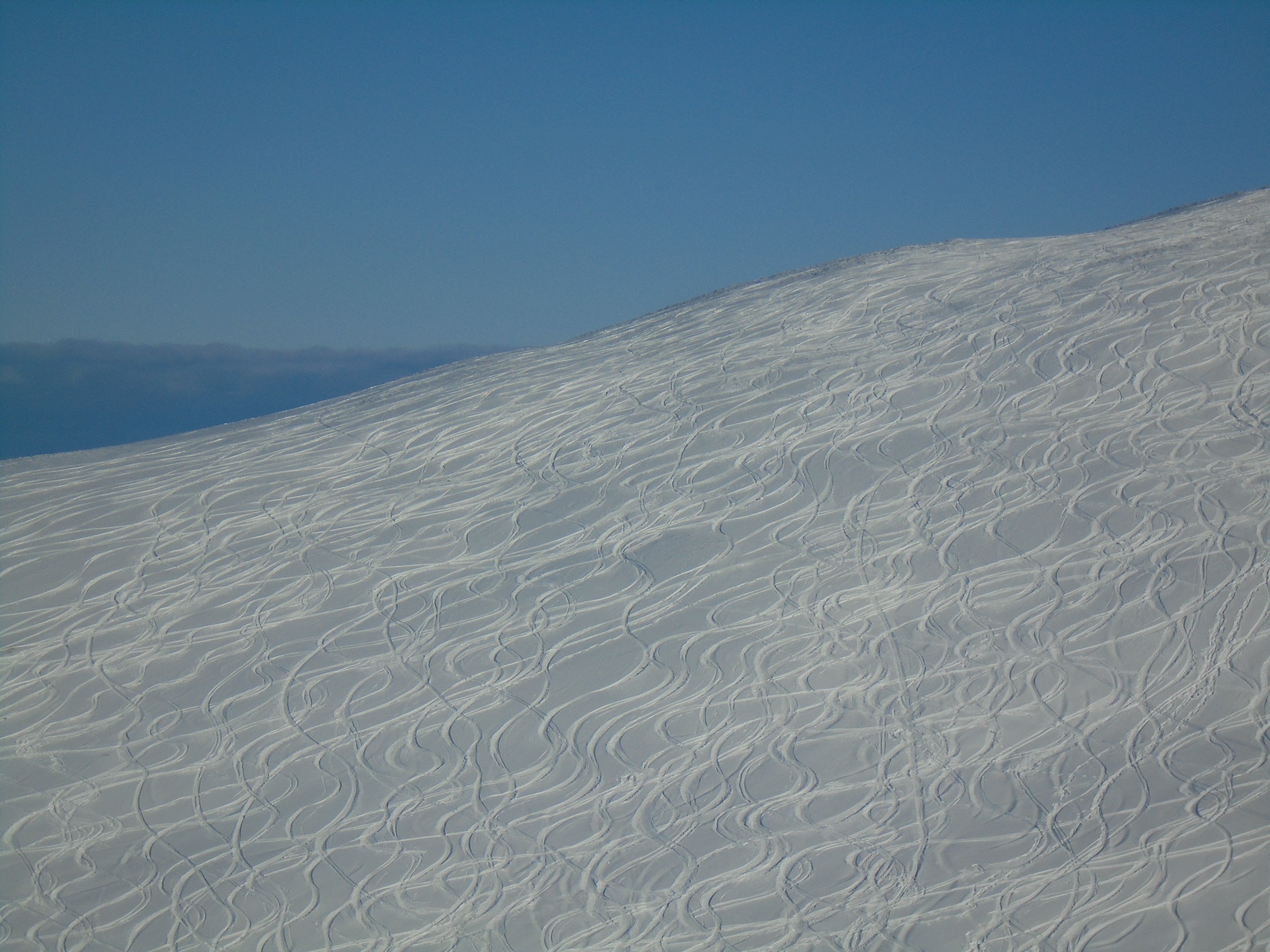
Lockdown #Two hasn’t silenced local traffic like #One did,  but snowfalls have quietened the land again several times so far in 2021, now bringing with it new hill dilemmas, including avalanche risk. It has also produced perfect conditions for skiers and snowboarders. Unable to travel to resorts, they have, often unwittingly, posed a threat to ewes, who are pregnant, as they were at the start of the first lockdown, by scaring them away from their heft (where they know how to find food under the snow). Along with wildlife they have been forced into gullies with deep drifts and fewer feeding opportunities. Sheep have been attacked in larger numbers than usual, too, by dogs allowed to run off the leash, owners not heeding notices explaining the law about pets around livestock. More information and guidelines about responsible conduct in the hills can be found here.

I walk in the hills with friends and visitors, especially over the Christmas holidays, but most of the time I go alone. I take work there when it’s still enough to sit and do some; I pace out plans for writing workshops and ideas for my own writing. I listen. I’m quiet but not silent:  one of the things I love most about hillwalking is the tradition of exchanging a greeting with anyone else you meet. I think something that has caused and escalated the Covid-era conflict is that newer hill-users don’t necessarily know about this – why would they if they have been accustomed to not acknowledging other people in the street throughout their lifetime, to telling their children not to speak to strangers, to – for a variety of valid reasons – keeping their heads down. But some are so preoccupied in their family groups, or on their phones (or, worse, playing music out loud), that I wonder why they actually bother to come to the hills and make them busier for everyone – in some places at weekends it’s actually quite hard to practice social distancing. Their sound travels far, too, when it isn’t windy, and that has been surprisingly often this winter. Some others are clearly only there for their anthropocentric adrenalin-sport and care nothing for the history or culture of the land, for those who live and work there, or for other species. I know plenty runners and mountain bikers and open-water swimmers who absolutely do not fit into this category, whose mode of travel is a means of deeply engaging with the place – and I am sure this is also true of many winter-sportspeople – but I also regularly see ‘hill-users’ who abuse the privilege of being there, oblivious to, and endangering, the hills’ natural and social ecologies.

Of course, one can never know what another person is enduring, why seeking out the hills may be a necessary outlet for them, but one especially cannot know this if they do not even make eye contact. There may have been days when I’ve been too upset or angry to speak to people in the street, but even when I cannot smile, I say hello to anyone I meet in the hills and the countryside. This very act can be instrumental in creating a shift of sensibility from distress to ease. I have a natural empathy with people in whom an ancient code of hill civility is as ingrained as the cross-hill drove routes on which they otherwise make low impact, and find their unease at the intrusion more understandable than the accusations that they are simply unwelcoming. 
POSTSCRIPT

Nan Shepherd’s study of the Cairngorms, The Living Mountain, was written in the 1940s and first published in the 70s. Her advocacy of ‘total mountain’, comprising all its elements, life-forms, weather and seasons; for circumambulation over summit-fever, has rightly become a classic and a manual for non-intrusive being in upland areas. It is a model for how to understand, recognise and witness place; to marvel and to mourn as appropriate. Through 2020-21 it  has been easier, then harder, than ever before, to find in the Pentlands the kind of full-sensory joy she recounts, when place and mind intermingle until both are altered and ‘one walks the flesh transparent . . . out of the body and into the mountain’ (p.106). 

I’ll give the last word to Shepherd. ‘Silence is not a mere negation of sound. It is like a new element.’
A Pentland Thread

Tying and tidying up some strands from the year as we face new restrictions and an uncertain festive period and start to the new year – this was one of the most affirming things I was involved in in 2020.

Edinburgh’s Pentlands Book Festival appointed three ‘Thread Leaders’ for an online experiment to encourage community responses to the 2020 Book Week Scotland theme, Future. Panashe Nyadundu wrote about Black Lives Matter, and why they matter in Currie. Reta MacLennan started a thread on the dreams and aspirations of residents of the upper Water of Leith valley villages: Colinton, Juniper Green, Balerno and Currie. I drew on my experience of lockdown locality and daily exercise in ‘Pandemic Perspectives’ – reflections on lockdown time & place, social and other forms of distance, seasonal shifts and more. Each leader curated the thread of new work responding to theirs for the PBF website. In Book Week Scotland itself we had a panel event, with readings, discussion and a q&a on Zoom, which was recorded and can be viewed here.
As a postscript, I made a ‘sampler’ poem using words and phrases from everyone who contributed, which can be read here. With huge thanks to all of them (I would have pasted it here were the WordPress block editor not so unstable – please click on the above links to read the Sampler and other writing on the threads, and to see my photos in better resolution!)

My own articles appeared in instalments, interspersed with the community responses in the form of poems, prose, maps and art work in several other mediums. Here are my text and photographs:

March/April: The Stretched Cleughs

By the end of the month it didn’t rain and we didn’t drive, Arran and the Cairngorms could be sighted from the Pentlands. Ben Lomond had been visible beyond the Lang Whang horizon for ten consecutive days. This was (to knowingly use an overused word) unprecedented in post-industrial times. And it broke my heart – it is how things should be, could be, and yet was only possible because of the pandemic. The occasional aeroplane still took off from Turnhouse, for Amsterdam or Heathrow. I should’ve been flying to Verona at the end of March; instead I was locked down beside the hills of home. And holiday-Italy seemed unimaginable compared to Covid-Italy. For that matter, hills I could see but couldn’t reach on foot – Scald Law, East Cairn – might as well have been in the Alps. As further-afield started to feel less feasible, a kind of mourning set in.

But something differently imaginable began to happen at that that turn of year when things change visibly, daily, when the horse chestnut across the road comes into leaf and we lose sight of Hillend. There was a bit more greening every time I walked through Dreghorn Woods to the hills. I opened yesterday’s quarantined mail with my cup of tea when I got back in. I found a rhythm. I found: various versions of out-and-back, circular, from-the-door exercise. Pacing, grounding, I found lesser-trodden paths. I found a hold, a bield, below the rounded hills.

The clocks went forward. There would be no light-evening walks on Arran, but I could make a virtue of what was around, with more daylight, and good weather, to explore it. But we didn’t know what our capacity was for our own, or our household’s, company, and for staying very local – because many of us had never been tested in this way before. When I mentioned this to a disabled friend, though, she effectively responded, ‘welcome to my world’.

I was, literally and figuratively, in a good place, though very aware of my comparative privilege and good fortune. There were things about pre-Covid life I had been enduring, rather than enjoying, finding subtly but cumulatively stressful when I left this edge of Edinburgh for the city centre: crowds, congestion, pollution, noise. So much of this ‘new normal’ suited better than the old. And yet the news and fake news gave a constant reminder of why we were in this situation.

I found a rhythm. The rhythm was disrupted. I found a rhythm.

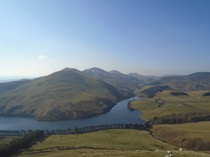
In the now emptier Pentland spaces, I developed a fresh appreciation of the valleys, or cleughs, that run south from the back of Capelaw and Allermuir hills, of the crescent swoop of the cleugh-head skylines. With sense of time increasingly distorted by the absence of normal routines and presence of some strange new ones, I became acutely attuned to the shapes, and especially the glacial incisions, of hills I have walked for more than 25 years. Beneath the seasonal, vegetational surface they could hardly – unlike the city centre – have changed much in a month, but they felt different, their glacier-sculpted forms broadened and post-glacial weathering accentuated. I became a sort of semi-feral creature of the place where the Covenanters fled from religious persecution in the seventeenth century. The air was full of skylark song amplified by the stilling, the quiet, the lack of traffic on the bypass. 

We were in a perpetual state of adaptation, to which body and mind responded at different rates – and to which front-line workers of course didn’t have the luxury of time to adjust. Body-clocks were out of kilter. Simple tasks, like unpacking the shopping, were exhausting because we were constantly in a heightened state of alert / vigilance. Routine activities became more demanding, and underlying anxiety about the raison d’etre of all this, the virus, grew. Bare shelves in Tesco brought home just how much food & shelter had become the immediate priority, followed by exercise & fresh air. There could be scant space left home-working, home-schooling, creativity. And sometimes, despite evident slowings-down, it could feel as though there wasn’t enough time. With dyspraxic tendencies that make co-ordination and being methodical hard at the best of times, my best efforts to sanitise everything in the right order felt too haphazard. In a manner more superstitious than scientific, I’d bargain that if I was extra-careful elsewhere, all would be well. 

New ethical dilemmas, a new territoriality, presented themselves in the hills as well as in shops. The question of what constituted reasonable etiquette exacerbated differences between people. Were you prepared to stay local, and not risk taking your contact-train further afield? Even if a farther field was only populated by sheep, it was lambing time, and farmers shouldn’t get sick because people go for a walk to make themselves feel better. In the nearest hills from home, the North Face of the Pentlands, I was as careful as I could be with gate fastenings, the main contamination-hazard, and became adept at using elbows and even walking poles. There was some (online) occupation of moral high ground from those sticking to the lower ground.  Fire risk increased. I tried not to think too far ahead. It became even harder to imagine further ahead.

For the first few weeks I resisted Zoom and the apparent rush to take all of life online. As others embraced remote working, and Hillend and everything beyond it vanished, I was unable to write. Instead I stilled a constant internal chatter by reading others’ poems out loud to the emptying cleughs. Everything I read seemed somehow apposite, prescient of this time.  Then I started to become bombarded by my own words, started a journal, blogged, transcribed exercise itineraries and walk routes, wrote a dozen poems, plus dozens more haiku.  Six weeks in I became acutely aware I was speaking my thoughts, or fragments of them, out loud, as though my unconscious were seeping up from under my breath. Deprived of a normal range of in-person communication, and surrounded by the clichés and metaphors of Covid, it was as though I was finding an – uncomfortable – way to externalise a concentrated interiority. 

Weeks divided into walk-time, that could generate a kind of euphoria, and a more anxious home-time, when I worried about the collateral effects of the pandemic: income, faulty and temporarily unfixable appliances or teeth, the thought of being in a crowd, or on public transport, again. Domestic plans would frequently be postponed by unplanned therapeutic walks. At this time of year I’d normally be ready to travel further. My ambition now was to watch the very-local change over the season. Would I settle into this, contented, or find it too limiting?

April / May: Shelterbelts

Slow-forward a few weeks and mindful of the demands on emergency services, and their contacts, in the event of an accident, I stopped climbing hills. Instead I drifted – it really was unplanned – further up the Water of Leith valley. Swapping heights for lengths, I cycled, walked, and delivered biscuits to a friend in Balerno recovering from a Covid-unrelated medical procedure. 

Then, ritually, obsessively almost, I paced the cracked-mud paths of the shelter-belts and that I’d previously overlooked, bypassed, when heading for the Pentlands: the woodland grids, dating back to the eighteenth century, that right-angled round a dozen fields. They proved very fit for purpose when walking in a colder wind. I found out more about the ‘Cockburn Geometric Wooded Farmland’ from council documents (https://www.sesplan.gov.uk/assets/files/docs/supporting-studies-and-docs/GB_Landscape_Character_Assessment_December_Final.pdf ), and from knowledgeable locals. We’d engage in a sort of shelter-belt dance, improvising the choreography (and protocols) of a distanced pas-de-deux: swerve and greet, greet and swerve (judge and be judged by those who don’t observe at least two-metre distancing). Passing places were pausing places – we needed this pause, us and the planet. 

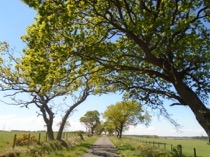
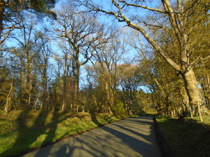
I loved the idea of a ‘Landscape Character Assessment’. Sloping Wooded Farmland! Geometric Wooded Farmland! Watercourses modified to follow field boundaries!  I became interested in where the ‘character’ of the land changes and opens out, where broadleafs thin along the lanes beyond the village. Through Cockburn, Buteland, Haughhead, Glenbrook, my personal route map from lockdown connected up the places I’d whizz past on my bike a few times a year.  Fieldside, woodside, forestside; farmstead, formal garden. I noticed lots of details for the first time, like the mossy walls. I almost didn’t mind not being able to get further afield. 

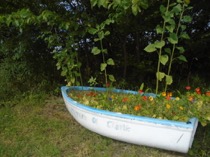
A lodge called ‘The Boathouse’ inland at Bankhead, and a memorial garden (for Charlie Cope of Goodtrees, who died in April), planted in an abandoned boat by local children, aptly symbolised the world-turned-upside-down of 2020.  Hope that it would right itself was expressed in the lovely lane and gate-art made by young people.

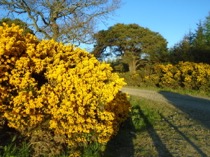
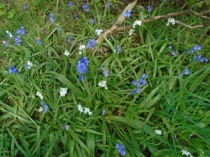
There was hope too in the changing verge flora: spring daffodils, primroses, garlic and bluebells, then gorse, so much glorious gorse. Later, iris and bog cotton at Red Moss. Orange-tip butterflies abounded, sensitised to the clean air and quiet. Laburnum, rhododendron and honeysuckle wilded where big house grounds met the lane. Their beech hedges re-greened. Limes and oaks leaved at different rates. Warm air released the aroma of bluebell, gorse, timber, pine. The upper Water of Leith, normally silenced by traffic from the A70, was audible in its incised channel below the gorse-bordered straight from Whelpside. There was four-part burnsong, with curlew solo, at Haughhead. 

(See also https://www.edinburgh.gov.uk/downloads/file/23010/balerno-villas)

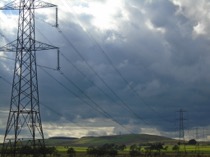
Overhead, power-lines drew an elevated hypotenuse across the axes of the shelterbelts. Above the green belt and the Central Belt, cables charted a diagonal course to / from the capital. Punctuating rights of way, pylons plotted a line for the hills. Beyond, visibility extended, hopefully, out of the parameters of lockdown. Below the National Grid, desire paths graphed the woods. 

June: headwaters, headspace and an imaginary island

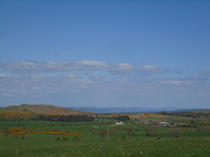
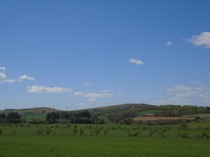
I ventured onto the ‘Leith Plateau Farmland’, the countryside beyond Balerno. I imagined this area as a small, fertile island bounded by the Pentland horizon, the visible circumference from Capelaw, Black Hill and the Cairns, round to Auchinoon and Corston Hills on the Lang Whang, down to Kaimes and Ravelrig. Centred here, around Buteland, I felt these skylines wrap around me, like an amulet: curative, protective. How much of this feeling of islandness, of peace, calm, was due to the gorse, I wondered; to the meadows, cnocs, and single dwellings?  The fineweather blue firth to the northeast made seacliffs of Dalmahoy and Kaimes. More wildflowers – yellow, purple, grass-heads, orchids – bloomed into a passable machair. This was my sanctuary: a substitute Rousay, a replacement Barra, a bield to experience the quiet of a Uist evening, that I  sought out several times a week. 

I’d continue from the Buteland road-end, through forest on one hand, past fields with growing lambs and calves, red-ploughed earth or ripening crops on the other. Where the lanes and shelter-belt paths right-angled round the fields, the track here described a dusty-earthed parabola: up to the moor, down to the ruins at Buteland Hill. Then it opened out above the buzzard-patrolled valley-bottom scraped flat by the glacial young Leith.  On the way back I could cycle through several seasons: wind and rain on the moor, gorse-scent releasing sun in the forest. 

My 2019 diary recorded where I was this time last year: often down in the Borders. Recompensed by local magic, I missed and didn’t miss these trips. On the day that 300 covenanters met at the Cauldstane Slap, I walked up to the border of the Borders again for the first time. 

Early and late exercise at midsummer fits around work and helps to offset seasonal insomnia. The lethargy of lockdown made it harder to get out of bed this year, but when I did make the effort I was amply rewarded. The imaginary island looked especially Hebridean in a haary dawn or dusk. In the evening and early morning it became clearer that we’re the guest species here. There might be hares in the first field after the road-end; the buzzard of Buteland Hill shoulder-swooped humans daring to reach Leithhead. 

It is an expanding experience to wait out the simmerdim of a clear June night, to determine when it  starts to get lighter, and hear the dawn chorus crescendo from silence. To see the sun come over the horizon at Buteland Farm, rise over the Water of Leith channel at Haughhead, risen above Whelpside. To turn to see the lit land brightening behind on the way home for breakfast.

Was it still an island? Irises were out, and so was more traffic. People came back, and with them new ethical and environmental dilemmas about parking and littering. Would the magic have served its purpose (and vanish) as the carparks re-filled and gorse faded? Dawn brought back the islandness, almost of-course-it-did, but the air, land-settled, also felt and smelled autumnal.

Like strict poetic forms such as the sonnet, lockdown could be an enabling constraint. I was glad when I could actually drive to the road-end on my ‘island’ and walk further upstream from it, pleased to have new horizons & visions again. I started to imagine having the confidence to do more, but was wary of going much further too quickly. I even wondered if my bodily and psychological readiness to emerge followed government permission to travel further. We were collectively exhausted from being in a prolonged fight-or-flight state: the pandemic had also taken its toll on those lucky enough to stay well and keep their jobs. I posted on Facebook about having a sort of simultaneous claustrophobia and agoraphobia and over 40 people agreed.

Annoyingly, if symbolically, when I tried to go away overnight, just into the Borders, my old car refused to accelerate on the open road, and had to be towed back. For a few days I just wanted to return to on-foot local exercise, to be held in hills that held me at the start of the pandemic. I took an evening walk up Howden Glen – now with a pink foxglove, rather than yellow gorse, border – and along the cleugh-head. Good to be back, amidst

the glacial channels / datytme slowing / the accelerating year

Afterword: Summing up the Pandemic Perspectives thread

Things changed visibly, daily again, as they did at the start of lockdown back in March. Hillend came back into view once more, as the leaves of 2020 fell from the horse-chestnut opposite. 

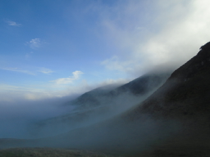
During a November week of still air and stunning cloud inversions, the Pentland cleughs filled with mist. Partially recognisable hilltops emerged from a sky-sea, the mingled elements creating an elevated shoreline liminality. Hard not to try to find metaphors in this, as we faced an uncertain winter and new, changeable restrictions, and took in the hopeful news:  progress with a vaccine; Joe Biden as the US President elect and Kamala Harris the first woman and person of colour to be VP elect. 

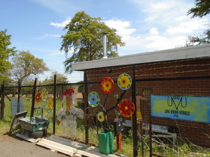
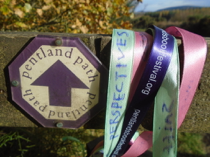
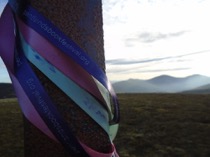
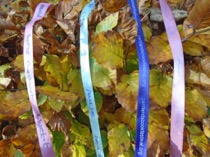
Back home, PBF posters and ribbons festoon local landmarks. To mark the end of this project, I placed and photographed ribbons in (and then removed them from) locations I’d written about for this thread. 

It’s been a privilege to read, see and assemble a rich array of responses: words on memory, in-the-moment presence, and virtual reality; visual representations – drawings, paintings, photographs, maps – of our place at this time. Here’s to the magic of language and landscape; here’s to the future.

Covid-era Poems by the Thread leader

I have poems about local lockdown published here: http://pendemic.ie/three-poems-by-helen-boden/ and here. I am also a contributor to Beyond the Storm – poems from the Covid-19 era – proceeds from sales go to NHS charities: https://www.writeoutloud.net/public/bookshop.php https://www.writeoutloud.net/public/blogentry.php?blogentryid=105446