
It was as emotional a weekend as it’s possible for a woman with absolutely no interest in football to have in front of her telly. I’d felt quite teary on hearing the announcement that the grand depart of the 2014 Tour de France would be in North and West Yorkshire, and drew big rings round the dates in my diary. Eighteen months later, last weekend, I stocked up on Wensleydale and retreated to the sofa to watch the world’s elite cyclists speeding along the routes that my father regularly rode on his day off, and which he introduced first to my mother, then me, in the car. We spent practically every weekend of my childhood driving out to the Dales or up in the local Pennines, sometimes with some grandparents, taking in a walk and lunch. This was where I learned to love landscape and place-names, to admire the way roads (and the M62) were engineered into the contours of the uplands, and to become aware of subtle distinctions in vegetation, building materials and accent as we moved from south to north of the region.
The entire race route seemed to be filled with places of familial significance. The start was of course in Leeds. This was the city where my grandmother took me Christmas shopping (to Schofields department store, the late Fortnums of pre-Harvey Nicks era Leeds) every autumn half term, and where I took my mum to Next and the Body Shop before lunch at Pizza Express on every other trip down from Scotland – a treat for her. On the alternative visit, we’d go out of town and up into the hills – a treat for me. The roles of taker and taken varied across the county, as well as across the generations.
The cyclists pushed north-west into the Dales National Park, the Tour helicopter performing its duty of diverting from the route to pick out landmarks, often of an ecclesiastical nature. Simultaneously, their names were engagingly captioned into French for the TV screen. Between the late nineties and 2005 I’d meet my parents for a weekend in the Swaledale area once a year. I’d usually travel by train to Ribblehead on the Settle-Carlisle line, where they’d pick me up. We’d drive down to Hawes for afternoon tea, then over the Buttertubs Pass, from now on in the Cote de Buttertubs, into Swaledale, where we’d spend a few days wandering around the villages of Keld, Thwaite, Gunnerside and Muker, or driving over the high moors to Tan Hill, the highest pub in England, close to where North Yorkshire, Cumbria and County Durham coalesce. At points along the road you can see over to the Lake District and the Irish Sea; at others, to industrial Teeside and the North Sea. Everywhere there is headspace aplenty, and you feel as though you really are on the roof of the country. Another day my parents would maybe drive down to Richmond while I took an excursion on foot into the hills – the walks above the Swale from Keld to Muker, and up past the leadmining scars of Gunnerside Ghyll are in my all-time-anywhere top ten – before meeting up again for the obligatory tea and cake. We were there for their fortieth wedding anniversary in 2001 and my mum’s eightieth birthday in 2003. Last weekend I was genuinely moved by the huge crowds at the usually deserted top of Buttertubs, already legendary in Tour and tyke lore – as well as by the sight of Jens Voigt, the oldest man in the race, who was first to the summit.
I had registered that Day One would cover the northern Dales and Day Two, the Pennine moors west of where we lived, but hadn’t actually checked out more detailed routes – it’s a bit like me not being able to engage with the Edinburgh Festival programme before August, or a travel guide before setting off on holiday. So it was a delightful surprise to learn that, after leaving York (‘change here for Leeds, Huddersfield and Manchester’ ) and Knaresborough (Mother Shipton’s Cave and a shop in the market square that sold amazing home-made biscuits in the 70s), the route continued on the A59 up to Blubberhouses Moor. Fab name, in either English or French, possibly from the Anglo-Saxon for ‘house / fortress by the bubbling stream’. Despite the initial semantic association one tends to make, its derivation has nothing to do with the emotions provoked by this occasion, but it is the scene of significant childhood and family memories.
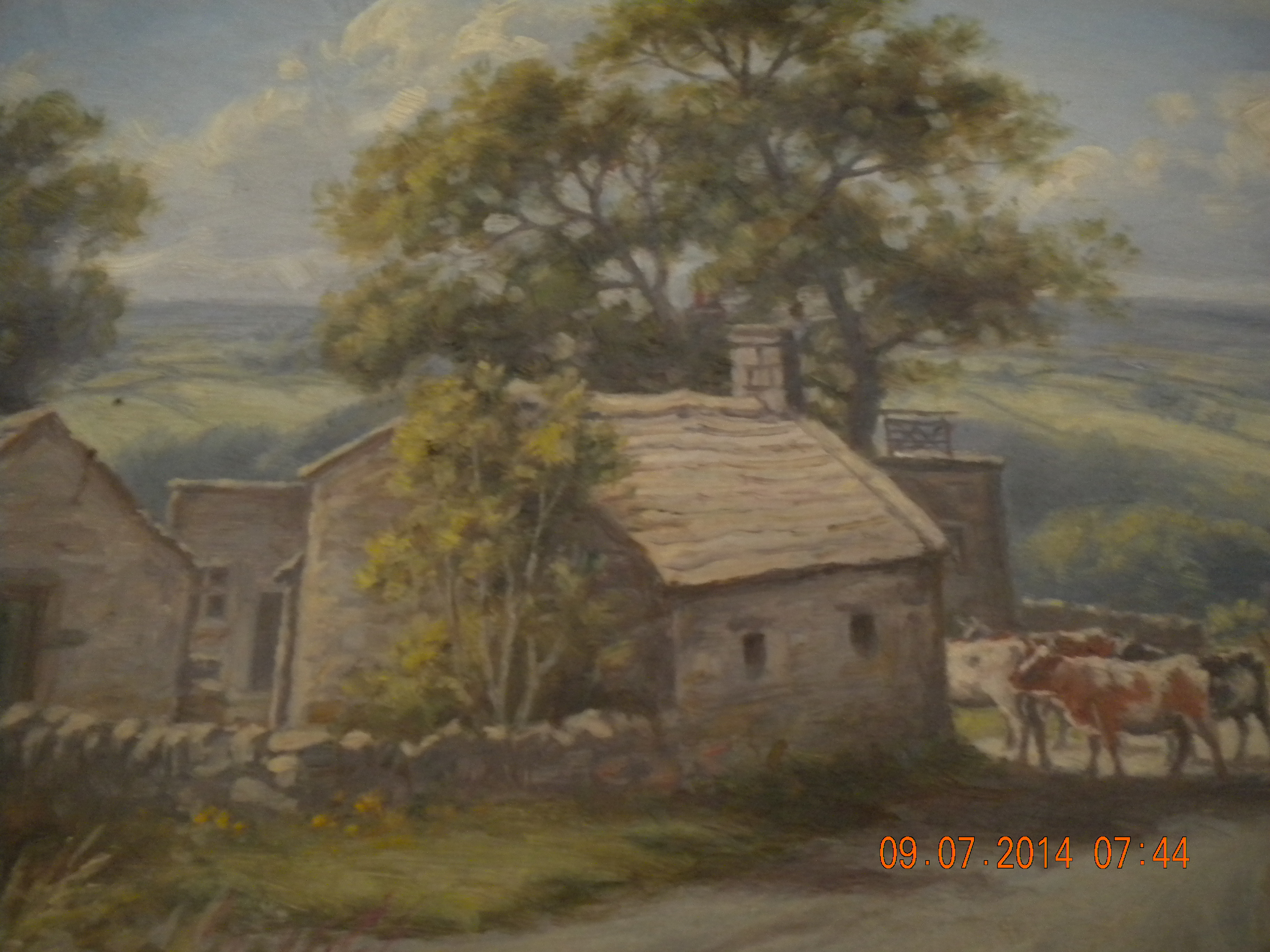
The Simpsons, friends of my dad’s parents, farmed at Kex Gill, right upon the summit of the Cote de Blubberhouses, after being relocated a few miles upstream from their previous home, at West End (really) when the valley was flooded by the water board to create Thruscross Reservoir. Their original farm was called The Gate. A pictographic sign of a five-barred version hung from a tree beside the road. I know this because I inherited a watercolour and an oil painting of the scene by Albert E Jackson. I have rarely felt stranger than when looking at them on the wall of my Edinburgh flat when I brought them up shortly after my dad died, eleven months after his wife. Now they’re just part of my furniture, alongside other artworks from and of the region, in a small corner of Lothian that is forever Yorkshire. I don’t even look at them properly very often, so this was a timely reminder to savour my possessions and the memories they engender. They are conveniently situated just above the TV, now showing the Tour back on French soil, minus two significant British riders.
My own parents became friends with the next generation at Kex Gill, Shelagh and Peter Harrison, and took me there from an early age. I used to name and bottle-feed the pet lambs, those orphaned or rejected by their mothers (I can still remember calling one Hannah); and Peter taught me to drive a tractor on one of their steep fields when I was about thirteen. At that time I wanted to be a vet. Shelagh, baker of the best cakes I can remember, is in her eighties, and we still exchange Christmas cards.
The Tour turned south towards our ‘local’ moors, over Oxhenhope, close to the wuthering heights of literary fame, but better known to my family for its hostelry, the Raggalds Inn; down to Hebden Bridge, former textile town turned hub for artists and writers since its Hughes / Plath era, and up Cragg Vale, the longest continuous road climb in England. I’ve walked up, but if my own cycling renaissance of the last couple of years has taught me anything, it’s that you experience terrain very differently en velo.
After skirting Huddersfield and whizzing through Holmfirth, the peloton headed up the biggest climb of the day, Holme Moss, on the Derbyshire border, before turning towards the finish at Sheffield and the steepest climb, a previously unknown suburban street called Jenkin Road. If I hadn’t been busy wanting to be a vet, mountaineer, dancer, plumber, opera singer, writer or teacher (only some of the above remain unrealistic dreams, so I’m not entirely beset by unfulfilled professional longings), I think I might have quite liked to be a tour planner, scouting locations and scrutinising gradients to create a route. I can imagine something of the challenge and satisfaction of orchestrating the combination of a series of lines of tarmac on the land surface (and of coloured inks on the map page) into a course, the template for an event. To a degree the selection is arbitrary: I also enjoyed re-imagining the roads not taken by the Tour, and in combinations possibly never taken on our family trips either.
From a (TV) spectator point of view the route made a most satisfactory visual narrative of how moor threads to dale and limestone turns to gritstone; of the passage between agricultural and industrial, and of the ubiquity of the drystone wall. With the presence of crowds and racers and great weather the narrative evolved into high drama. On steep and narrow sections of the road competitor and spectator became virtually indistinguishable from each other, a carnival superimposed on the normally sombre landscape.
Holme Moss was site of one of the two great West Yorkshire beacons, its TV masts. Like its sibling rival on Emley Moor this local landmark has been locally invested with almost mythological significance. Viewed from the Pennine foothills where I grew up, they and a series of other communications masts punctured the horizon of the high moor at intermittent intervals; by them you found both your physical and psychological bearings. I recall a semi-rural myth that you could predict who was going to win a general election, not from the exit polls, but from the direction the clouds were scudding (they rarely sauntered) over Emley Moor. The first sighting of the mast from a train crossing the vale of York meant that, for good or ill, I was approaching home. Like many leavers, when I was younger I did not always want to return. In the last decade I have no doubt romanticised the place, mainly because my parents died, as parents do, and the family home was sold, effectively severing my direct links; and also in resistance to some popular and press views of the region, for example in the wake of the ‘disappearnce’ of Shannon Matthews. The visit of the Tour de France has added a few further stanzas or paragraphs to this narrative of personal engagement – quite literally so, here.
According to certificates from the Mid-Yorkshire District Association of the Cyclists Touring Club, my father cycled 100 miles in 8 hours on September 16th 1945, 200 miles in 24 hours on June 22nd-23rd 1946, 100 miles in 6 hours on October 6th 1946, 150 miles in 12 hours on September 21st 1947 and 130 miles in 12 hours on May 30th 1948. Some of his cycling memorabilia has been used in Jan Bee Brown’s film and exhibition ‘Daisy Daisy’ in the Yorkshire Dales Journeys event at the Dales Countryside Museum, Hawes, which runs until 30 September.
 helen boden literary arts